


Expos as Sites of Experimentation: Considering the Architecture of Expo 2025
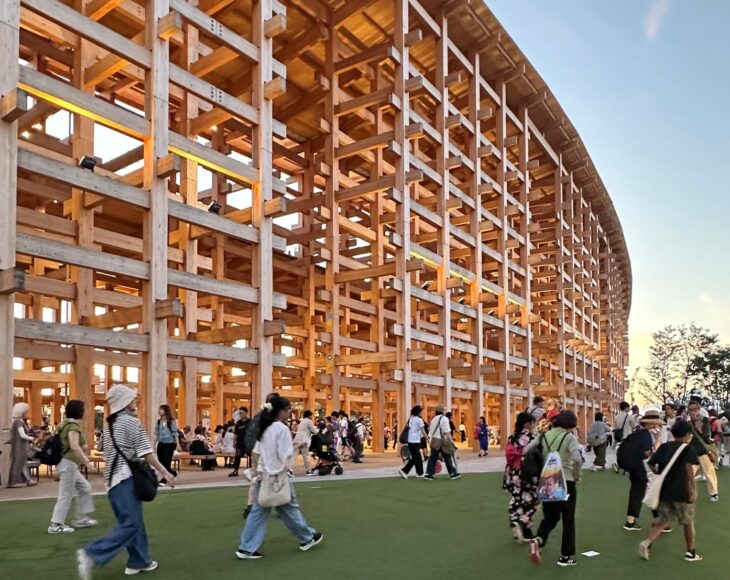
“The Grand Ring is the focal point of Expo 2025’s architecture.”
An Expo is a festive space that exists only temporarily. Its greatest significance for architectural culture is that it allows “experimentation” that is not permitted in ordinary projects. Numerous world’s fair buildings, such as the Crystal Palace at the 1851 Great Exhibition in London, the Eiffel Tower and Galerie des machines (Machinery Hall) at the 1889 Paris Exposition, and Buckminster Fuller’s geodesic dome (American Pavilion) at Expo 67 after World War II, have shaped the history of modern architecture.
All photos: Courtesy of the author
“Surprisingly impressive” this Expo
As of this writing, four months have passed since the opening of Expo 2025 Osaka, Kansai, Japan (hereinafter Expo 2025) on April 13, 2025. Prior to the event, various criticisms and questions had been raised, including concerns about the appropriateness of the project costs and the plans for utilizing the site, which involve developing an integrated resort (IR), including a casino. Other concerns included methane gas emissions and whether there was any justification for hosting an Expo in Japan at this time. Even after the event began, there was no shortage of topics of criticism, such as the experimental toilets being difficult to use and the appearance of swarms of chironomids. Unpaid pavilion construction costs were also a cause for concern. However, public perception has steadily improved, and the number of visitors seems to be growing steadily as well.[1]
Its reputation in the architectural world has changed similarly. Before the opening, the Expo received less attention than the Tokyo Olympics, and there was a lot of indifference, as well as criticism. However, after some time had passed, we began to hear many people say, “I went, and it was surprisingly good.”
The Expo as Architecture
In a sense, it was only natural that Expo 2025 would gain more positive attention in the architectural world. This is because architecture asserted such a dominant presence at the expo.
Architect Fujimoto Sou, the venue design producer, conceived the “world’s largest wooden building,” the Grand Ring. Beyond its practical functions of providing visitor circulation, shade, and an observation deck, the Grand Ring became the symbol of Expo 2025. Additionally, renowned architects such as Ito Toyoo, SANAA (Sejima and Nishizawa and Associates), Kuma Kengo, and Norman Robert Foster designed unique structures, including core facilities like the event hall and guesthouse, as well as pavilions representing countries worldwide and signature pavilions created by eight theme project producers, including researcher and media artist Ochiai Yoichi and data scientist and Keio University professor Miyata Hiroaki. Additionally, twenty young architects were selected through an open competition to play an active role in designing small shared facilities, such as restrooms and rest areas, scattered throughout the venue.
Despite concerns about construction delays, particularly for the international pavilions, the event was ultimately completed without any major issues. This once again demonstrates the strength of Japan’s construction industry.
The strong presence of architecture at Expo 2025 also means, on the flip side, that non-architectural content left a weak impression. As an author specializing in architectural history and theory, the author is aware of their own bias. However, most of the exhibits were primarily video, and the impact of the exhibits that made visitors feel they absolutely had to see them “here and now” was limited. Additionally, the reservation system, which had already received very negative reviews, was actually quite cumbersome—frankly, user-unfriendly, and it was difficult to reach the exhibition spaces in the pavilions. This year’s Expo 2025 had the slogan “A World Expo without queues,” but in reality, it was a completely unrealistic “World Expo with queues.”
These exhibits and the reservation system naturally gave architecture with enjoyable exterior designs greater prominence for visitors to the venue. Unfortunately, the non-architectural exhibits such as the Public Art exhibits left a weak impression.
Due to time constraints, the author must admit that they were unable to see many of the exhibits. However, some of the exhibits that made the biggest impression during the limited visit were the Qatar Pavilion (designed by Kuma Kengo, exhibition design by AMO, Figure 1), which spatially conveys the tension between development and nature, and city and countryside, and the China Pavilion (designed by Cui Kai), which uses a series of highly sophisticated propaganda-like images to depict traditional culture and the beauty of nature, as well as the smart modern urban lifestyle that harmonizes with them.
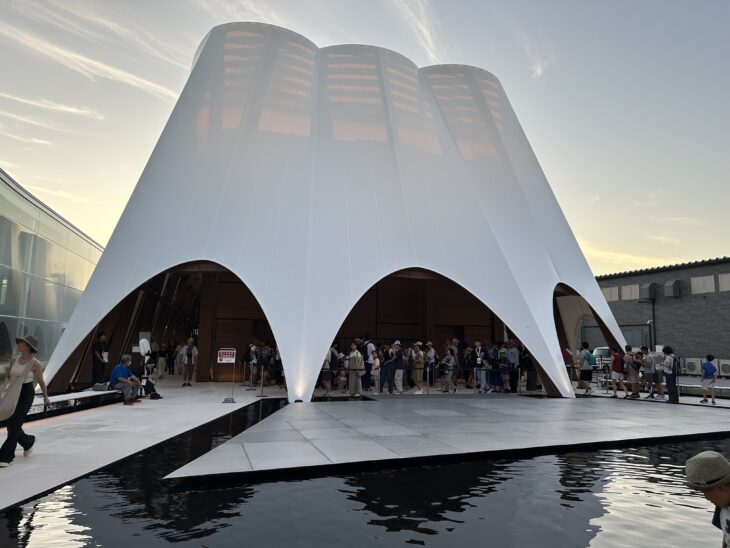
Figure 1: Qatar Pavilion
Primitive and futuristic—the Grand Ring is incredible
The Grand Ring is the focal point of Expo 2025’s architecture. With a circumference of two kilometers and a height of 20 meters, it is more comparable to civil engineering infrastructure than to architecture. The Grand Ring also lacks interior space. However, its columns and beams, constructed using the traditional Japanese joinery nuki-setsugo (nuki [penetrating tie-beam]-joints method) of laminated wood, have a much more human sense of scale than reinforced concrete or steel frames, which are more characteristic of civil engineering. It’s intriguing that the Grand Ring truly deserves to be called “architecture.” The addition of the “raw wood” texture creates a unique spatial experience. While the Grand Ring possesses the superhuman enormity of a monument to a national celebration, it also feels soft and physical. I often saw people resting against the Grand Ring’s pillars after exploring the venue, a sight rarely seen with civil engineering infrastructure.
The Grand Ring was designed by Fujimoto Sou, a highly successful architect who has completed numerous projects in Japan and abroad. Fujimoto is well known for his architectural philosophy, “Primitive Future,” which he coined early in his career. This concept is both “primitive” and “futuristic.” Fujimoto aims to create architecture that embodies this ambiguity. The Grand Ring is constructed by simply assembling large wooden beams, but by expanding them to an astonishing scale, it has created a “never-before-seen sight.” It is an architectural expression that is very much in the style of Fujimoto.
The shape of a circle is simple and clear. However, the interwoven appearance of the pillars placed toward the ground/floor changes the way they fall below the roof. Above the roof, the floor changes gently, like terrain, making the actual experience surprisingly diverse.
A recommended first step when visiting the venue is to climb the Grand Ring, also known as the “Ring Sky Walk” (Figure 2). It offers a panoramic view of the venue’s center and the surrounding mountains. Although each pavilion has its own unique design, the height restrictions based on the Ring allow visitors to enjoy a skyline that perfectly balances unity and diversity. The view is like looking down on a historic European city from the top of a tower—a visual pleasure. On the day of the author’s visit, a Bon Odori festival was being held at the Ring Sky Walk. At dusk, it was surreal to see thousands of people dancing in a circle in the air and enjoying the Bon Odori. The core facility of the 1970 Japan World Exposition (hereinafter Expo ‘70) was the “Festival Plaza,” but at Expo 2025, it was the “Festival Ring.” A well-known example of a historical wooden “nuki-setsugo” structure is the Nandai-mon (Great South Gate) of Todai-ji temple in Nara. In fact, there are similarities between the two in the structural expression of the powerfully assembled pillars and beams.
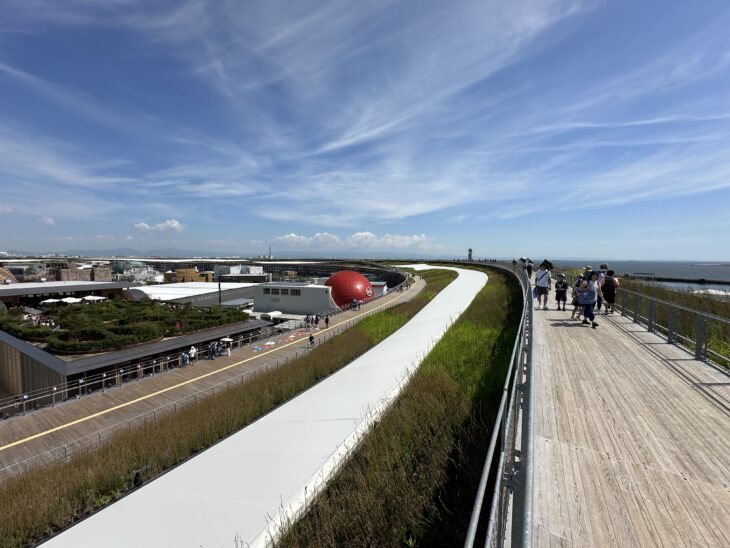
Figure 2: Ring Sky Walk
However, in terms of spatial experience, the author was reminded of the Japan National Stadium, which was designed by Kuma Kengo and others for the 2020 Tokyo Olympics. Technically, of course, the Japan National Stadium, with its decorative wooden louvers, and the Grand Ring, with its laminated timber structure, are positioned completely differently. Nevertheless, an underlying theme seems to be the unique balance between the “extraordinary” and the “ordinary,” where the simple texture of wood takes center stage while the stadium serves as a backdrop for an uplifting national celebration.
The symbolism and aberration of the venue design
The Grand Ring is an exceptional piece. It successfully gives tangible credibility to the Expo 2025 theme, “Designing Future Society for Our Lives,” which was previously vague.
However, there were some concerns about the overall venue master plan. For instance, since the Ring does not encircle the entire venue, areas such as the west side are significantly obstructed by being positioned far outside the Ring. While this is a trade-off with the symbolism of the circle, one must acknowledge that the venue’s layout is slightly distorted. Couldn’t they have achieved more balance by adjusting the size?
The location of the EXPO National Day Hall, where participating countries held their national day performances, bothered me the most.
National Day is a big day for each country, and the host country should have given it a more prominent spot as a sign of gratitude to its guests. However, it ended up in a corner outside the Ring. This location is highly visible from the seaward side, and the architectural façades face that direction. Since audiences arrive by subway or car, not by sea, though, the layout seemed unnatural. From my experience approaching from the Grand Ring as an author, the main stage seemed to be at the end of a back alley. It lacked formality and a festive atmosphere. It may seem a bit cliché, but wouldn’t it have been more appropriate for the two types of “customers” — spectators and participating countries — to have a stage space in the heart of the venue, as was the case at Expo ‘70 (Festival Plaza) and the more recent Expo 2020 Dubai (Al Wasl Plaza)?
Interestingly, a wooded area called the “Forest of Tranquility” was established in the heart of the venue, with more than 1,500 trees planted.
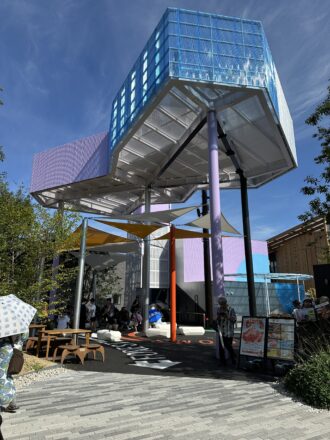
Figure 3: Rest Area 3
The forest was created at the center of the Ring. This layout plan is nothing less than a direct expression of Fujimoto’s venue design philosophy of “Unity in Diversity” and “a society living in harmony with nature.” Based on this philosophy, placing a stage in the center of the venue where participating countries would perform would be inappropriate. The forest, a symbol of “nature” and the common foundation of all humanity, had to be placed in the center.
“Forest of Tranquility,” a landscape design by Fujimoto, Kutsuna [Hiroki], et al., cultivates an environment that appears to be ancient, creating a comfortable space within the Expo 2025 site surrounded by man-made structures. “Rest Area 3” (design: Yamada Suzuko, Figure 3) is a colorful structure that stands tall and straight as if superimposing itself on the forest and continuous tree line. The author believes that Rest Area 3 is noteworthy because it creates a gradual continuity with the surrounding environment within the Expo 2025 site, which tends to be “standalone.”
An architect like John Lennon
Regardless of the philosophy behind the design of the venue, an Expo is essentially an event that brings “nations” together as units. Historically, expositions have also been a “display” for great powers to exhibit the people and things they acquired through imperialism and colonialism (Yoshimi Shunya, Hakurankai no Seijigaku [Politics of the exposition]). Furthermore, the modern value of the “nation-state” is currently in the making and is a cause of serious problems. It is important to keep in mind that the Expo is based on these values and is essentially an event that endorses (or emphasizes?) them.
Fujimoto acknowledges the fundamental issues surrounding the Expo, stating, “Some say the Expo is outdated,” and then continues: “At a time when cries of division are being made, America, China, Israel, and Palestine will all come together here for six months. There is no other event like this. That’s why it’s so meaningful to send the message that the world can become one” (Casa BRUTUS, June 2025 issue).
The concept is easy to understand, and the author hopes it is. However, gathering at the Expo 2025 site will not stop Israel’s genocide in the Gaza Strip or ease the US-China conflict. Incidentally, Israel and Palestine were exhibited in separate “Commons C and D” sections. However, the Expo 2025 Official Guidebook listed their respective capitals as “Jerusalem” and “East Jerusalem,” with a footnote stating, “These descriptions do not represent the host country’s recognition or legal position.” This expresses a stance of accepting the status quo. For a more familiar example, Taiwan (the Republic of China) did not participate as a nation but exhibited as the “TECH WORLD” pavilion of the Tamayama Digital Tech Company. This confirmed the “One China” policy within the international community. Conversely, at Expo ‘70, the People’s Republic of China, which was not a UN member, could not participate.
Of course, it’s impossible to solve a serious international problem through the design and production of an Expo venue. Perhaps the architecture should convey a message along the lines of “the world is one” for the Expo. However, the author is concerned that this kind of spatial presentation of a vague sense of unity could become a comfortable veil obscuring the current state of the world, which, in reality, is rife with serious divisions. The author does not mean to nitpick, but cannot help but feel a sense of incongruity or limitation in Fujimoto’s comments. He doesn’t mention Russia and Ukraine, two countries involved in one of the biggest international issues in recent years. Ukraine exhibited at Expo 2025, but Russia decided not to participate. Does that mean Russia is not included in “one world”?
Architecture critic Igarashi Taro compared Fujimoto’s concept to John Lennon’s vision of a borderless world (“Atarashii Saino ga Miidasareru ba toshiteno Bampaku (The expo as a place to discover new talent),” TECTURE MAG). The author agrees. In other words, Fujimoto’s image as an architect is closer to that of a popular musician than an intellectual or thinker. The true worth of an intellectual is measured by the strength of their words and ideas. However, a musician’s true worth is shown by their music, and the message they convey is secondary.
Rather, it should be said this way: Fujimoto’s strength and greatness as an architect lie in his ability to convey an emotional message like “Unity in Diversity” unpretentiously. This message moves and warms the heart. The positive reception of Expo 2025 after its opening is perhaps proof of its success. His large-scale solo exhibition, “The Architecture of Sou Fujimoto: Primordial Future Forest,” held at the Mori Art Museum in Tokyo during the expo, was a huge success, brimming with the joy of architecture. Perhaps he embodies the image of the architect needed today. However, the author still wants architects to create works that efficiently attract attention with emotional yet old-fashioned messages and foster a sensitive and delicate sensibility toward reality.
Problem raised by Yamamoto Riken
Incidentally, Yamamoto Riken, the 2024 recipient of the Pritzker Architecture Prize, often referred to as the “Nobel Prize of architecture,” has strongly criticized Expo 2025. His criticism focuses on two points. First, the process by which Fujimoto Sou was appointed venue design producer was opaque. Second, Fujimoto failed to adequately explain the concept of the venue design, with the Grand Ring at its core, to society. These are typical issues raised by Yamamoto, an architect who has always placed great importance on “transparency” in architecture. Yamamoto and Fujimoto even had a direct dialogue at Genron Café, founded by the thinker Azuma Hiroki (“Bampaku to Kenchiku—Naniwo Nasubekika [Expo and architecture: What should be done?]”).
It’s true that the process leading up to the realization of the Grand Ring has some ambiguities. Let’s briefly summarize it. As Yamamoto points out, the process that led to Fujimoto’s selection as producer lacked transparency. According to Fujimoto’s remarks at Genron Café, the Japan Association for the 2025 World Exposition interviewed several candidates and made the decision based on the judgment of senior advisors, including architect Ando Tadao. As producer, Fujimoto designed the venue, focusing on the Grand Ring. The Japan Association then publicly solicited proposals for the Ring’s “general design” and selected the Tohata Architects & Engineers/Azusa Sekkei consortium. Fujimoto served as a judge for this proposal. The subsequent “final design and construction supervision” contract was awarded through open competitive bidding using the comprehensive evaluation method to three joint ventures (JVs) led by Obayashi Corporation, Shimizu Corporation, and Takenaka Corporation. This is a common trend in public works projects in recent years. While there was a lack of disclosure of information, such as the proposal submissions, as Yamamoto pointed out, formal transparency was ensured.
Producer or Architect?
The author was surprised by the credits for the Grand Ring on the official Expo 2025 website. Alongside the companies selected through proposals and bids, Fujimoto was credited for “General Design, Final Design, and Construction Supervision.” This type of combined crediting seems unusual to those in the architecture industry, especially for general design. The Japan Association for the 2025 World Exposition appointed Fujimoto as the Expo Site Design Producer for the general design proposal. In other words, the association acted as an agent for the client and served as a judge. Therefore, the current credit system makes it difficult to clarify the relationship between “ordering” and “receiving the order.”
Since this information comes from the official website, we can safely assume that these unusual credits reflect Fujimoto’s intentions. But why did they opt for such an unnatural credit notation instead of simply saying “Produced by”?
Since the author did not ask Fujimoto directly, this is merely the author’s interpretation, but the credit notation likely declared Fujimoto’s stance as an architect: he accepted full responsibility as the “designer” of the Grand Ring. The “responsibility” referred to here is not limited to the creative level, but also includes serious legal liability for defects. Fujimoto likely established this close collaborative system in consultation with the organization selected after a proposal and bidding process. Indeed, he worked hard in his roles as designer and supervisor.
How you interpret Fujimoto’s behavior depends on your perspective. On the one hand, it could be seen as the result of an architect-producer’s tireless efforts to oversee a project he conceived. However, it could also be seen as the client (or its agent) overstepping its authority by interfering with the design and supervision services of a contractor who was supposedly selected through a fair process.
Honestly, from a formal or common sense perspective, Fujimoto’s behavior seems more like the latter. Common sense dictates that, once a proposal and bidding process has been carried out, the selected contractor should perform the work. Otherwise, the system would be meaningless, not to mention the problems inherent in the proposal system itself. As the author has already mentioned, it’s also quite questionable that, at least in terms of credit, the producer, who should be on the client’s side, is listed as having personally received the design and supervision services (and therefore certainly not receiving any compensation for the work).
However, when imagining the reality of an architectural design by an architect, it seems that the former is inevitable. If the work of “venue design and production” were limited to pavilion layout plans and concept proposals, it could be dismissed as “production.” But what if the need for architecture arises within the “produced” venue configuration? This is unavoidable in the case of a massive Expo site. As an architect, you would naturally think that you cannot fulfill your responsibility as a “venue design producer” unless you continue to carefully consider the design of the building and supervise the site even after construction has begun.
This makes it difficult to distinguish between “venue design producer” and subsequent design and supervision services. This is probably why Fujimoto chose “General Design, Final Design, and Construction Supervision,” even though he knew it was a specific type of credit notation. Furthermore, this seems to have been an honest act, as he did not try to hide his professional responsibilities behind the flexible title of “producer.”
The case of Tange Kenzo
When considering the inseparability of the roles of “producer” and “architect” in such a unique and massive project as the World Expo, a comparison with Expo ‘70 is a good reference.
As is well known, Tange Kenzo (1913–2005) was the primary designer of the Expo ‘70 venue. He took over from Kyoto University architectural planning scholar Uzo Nishiyama (1911–1994) and created the venue’s master plan. Tange then served as “Principal Architect for the Core Facilities,” overseeing the “Symbol Zone,” the heart of the venue. This area included the Big Roof (Roof of the Festival Plaza), Festival Plaza, the Expo ‘70 Art Museum, and the Expo Tower. Tange assembled a team of around ten architects who worked on everything from the master plan to the design of the entire zone. As a result, multiple design teams collaborated and shared responsibilities. For instance, the Urban Research & Technical Center (URTEC) designed the massive steel-tube space frame of the Big Roof; Arata Isozaki & Associates designed the facilities in Festival Plaza, which hosted various events; and Kiyonori Kikutake Architects and Associates designed the Expo Tower.
From reading architectural magazines from that time, it becomes clear that Tange strictly separated the roles of producer and architect. The producer was in charge of overall coordination, while the architect was in charge of individual designs (Tange Kenzo and Kawazoe Noboru [1926–2015], “Nihon Bankoku Hakurankai ga Motarasumono [What the Japan world exposition will bring],” The Japan Architect, May 1970 issue). This distinction is reflected in the design credits, where Tange and URTEC are listed as “Principal Architects for the Core Facilities” in the designers’ column for the Big Roof, the largest building.
However, this division of roles was purely a formality. Although Kamiya Koji headed URTEC, Tange founded the design firm and oversaw operations. As a professor at a national university, he could not represent a private company. Therefore, the Big Roof was essentially “the work of Tange (his firm, URTEC).” In other words, the division of roles was purely a formality. In reality, as with Fujimoto, “producer = architect.”
Incidentally, the formal consistency achieved by Tange, the agent representing the Expo ‘70 Association, entrusting his own firm, URTEC, with the design of the Big Roof is similar to the commissioning of the Tower of the Sun, a project that cost 3 billion yen to produce, by Okamoto Taro (1911–96), the “Producer of the Theme Pavilion” at Expo ‘70, from his own studio (Institute of Esthetic Research) (Komatsu Sakyo [1931–2011], Yaburekabure Seishun Ki [Broken youth]).
The crux of the matter—if we are to ensure transparency
While Tange Kenzo formally separated his roles as producer and architect for the Expo ‘70 venue, Fujimoto Sou could be said to have consistently taken on the role of architect for the Expo 2025 venue. However, the substance of both roles is the same. As long as the architect is playing that role, it is best to think of “producing the venue design” and “designing the venue’s core facilities” as inseparable.
If there is a difference between these two, it is that while Tange excelled not only in architectural design but also in urban design, as exemplified by “A Plan for Tokyo 1960” and the “Hiroshima Peace Park Project,” Fujimoto’s career has been weakly characterized as an “urban designer.” This seems reflected in the venue’s composition, where Fujimoto’s architectural work, the Grand Ring, was essentially the sole “winner.”
In any case, if the “venue design production” and subsequent design and supervision services are inherently linked as part of the architect’s profession, then the problem lies in attempting to forcefully separate them by holding an open call for proposals during the general design phase. Consequently, a unique credit system was created. As mentioned above, this format means that Fujimoto, as producer, cannot receive compensation for design and supervision services. However, it seems likely that he was carrying out substantial design work and supervision services on a volunteer basis, a disproportionate amount of work for the vague title of “producer.” This is not a matter that should be dismissed as a touching tale.
A total of 11 producers were featured at Expo 2025. Fujimoto was the Expo Site Design Producer, and Ochiai Yoichi and others were Theme Project Producers. While they are nominally parallel, the signature pavilions are sponsored by private companies and are themed projects. In contrast, the main source of funding for the construction of the venues, including the Grand Ring, is likely to be public funds from the national government, Osaka Prefecture, and Osaka City. Therefore, it is more accurate to consider them as different in nature. In the former case, producers and designers can team up freely. In the latter case, however, a transparent and fair selection process must be put in place at some point, as is common practice for public buildings these days. This is probably why the general design called for public proposals.
However, given the circumstances discussed above, there might have been fewer problems if transparency had been ensured in the producer selection process rather than the general design process. This would have resulted in different methodologies for selecting producers for thematic projects and venue design. The work content of “venue design,” which is essentially inseparable from architectural design and carries legal responsibility, differs from the more conceptual “theme project.” Therefore, it seems more sensible to adjust the selection method for each, rather than making them the same in a way that suits the respective circumstances of each. Furthermore, the architect selected as the venue design producer was responsible for the general design at least, which would ensure consistency with the work content.
This did not happen probably because of a lack of understanding of venue design, architectural design, and the professional role of architects, which may be unique. This is a problem within the architectural world and architectural media. To prevent similar problems in future national projects, more effort should be made to educate society about the reality of architectural design and the role of architects, and to ensure they are given appropriate institutional roles. This is why the author has provided such detailed information in this article.
Expo Architecture in the Era of the SDGs
An Expo is a festive space that exists only temporarily. Its greatest significance for architectural culture is that it allows “experimentation” that is not permitted in ordinary projects. Numerous world’s fair buildings, such as the Crystal Palace at the 1851 Great Exhibition in London, the Eiffel Tower and Galerie des machines (Machinery Hall) at the 1889 Paris Exposition, and Buckminster Fuller’s geodesic dome (American Pavilion) at Expo 67 after World War II, have shaped the history of modern architecture. Expo 2025 is undergoing various “architectural experiments.” Many of the facilities, including the Grand Ring, are made of wood or timber. This reflects the global attention being paid to wood as a sustainable building material, as well as Japan’s promotion of “urban timber construction.[2]”
Furthermore, many architects are designing with the intention of having their work circulate over a long period of time rather than focusing solely on the Expo site itself. These efforts, such as using recycled materials and designing with the intention of relocating and repurposing after the Expo closes, reflect “the era of the SDGs,” in which social and environmental sustainability are being questioned. Notable examples include the Women’s Pavilion (Figure 4), designed by Nagayama Yuko et al., which reused materials from the Japan Pavilion at Expo 2020 Dubai and will be reused at the 2027 Yokohama International Horticultural Exposition; and Kawase Naomi’s “Dialogue Theater” pavilion, designed by Suo Takashi, which was constructed by dismantling, relocating, and rebuilding three abandoned school buildings from Nara and Kyoto.
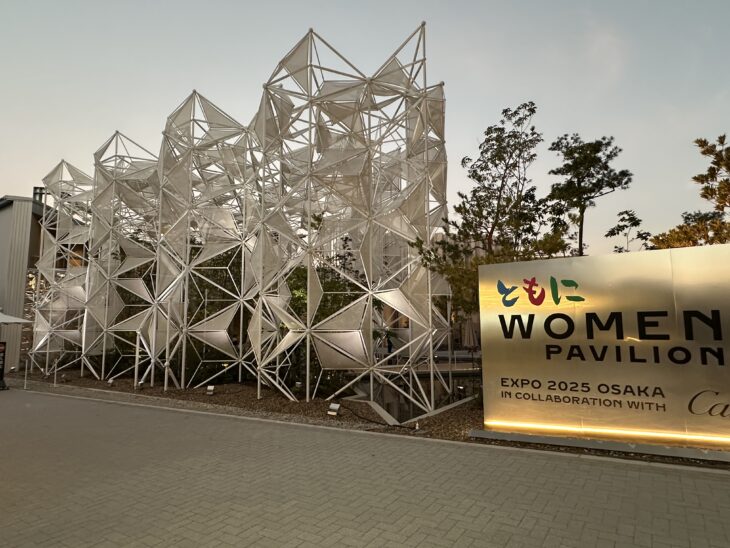
Figure 4: Women’s Pavilion
This circular approach is evident in the shared facilities designed by twenty groups of young architects of the same generation as the author. For instance, Rest Area 1 (Fig. 5), designed by Onishi Maki of Onishi Maki + Hyakudayuki, has a roof covered in brightly colored deadstock fabric. Restroom 2, designed by Kobayashi Hiromi, Ono Hiroshi, and Takemura Yurika, repurposed the historic zannen-ishi stones[3] (unfortunate stones) that were unused in the reconstruction of Osaka Castle. Restroom 5, also known as “The 200 Million Yen Toilet” and designed by Yonezawa Takashi, features a playful design reminiscent of building blocks. It is assumed that the restroom will be dismantled and transported after Expo 2025.
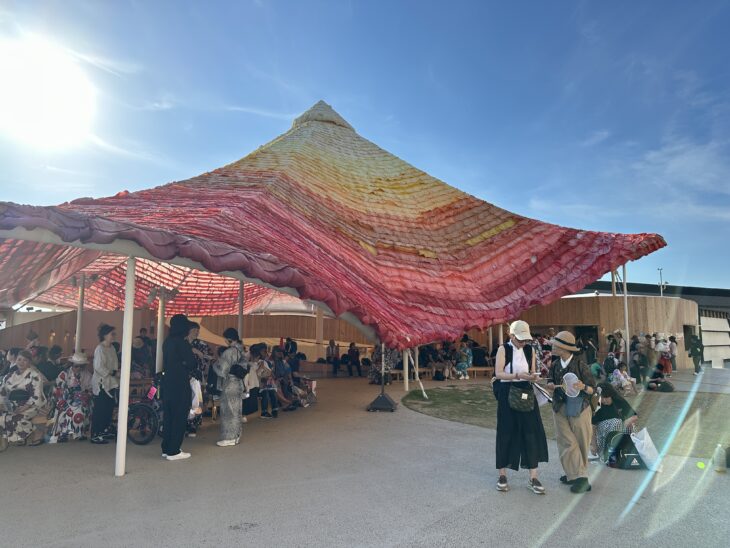
Figure 5: Rest Area 1 “Korokoro Hiroba”
How experimental is that experiment?
In his book Kenchiku wo Atarashikusuru Kotoba (Words That Make Architecture New, co-edited and written with Muraji Yutaro), published last year, the author himself placed emphasis on keywords such as “sustainability” and “circulation.” Therefore, the author is sympathetic to these practices [at Expo 2025].
At the same time, however, the author has mixed feelings. The essence of an Expo is the temporary celebration of “building and tearing down,” which is literally far from sustainable. A small-scale experiment in “recycling” at a large venue could be seen as a “futile effort” at best. At worst, however, it could serve as an alibi to transform an outdated national celebration that wastes resources into something that meets the SDGs. In fact, architectural media outlets have actively covered ambitious architectural endeavors with programs such as “Top 3 Recommended Expo Architecture.” However, at the same time, it seems as though expert commentary and scrutiny that takes a bird’s-eye view of the Expo as a whole have lagged behind. Of course, this is a flaw in recent architectural criticism and media rather than the architects themselves.
The Building Standards Act does not apply to Expo buildings, which are temporary structures. Therefore, there are technical and legal hurdles to overcome if a building is to be relocated and repurposed after the expo closes. In some cases, it can cost more to do so than to build a new one. Despite public solicitations for the reuse of shared facilities designed by young architects, it was reported that most of the proposals were not found. It has also been decided that only a portion of the Grand Ring will be preserved as an observation deck, and the rest will be demolished.[4] This is reasonable given the difficulty of handling such a large temporary wooden structure. The Women’s Pavilion, which will soon have appeared at three expos (Dubai, Osaka, and Yokohama), is a unique achievement made possible by the skill and enthusiasm of those involved.
Isozaki Arata was emotionally opposed to the idea of a national festival but was involved in Expo ‘70 as the designer of Festival Plaza. He once recalled that he could not resist the “sound of experiment” (Isozaki Arata, Han-Kaiso I [Anti-memoirs I]). Expos, offering the opportunity to conduct experiments that would normally be impossible, are certainly a fascinating opportunity for architects. However, the resulting architecture for Expo ‘70 often resorted to a mere parade of vibrant forms. Art critic Sawaragi Noi described the Expo architecture, created by the avant-garde architects of the time, as “eccentric and avant-garde” (Sawaragi Noi, Senso to Bampaku [World wars and world fairs]), an example of spoiled avant-garde design. Many architects, including Ito Toyoo and Kuma Kengo, had high hopes for Expo ‘70 in their youth, only to be disappointed by its empty vision. Isozaki, who was tempted by the experiment, also fell ill due to the contradictions he encountered. After the Expo, he began seeking a different kind of architecture than that of his mentor, Tange Kenzo, who had been at the center of the Expo’s architecture. Thus, Expo ‘70 served as a “negative example” and marked a turning point in Japan’s postwar architectural history.
How will Expo 2025 be remembered in architectural history? Many buildings were constructed to “reflect” the SDGs era. However, it’s unclear if these buildings were truly “experiments” that paved the way for the future of architecture. The extent to which the architectural experiments at Expo 2025 were truly experimental can only be determined retrospectively. This will depend on factors such as how much the buildings are reused after the event and how the knowledge and technology gained from them will be applied to future projects. Like Expo ‘70, which was praised as “eccentric and avant-garde,” Expo 2025 could also become a historic milestone, albeit in a negative sense. While it’s difficult to see amid the excitement of the event, many architects have distanced themselves from Expo 2025. A comprehensive retrospective that includes these architects is needed.
An experiment that transcended the “online backlash” that might have occurred in the social media era
We live in the age of the SDGs, as well as the age of social media. The architecture of Expo 2025 has experienced several rounds of online backlash, from the Grand Ring to the 200-million-yen toilet. Similar risks will inevitably arise in future large-scale projects. In the age of social media, one could argue that “backlash prevention” is essential to architecture and will only become more important.
Expo 2025 demonstrated that architects’ sincere efforts to explain their work can be surprisingly effective. Since Fujimoto Sou of the Grand Ring and Yonezawa Takashi of the 200 Million Yen Toilet started clearly explaining the costs and design intent on X (formerly Twitter), criticism based on misunderstandings has considerably decreased. Compared to the “New National Stadium Controversy,” this is something to be happy about, as Zaha Hadid (1950–2016)’s design for the stadium was canceled.
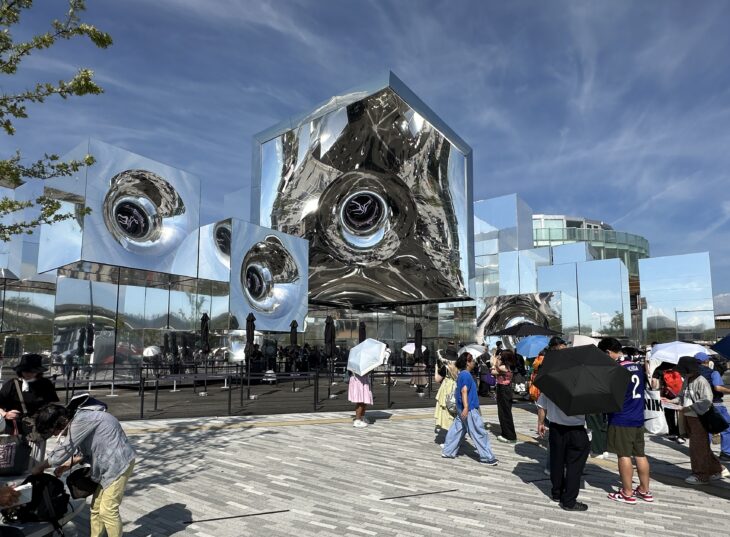
Figure 6: Signature Pavilions “null²”
On the other hand, the challenges architecture faces in the social media era are not limited to tackling online outrage. The social media era is, by its very nature, an era of highly open communication. Given that Expo 2025 is being held in such an era, perhaps it would have been better to have seen more architectural experimentation focused on information and communication. Looking back, when Expo 2025 was first proposed, one of its themes was an experiment in “Common Ground,” where things and information, the physical and the digital, overlap. Toyoda Keisuke, who was centrally involved in this idea as an architect, designed Ochiai Yoichi’s signature pavilion, “null2” (Figure 6).
For example, let’s try to make the architectural design process completely transparent. The Grand Ring would be a good subject. As a national public project, the Expo’s clients are the Japanese taxpayers, the citizens of Osaka Prefecture, and the citizens of Osaka. Taxpayers would be involved in creating this national monument, following its development, interacting with it through social media, and sometimes even making design suggestions. It would be like a super-scale version of “public comment.” Since the 2011 Great East Japan Earthquake, the architectural world has become more active in the collaborative design of architecture through workshops with disaster victims and citizens. The Grand Ring could be positioned as an extension of this trend. The Grand Ring’s “circular” shape is also a fitting platform for communication between architectural professionals (architects) and non-professionals.
Of course, architectural design is a highly specialized task, so the opinions expressed may be useful but also nonsensical. Therefore, architects are not required to follow them all. They can consider these opinions, but ultimately make the final decision as experts. This is essentially the same as the circumstances in workshops conducted during the planning and design process for real public facilities. Azuma Hiroki’s General Will 2.0[5] is a theoretical idea that could be helpful. It puts “constraints” on politicians’ arbitrary decisions by visualizing the desires and unconscious of the masses in a form similar to the live streaming service NicoNico Live’s “danmaku[6]” (barrage).
In an advanced information environment, architects develop designs by engaging in dialogue with countless people. This concept is not new. In 1997, Isozaki Arata used the popular Internet of that time to invite an unspecified number of people to participate in the planning process of China’s utopian urban planning project, The Mirage City — Another Utopia. In other words, he deconstructed the concepts of “architecture” and “urban planning” by incorporating the diverse opinions of non-experts. This radical experiment is typical of Isozaki, an avant-garde architect who advocated “Kenchiku no Kaitai[7]” (dismantling architecture) around the time of Expo ‘70.
Expos as lessons in communication
Although the “Mirage City” exhibition could be described as a pioneering experiment in architecture and the Internet, the results were not particularly encouraging. This is understandable given that platforms for gathering opinions, such as email and message boards, were still in their infancy, and the amount of information that could be handled was extremely limited.
However, the exponential growth in the amount of information that can be processed, coupled with advances in digital democracy technology that facilitate consensus building while avoiding fruitless debate and online backlash, suggests that a more productive solution may be possible. With the support of a digital engineer (like Audrey Tang?), the architect would engage in dialogue with countless people about design and planning issues, identify commonalities and conflicts, and then put together the architecture. Rather than the avant-garde “Kenchiku no Kaitai (dismantling architecture),” this process should be called “Kenchiku no Kaiho (liberation of architecture)” in a simpler and more positive sense.
Architecture will be “liberated” from being the arbitrary creation of architects and become a social entity open to a much larger audience. Through this process, we will likely share the specialized work of architectural design and the expertise architects demonstrate in the design process. If this socially cultivated experience helps us avoid pointless conflict and division in future public architecture and urban development, even in some small way, then it will have been worthwhile for a temporary building during a six-month national celebration.
The author thinks it would have been great if such lessons on social communication surrounding architecture had been experimented with in Expo architecture in the social media era.
In an irresponsible and extreme sense, it would be acceptable for the design and plans for the building to partially fail as a result of the dialogue between architects, people, objects, and information. At Expo ‘70, for example, Okamoto Taro’s Tower of the Sun violently piercing through Tange Kenzo’s Big Roof was remembered as a monument because of the dynamism of this “failure.” Of course, failure is not an option in architecture or in our daily lives. However, the value of an Expo as a temporary festive space lies in its “experiment.” Even if some failures remain like scars, they are a proud mark that proves that diverse communication was exchanged.
Related article: From the Normalization of Diplomatic Relations to Its 50th Anniversary: A History of Architectural Exchanges between Japan and China
https://www.japanpolicyforum.jp/culture/pt2023030316400412974.html
Translated from “Bampaku wa Jikken no Tameni Aru: Osaka, Kansai Bampaku no Kenchiku wo Kangaeru (Expos as Sites of Experimentation: Considering the architecture of Expo 2025),” Sekai, October 2025, pp. 102–116. (Courtesy of Iwanami Shoten, Publishers) [February 2026]
 ICHIKAWA Koji, Ph.D.
Architectural historian, Assistant Professor, Graduate School of Engineering, Tohoku University
Born in 1985. His specialty is architectural urban history in Asia. His publications include Tiananmen Square: A Spatial History of the Chinese National Square (Chikuma Shobo), and Wang Shu’s “Building Homes” (Misuzu Shobo, co-translation).
[1] Expo 2025 ran from April 13 to October 13, 2025, for a total of 184 days. It attracted 25,578,986 general visitors, for a total attendance of 29,017,924, including related personnel. More than 200,000 people attended daily. These numbers surpassed those of the 2005 Aichi Expo (approximately 22.05 million) and the 1990 Tokyo International Flower Expo (approximately 23.13 million). Expo 2025 ranks as the second-highest attended expo in history, behind only the Shanghai Expo.
[2] “Urban timber construction” refers to the movement of using wood to build mid- to high-rise buildings and commercial facilities in urban areas. Previously, reinforced concrete (RC) and steel frames (S) were the norm in these areas.
[3] These are huge stones that were cut for the stone walls of Osaka Castle in the early Edo period (1603–1867), but were left unused due to falling during transport, being the wrong size, or being the wrong shape.
[4] About 200 meters of the northeast section of the Grand Ring will be preserved as a climbable observation deck. The “Expo 2025 Memorial Hall” is planned for construction nearby on the former Expo site, and it is expected to become a symbol of the area (as of January 2026).
[5] Azuma Hiroki has redefined Rousseau’s “general will” in line with the modern information environment. He argues that there are limits to consensus building through deliberation (discussion), and that the visualization and statistics of “people’s knee-jerk reactions,” as on Twitter (now X) or NicoNico Live, will be the foundation of modern democracy. In this world, the government would transform into an “infrastructure” that, like Google, finds optimal solutions behind the scenes. He presented such a “thought experiment (dream).”
[6] On NicoNico Live (Niconico), a “danmaku” (barrage) refers to the fast-scrolling on-screen comments that fly across the streaming video like bullets, creating a dense curtain-like effect that can almost obscure the image. It is said that this feature originated from Japanese shooter games and revolutionized video interaction beyond YouTube’s static comment boxes.
[7] Isozaki Arata articulated this argument in his seminal work Kenchiku no Kaitai (Dismantling architecture), published in 1975. The book compiles essays he wrote around 1970, in which he critically examines the concepts of modernist architecture and functionalism, questioning their universality and limitations. This work represents a pivotal moment in the development of Isozaki’s theoretical thinking.
Keywords
- Expo 2025 Osaka, Kansai
- architecture
- Grand Ring
- experimentation
- sustainability
- Women’s Pavilion
- social media
Related posts:
 Regarding the “Limited Exercise of the Right of Collective Self-defense” Based on the Determination of “Survival-threatening Situations”
 Sakaguchi and Kitagawa win Nobel Prize: Japan celebrates dual achievement in same year as two researchers who persevered through adversity call for support for basic research
 Seven Major Changes in the Security Environment
 How Should We Respond to Successive Incidents? Understanding through a Culture of Coexistence: Bears and the Japanese People
 Why Are Debates Surrounding Family and Gender So Contentious? The “Principle of Deliberation” to Which We Must Return