


Regarding the “Limited Exercise of the Right of Collective Self-defense” Based on the Determination of “Survival-threatening Situations”
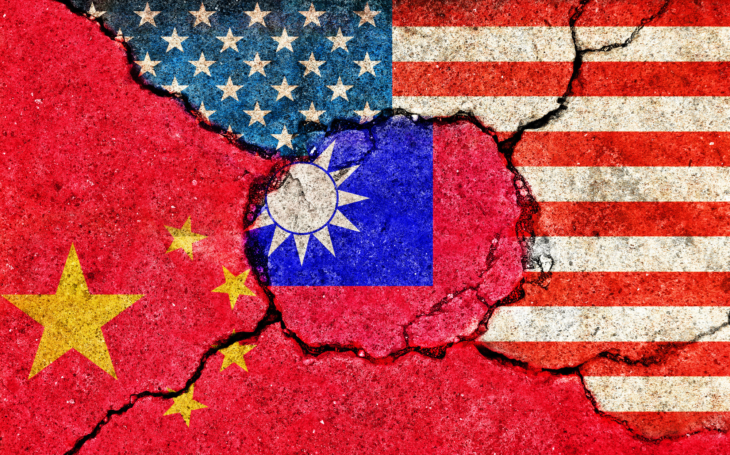
No one wants a confrontation between the United States and China over a Taiwan Strait contingency. However, if such a confrontation becomes unavoidable, Japan could be forced to make a legal judgment about “survival-threatening situations.”
Photo: Barks / photolibrary
What constitutes a “survival-threatening situation”? The government’s view is that Prime Minister Takaichi’s November 2025 response, in which she stated that a naval blockade around Taiwan could constitute such a situation, does not change the government’s previous position. However, many issues remain unresolved, and the legal basis is not necessarily clear. Tsuruta Jun examines the situation envisioned in this response, the legal structure of such existential threat situations, and the right of collective self-defense.
Prime Minister Takaichi’s remarks to the question of survival-threatening situations
During the Lower House Budget Committee session on 7 November 2025, Prime Minister Takaichi Sanae responded to a question from an opposition lawmaker who asked whether a blockade of the Bashi Channel between Taiwan and the Philippines would constitute a “survival-threatening situation.” She stated the following:
“If an armed attack [by China] were to occur against Taiwan, ‘if a naval blockade were to be imposed by warships,’ and if other measures were also taken to counter it, the use of force could occur. For example, ‘if the US military were to come to Taiwan’s aid to break the naval blockade, and China were to use some other form of force to prevent this,’ such a situation could be anticipated. Therefore, I believe that we must make a comprehensive judgment based on the information regarding the situation that would arise at that time.” (Underline for emphasis added by the author.)
“What means would China use to bring Taiwan under the complete control of the Beijing government? It could be a sea lane blockade, the use of force, disinformation, or cyber propaganda. There are a variety of possible scenarios. However, if it involves the use of battleships and the use of force, then no matter how you look at it, this could become a survival-threatening situation.” (Underline for emphasis added by the author.)
Subsequently, regarding the determination of a survival-threatening situation, the Japanese government stated, “The government will make a judgment based on all information and consider the specific circumstances of each situation” (Response to a Question on Survival-Threatening Situations, [Lower House Written Reply to a Question formulated by a Diet Member,[1] No. 71, 25 November 2025]). The government also stated that Prime Minister Takaichi’s remarks do not change the Japanese government’s previous position.
It is unclear what kind of situation Prime Minister Takaichi had in mind when she referred to “cases that could become survival-threatening situations.” However, considering the underlined parts of her response above, her “envisioned cases” (i.e., situations that are considered survival-threatening) and her assessment of the situation can be summarized as follows.
If the Chinese Navy launches a naval blockade around Taiwan and the US Navy arrives to break it up, and the Chinese attack the US Navy, this could be considered a survival-threatening situation.
What are survival-threatening situations?
What exactly are survival-threatening situations? To exercise the right of collective self-defense under international law limited in the “specific situations,” Japan defined them as “survival-threatening situations.” In 2015, Japan revised its Act on Response to Armed Attack Situations[2] to include provisions regarding such situations. According to the law, a survival-threatening situation is defined as “a situation in which an armed attack against a foreign country that has a close relationship with Japan occurs, and as a result, threatens Japan’s survival and poses a clear danger of fundamentally overturning people’s right to life, liberty and pursuit of happiness” (Article 2, Paragraph 4).
In light of determining survival-threatening situations, the Japanese government has stated that the “limited exercise of the right of collective self-defense,” rather than the “general exercise of the right of collective self-defense,” can be exercised. The “limited exercise of the right of collective self-defense” refers to “the use of force as an unavoidable and minimal necessary measure of self-defense to defend our country,” not to “defend another country” (Prime Minister Takaichi’s remarks at the House of Representatives Budget Committee on November 7, 2025).
Determining a survival-threatening situation is an important procedure that serves as the “starting point” for Japan’s use of force. However, this determination only marks the beginning; it does not authorize Japan to use force. The procedure under Article 9 of the Armed Attack Situation Response Act involves four steps: (1) The identification of survival-threatening situations, (2) The creation of a “basic response plan” detailing the facts underlying such identification, general policies for handling the situation, and key measures for response, (3) Cabinet approval of the basic response plan, and (4) National Diet approval of the basic response plan. Through these steps, the Self-Defense Forces, having been ordered to conduct defense operations (Self-Defense Forces Law Article 76, Paragraph 1), may exercise the necessary force to defend Japan (Self-Defense Forces Law, Article 88, Paragraph 1).
What is the right of collective self-defense under international law?
According to international law, the right to collective self-defense allows other countries that are not under direct attack to join together in a counterattack when a country is attacked and requests assistance. Collective self-defense is an “inherent right” recognized under Article 51 of the UN Charter and customary international law.
Article 2, paragraph 4 of the UN Charter prohibits the “threat or use of force” in international relations, thereby finalizing the prohibition of war and the use of force. However, the Charter allows for exceptions to this principle, including military measures under the UN’s collective security system and the right to individual or collective self-defense.
Exercising individual and collective self-defense rights is an exception to the principle of not using force. However, it is intended to supplement the UN’s collective security system until it is fully operational. The system is designed to restrain as much as possible the use of force at the discretion of individual states.
According to the United Nations’ collective security system, the United Nations Security Council (UNSC) may take measures, including military means, if it determines a threat to peace, a breach of peace, or an act of aggression by a state (Articles 39, 41, and 42 of the UN Charter).
However, concerns have been raised about the effectiveness of the UN’s collective security system. Permanent members of the UN Security Council (UNSC) have veto power, which allows them to block UNSC decisions (Article 27, Paragraph 3 of the UN Charter). Furthermore, even if the collective security system functioned properly, it could still take time for the UN to take military action after an armed attack occurs. Therefore, the right of individual self-defense for an attacked country to protect itself and the right of collective self-defense for a third country to assist an attacked country in exercising its right of individual self-defense were recognized (Article 51 of the UN Charter[3]).
Requirements for exercising the right of collective self-defense
One requirement for exercising the right to collective self-defense is “an armed attack against a state.” Another requirement is that the attacked state “request assistance” from a third state. At the very least, the “consent” of the attacked state is required. This requirement seeks to minimize the use of force at the discretion of individual states. Furthermore, the exercise of the right to collective self-defense must satisfy the principles of “necessity and proportionality.” Measures taken in exercising the right to collective self-defense must be a necessary response to an armed attack on the attacked state and proportionate to that attack.
In response to the question of “envisioned cases,” Prime Minister Takaichi mentioned “an armed attack on another country with close ties to Japan[4],” i.e., the United States (US Navy), based on the definition of survival-threatening situations in Article 2, Paragraph 4 of the Act on Response to Situations. However, she made no reference to “clear danger to the survival of our country and the fundamental overturning of the people’s right to life, liberty, and the pursuit of happiness.” She also made no mention of a “request for assistance” from the US to Japan or the US’s “consent.”[5] Her response lacks an explanation of the requirements for determining survival-threatening situations and for exercising the right of collective self-defense under international law.
Article 82, paragraph 2 of the Self-Defense Forces Law stipulates that, regarding the use of force by the Self-Defense Forces during defense operations, “When using force as provided for in the preceding paragraph, international laws, regulations, and customs shall be observed where applicable, and the use of force shall not exceed the limits deemed reasonably necessary under the circumstances.” The requirement to “request assistance” in order to exercise the right of collective self-defense under international law can be interpreted as “international laws, regulations, and customs” within the same clause. The requirements of “necessity and proportionality” are also stipulated within the same clause.
The fact that a request for assistance by the attacked country is a requirement for exercising the right of collective self-defense is related to our understanding of what kind of right the right of collective self-defense is. Based on the rulings in several cases, such as the Nicaragua Case (Nicaragua v. United States) by the International Court of Justice, the purpose of exercising the right of collective self-defense is to “assist the attacked state in exercising its right of individual self-defense,” the interests protected by the exercise of the right of collective self-defense are “the political independence and territorial integrity of the attacked state,” and the entities that can exercise the right of collective self-defense are limited to “states that receive a request for assistance from the attacked state.”
On the other hand, Japan’s exercise of the right of collective self-defense is “solely for the defense of our country,” according to Prime Minister Takaichi’s remarks at the Lower House Budget Committee on November 7, 2025. It is not intended to “assist an attacked state in exercising its right of individual self-defense.” The interests protected by Japan’s exercise of the right of collective self-defense are “the survival of our nation” and “the lives, liberty, and pursuit of happiness of our citizens,” not “the political independence or territorial integrity of the attacked nation.”
Legal justification for the use of force based on the determination of survival-threatening situations
Japan has positioned the determination of survival-threatening situations as the starting point for the process of exercising the right of collective self-defense under international law in a limited manner to “specific situations.” However, the Japanese government describes the use of force based on the determination of survival-threatening situations as a “limited exercise of the right of collective self-defense.” Nevertheless, its purpose and the interests it protects differ from those of the right of collective self-defense under international law.
When considering determination of a survival-threatening situation, an armed attack against Japan has not yet occurred. If an armed attack has already occurred, the determination is of an “armed attack situation” rather than a “survival-threatening situation.” Therefore, under international law, the use of force based on a determination of survival-threatening situations cannot be justified by the right of individual self-defense.
The circumstances that are considered for determination as survival-threatening situations are specific and limited situations, such as when an armed attack occurs against “another country with close ties to Japan,” and as a result, although an armed attack against Japan has not yet occurred, “there is a clear danger that an armed attack against our country will occur if left unchecked, and it will become impossible to prevent the resulting damage” (Nakano Takeshi, Boeiho [Defense law]) (Yuhikaku, 2023) p. 181).
However, if such a situation is designated a survival-threatening situation and the use of force is warranted, it is not easy to justify the exercise of the right of self-defense under either the right of collective self-defense under international law or the right of individual self-defense under international law. If we were to try to legally justify Japan’s use of force in such a situation, domestically, it would be justified based on the Self-Defense Forces Law, which determines survival-threatening situations in order to “defend our country,” and externally, it would be justified by exercising the right of collective self-defense under international law to “defend other countries” based on the occurrence of an armed attack against “other countries with close ties to Japan” and a “request for assistance” from that country. Even though it is a single use of force by Japan, the domestic and external justifications differ in how the purpose of the use of force and the interests being protected are perceived.
Japanese security officials should be more mindful that the legal justification for the use of force based on the determination of survival-threatening situations is not easy to obtain.
Translated from an original article in Japanese written for Japan Policy Forum [February 2026]
Reference:
United Nations Charter
https://www.un.org/en/about-us/un-charter/full-text
Act on the Peace and Independence of Japan and Maintenance of the Security of the Nation and the People in Armed Attack Situations, etc.
https://www.japaneselawtranslation.go.jp/ja/laws/view/4925
[1] “Written Reply to a Question formulated by a Diet Member” (known in Japanese as naikaku shushitsu) refers to an official document prepared and submitted by the Cabinet in response to written inquiries from members of the Diet, following a formal Cabinet decision. These documents serve to clarify the government’s official positions or factual understandings and are regarded as public records with significant legal and political implications.
[2] The official name is “Act on the Peace and Independence of Japan and Maintenance of the Security of the Nation and the People in Armed Attack Situations, etc.”
[3] Nothing in the present Charter shall impair the inherent right of individual or collective self-defence if an armed attack occurs against a Member of the United Nations, until the Security Council has taken measures necessary to maintain international peace and security. Measures taken by Members in the exercise of this right of self-defence shall be immediately reported to the Security Council and shall not in any way affect the authority and responsibility of the Security Council under the present Charter to take at any time such action as it deems necessary in order to maintain or restore international peace and security.
[4] The Japanese government defines “other countries with close ties to Japan” as “countries that generally share an interest in addressing armed attacks from outside as a common danger and express a willingness to act together against them” (Response to Questions Concerning the Government’s Response on the Right of Collective Self-Defense, House Written Reply to a Question formulated by a Diet Member, 189, No. 7, February 6, 2015).
[5] However, the “ Guidelines for Japan-U.S. Defense Cooperation,” formulated on April 27, 2015, states the following in the section titled “ Actions in Response to an Armed Attack against a Country other than Japan”: “The Self-Defense Forces will conduct appropriate operations involving the use of force to respond to situations where an armed attack against a foreign country that is in a close relationship with Japan occurs and as a result, threatens Japan’s survival and poses a clear danger to overturn fundamentally its people’s right to life, liberty, and pursuit of happiness, to ensure Japan’s survival, and to protect its people.” Specifically, one such operation is described as follows: “The Self-Defense Forces and the United States Armed Forces, in cooperation with relevant agencies, will cooperate in escort operations to protect ships and vessels, as appropriate.”
Keywords
- survival-threatening situation
- armed attack
- naval blockade
- collective self-defense
- use of force
- Taiwan
- international law
Related posts:
 “A World with America” and “A World without America”
 Xi Jinping’s Regime: Political Dynamics of Personal Dictatorship
 Seven Major Changes in the Security Environment
 Will “Chinese-style” Development Permeate Hong Kong?
 Japan’s Strategy as a Pioneer in Central Asian Diplomacy: Observations from the First “Central Asia plus Japan” Dialogue Summit