What Is Meant by Supply Chain Resilience?
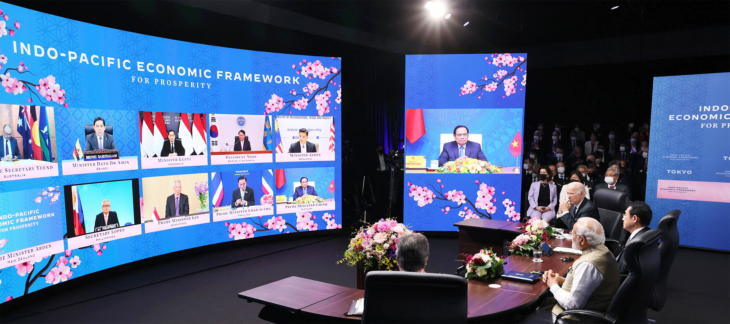
The Indo-Pacific Economic Framework for Prosperity (IPEF) supply chains agreement encourages members to share the information on supply capacity during disruptions. These mechanisms blunt the impact of economic coercion, such as export controls, by reducing their expected effectiveness. By institutionalizing cooperation among like-minded partners, the framework enhances collective resilience and strengthens deterrence. IPEF was launched in Tokyo on May 23, 2022.
Photo: Public Affairs Office, Cabinet Secretariat
Supply chain management to prepare for geopolitical incidents requires strategic thinking, where predicting the reaction of geopolitical competitors is essential to designing effective countermeasures.
- Deterrence is the key for promoting supply chain resilience
- Friend-shoring is a double-edged sword
- Risk can be alleviated by trust-building through inter-firm networks across national borders
With looming uncertainty in the global business environment, the pursuit of economic efficiency is increasingly associated with supply chain vulnerabilities. “Resilience” became a keyword in supply chain management and now forms the core aspect of economic security.
Supply chain vulnerabilities are attributed either to (1) physical risks, (2) cyber risks, or (3) geopolitical risks.[1] Physical risks include those of natural hazards, climate change, and pandemics. Cyber risks are represented by malicious attacks on critical infrastructure or theft/leakage of confidential data, while nowadays the disinformation maneuver using generative AI is gathering sharp attention. Geopolitical risks range from classic examples of energy crises triggered by Middle Eastern affairs to the more contemporary phenomenon of “weaponized interdependence,” a product of increasing complexity in global production networks.
“Game-like nature” of geopolitical risks
The three types of supply chain risks can be ranked by the degree of “proactiveness”; namely, to the extent that human intention intervenes in the manifestation of risks, such that:
Physical risks < Cyber risks < Geopolitical risks.
The proactiveness of physical risk factors is low because they are primarily caused by natural incidents (except for human-driven bioterrorism). By contrast, cyber risks are considered more proactive because the majority of threats are related to cyberterrorism targeting network vulnerabilities. However, considerable damage can be also caused by passive negligence, such as personal data leakage through emails to a wrong addressee or the loss of a PC terminal. Geopolitical risks are entirely attributed to political motivations, making human entities (i.e., decision makers) of adversary nations as the sole risk factors.
Here, the approach to promote supply chain resilience varies depending on the proactiveness of risk factors in concern.
For physical risks (the least proactive) such as those stemming from natural hazards and pandemics, the conventional countermeasure includes diversification of suppliers and production bases, expansion of inventory, development of substitutes, and promotion of recycling technologies.
By contrast, geopolitical risks (the most proactive) involve human intention for their manifestation and hence require some degree of strategic thinking in designing risk countermeasures. This is because of the “game-like” nature of risk management that geopolitical relations entail. Namely, our risk countermeasure itself influences the perception of the entity from whom the risk originates, and therefore changes the risk environment that we operate in. There is an interaction between what we do, and how they react, making strategic thinking necessary. And this is exactly why we need to refer to the classic security playbook in considering supply chain resilience against geopolitical risks.
Considering deterrence in economic security
In the field of international security, traditional deterrence theory has two contrasting approaches: “deterrence by punishment” and “deterrence by denial.” The former refers to the credible demonstration of retaliatory capabilities to entirely offset the gains from a pre-emptive attack. For example, concepts like “mutually assured destruction” in the 1960s were based on this idea.
By contrast, deterrence by denial assumes the mechanism that reduces the effectiveness of an opponent’s hostile actions, thereby discouraging the opponent from taking such actions. In the military domain, air-defense missile systems are a primary example.
In the context of economic security, it is rather difficult to envisage what might form deterrence by punishment. Perhaps it may correspond to seizing control of supply chain core competence, such as production of advanced semiconductors and critical materials, or by insinuating retaliation through economic statecraft utilizing these strategic assets. In Japan, this is often discussed under the slogan of “strategic indispensability,” although questions still remain as to how effectively this would convey a punitive message to the opponents.
As for deterrence by denial, economic partnerships among like-minded nations, or “friend-shoring,” may play such a strategic role on top of the conventional function of risk diversification. Friend-shoring refers to forming a production ecosystem among countries with similar political systems/values, or governments’ efforts to establish such a system. For example, the Supply Chain Agreement in the Indo-Pacific Economic Framework for Prosperity (IPEF), the Single Market Emergency Instrument under the EU Economic Security Strategy, or the US-Japan Agreement on Strengthening Critical Minerals Supply Chains in 2023, all have mechanisms in place which encourage member countries to share critical supplies within the group, or at least to exchange information regarding their supply capacities, when allied countries are facing serious bottlenecks.
From the viewpoint of adversaries, this lowers their expectation on the effectiveness of hostile actions, such as economic coercion through export restrictions on critical materials, thereby reducing the willingness to launch such measures. Most importantly, deterrence can be enhanced through institutionalization of these mechanisms within friend-shoring arrangements which raises the credibility of allies’ willingness to commit in collective actions.
The economic security dilemma
The fundamental premise of the deterrence theory is that a credible threat is the best means of preventing an opponent from engaging in undesirable behavior. In discussing economic security within the classic security framework, it is then necessary to consider the cases in which this premise does not hold; namely, the situation where deterrence fails and the conflict escalates.
Theories of international relations often refer to the concept of the “security dilemma.” It depicts a mechanism in which one country’s attempt to enhance its own national security conversely imperils that security. For example, military buildup or alliances, even with a genuinely defensive motive, may be perceived by opponents as a threat to their security, and thereby drive these countries to mirror-image reactions (i.e., military buildup/alliances). As a result, both camps are trapped into a vicious cycle of escalating global risks and tension.
There have been a great deal of studies on the security dilemma in military and diplomatic contexts, but the application of the model to the issue of economic security is still limited. Today, with rapid permeation of advanced technologies into economic activities, it has become increasingly difficult to distinguish between products for civilian uses and those for military uses. Accordingly, reorganization of supply chains through derisking/decoupling measures have an important implication for the current and future inter-state power relations.
Friend-shoring is analogous to military alliances in traditional security, which implies that excessive promotion of friend-shoring may lead to an “economic security dilemma.” For instance, the United States’ Indo-Pacific Strategy, which rivals China’s Belt and Road Initiative, clearly positions the IPEF as a friend-shoring instrument. Such friend-shoring races may lead to transforming the global economy into a two-block regime if these superpowers intensify their battles for supply chain dominance over the rest of the world.
Global supply chains as a trust-building mechanism
The security dilemma is based on the same line of logic as the “prisoner’s dilemma” in game theory. Each side of the game knows in advance that it will benefit both parties if one cooperates with the other. However, mutual distrust and misunderstandings, fostered in the absence of communication channels, invoke the inner state of crisis, frustration, and fear in both sides. Eventually, they fall into the choice of non-cooperation for a one-shot game. Note that this happens not because of their incompetence in calculating gains and losses; on the contrary, it is the product of a rational choice by each side in a given environment.
The fundamental cause of the dilemma lies in the structure of the game, where, like prisoners in cells, the parties lack an effective communication channel to engage in complicity for joint survival. This is why the security dilemma is often alluded to in military domains for which informational asymmetry is a rule rather than an exception, as seen in the harsh intelligence operation during the Cold War.
Today, we often talk about the weaponization of interdependence. It is true that supply chains can be used for economic statecraft to outmaneuver opponents. It is also true that weaponized supply chains have significantly increased their destructive power and speed because of rapid technological progress. Nevertheless, it is important to realize that, unlike military tanks, fighter jets, or battleships, global supply chains (GSC) can serve as extensive communication channels across national borders.
Supply chains themselves are nothing more than a bundle of economic transactions, but each of these transactions contains multi-faceted information about the contractual parties (suppliers and clients), such as product specification, service quality, supplier networks, business competitors, management profiles, and the scope of technologies and intellectual property rights. They are mutually evaluated from various perspectives, during which trust between the parties can be fostered and eventually materialized in the form of a legally endorsed business contract. In this way, firms’ uncompromising motives for risk management and profit maximization are the fundamental basis for trust-building between the parties.
Of course, firms do not do business for the sake of national security; their primary motives are to maximize profits and corporate values. Rather, it should be the interest of governments to recognize the trust-building function of GSCs and establish the relevant institutional architecture for its active use.
For example, the ASEAN Regional Forum (ARF) has a Track 2 system which aims to bring the opinions of private sectors and think tanks into official governmental agenda. In particular, the Council for Security Cooperation in the Asia-Pacific (CSCAP), ARF’s main intermediary organization, can be a promising platform for this purpose, by effectively combining informational exchanges through inter-firm supply chains and inter-state policy channels.
Utilizing the dual nature of GSCs
Some argue that deepening economic interdependence has made wars more costly and hence contributes to peacekeeping. This is a long-standing view in the field of political economy, but the recent development of global politics make it difficult to believe that economic pay-off calculations have any decisive influence on national security decisions.
By contrast, the current argument in this article focuses on the informational asymmetry between nations as a primary risk factor. In the light of macro-level risk management, GSCs can be an important public asset as a trust-building mechanism by facilitating communication across national borders. Furthermore, GSCs’ communication channels have multiple paths along dispersed supply chains and hence are quite amenable to the idea of risk diversification.
Namely, GSCs are deemed “dual-use” instruments, combining both short-term/tactical functions of economic statecraft (such as economic sanctions) and long-term/strategic functions of maintaining communication between nations as a trust-building apparatus. While effective deterrence through economic statecraft is crucial for surviving today’s power-centric dynamics, we should also develop a built-in mechanism in supply chains to prevent this from becoming the goal rather than a mean in itself.
(This article is partially adapted from Nikkei BP’s “The Geopolitics of Global Value Chains.”)
Translated from “‘Sapurai Chein Kyojinka’ towa Nannokotoka (What Is Meant by Supply Chain Resilience?),” Gaiko (Diplomacy), Vol. 92 Sept./Oct. 2025, pp. 44-49. (Courtesy of Jiji Press) [January 2026]
 INOMATA Satoshi, Ph.D.
Chief Senior Researcher, Institute of Developing Economies, Japan External Trade Organization (JETRO)
Born in 1966. Received his Master’s degree in Economics from the University of Oxford in 1991 and joined the Institute of Developing Economies in the same year. He received his Ph.D. in Economics from the Hitotsubashi University Graduate School in 2014. He has previously served as a visiting researcher at the University of London and the OECD. His publications include Gurobaru Baryu Chein: Shin Nanbokumondai eno Manazashi (Global value chains: A new perspective on North-South issues) and Gurobaru Baryu Chein no Chiseigaku (Geopolitics of global value chains).
[1] The typology in “Policy Recommendations on Supply Chain Resilience” by the Japan Economic Foundation, March 31, 2025.
Keywords
- supply chain resilience
- geopolitical risks
- countermeasures
- game theory
- deterrence
- friend-shoring
- security dilemma