


“A World with America” and “A World without America”
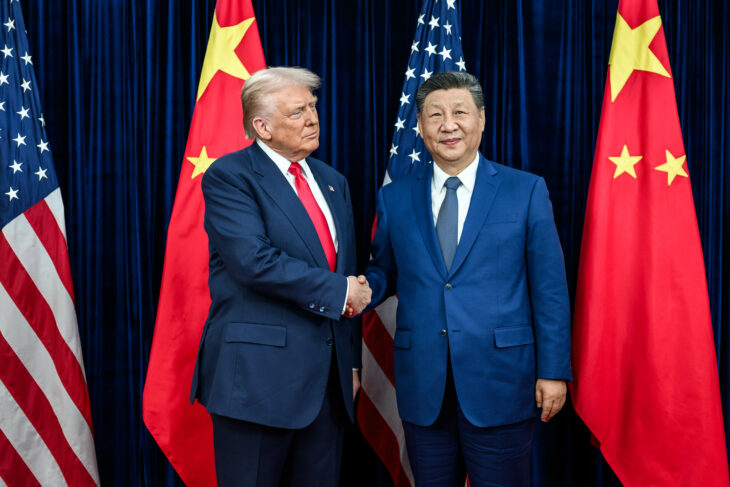
International politics is shifting. As China’s presence grows and America’s influence relatively wanes, the world navigates toward a new, uncertain order.
Photo: US President Donald Trump shakes hands with Chinese President Xi Jinping before a bilateral meeting in Busan, South Korea, October 30, 2025. (Official White House Photo by Daniel Torok)
Editor’s note: This article was written in October 2025 and originally appeared in the December issue of Chuokoron, published on November 10 of the same year.
“A World with America” and “A World without America”
International politics is in flux. Such clear, tectonic shifts are rare.
In the summer of 2025, dozens of world leaders attended international conferences hosted by the Chinese government in Tianjin and Beijing. Their presence in photographs seemed to endorse China’s leadership. Meanwhile, US President Donald Trump negotiated a ceasefire between Israel and Hamas in the Gaza Strip. The White House and Trump’s supporters continue to promote an image of Trump as a global peacemaker. As of mid-October 2025, the United States and China were continuing their tariff negotiations and threatening to impose new export restrictions and tariffs. However, it is believed that there is a high possibility that a US-China summit will take place.
Countries realizing that the world situation is heading toward an incredibly turbulent sea are starting to move in search of their own compass. Although the “world with America,” where the US presence is clearly felt through alliance talks, military exercises, etc., is still alive and well, an increasing number of countries are forging closer ties with China and Russia, regardless of the US’s opinion, and the “world without America” is expanding. President Trump himself might even join forces with the “world without America.”
Global trends that defy traditional ways of thinking and behaving have become the norm. The post-Cold War view of international order, based on the United States’ overwhelming power, is no longer relevant.
Some counterarguments may point to the “resilience” bounce-back effect, suggesting that the current turmoil will subside once President Trump’s term ends, much like dust settling. It’s true that American politics may regain some semblance of stability with the election of the next president, or perhaps the president after that. However, it’s generally believed that it will take a long time for America’s polarized politics to heal, and it won’t be easy for the US to once again become serious about supporting the international order. Above all, looking at the current US, countries around the world are resolutely preparing for the dramatically changed times and are beginning to adopt new approaches.
China’s diplomatic offensive is expanding the “World Without America”
China’s diplomacy, which brings together leaders from various countries, is clearly increasing its “demonstrative power.” From August to mid-September 2025 alone, notable events included the announcement of the Plan of Action to Implement the ASEAN-China Comprehensive Strategic Partnership (2026–2030), the Shanghai Cooperation Organization (SCO) summit in Tianjin, the launch of the Global Governance Initiative (GGI), the 80th anniversary Victory Day parade in Beijing, and the virtual BRICS summit. While these events occurred in waves, it was symbolic that China, Russia, and North Korea were lined up in the first row when the leaders marched together in Beijing. This arrangement shared a common context of resistance to the United States.
Of course, this does not mean that China’s appeal has increased; rather, it has skillfully taken advantage of the influence vacuum and declining trust created by the United States. However, China promoted its own vision of international order, leaving the impression that a different axis from the US-centered one, and a multipolar world, might be possible.
Trilateral cooperation between China, Russia, and North Korea is still limited. Until now, China has tried to avoid being equated with Russia and North Korea, but it has recently taken bold steps to reclaim regional leadership while also trying to increase the leverage against North Korea. All three countries are subject to US sanctions, but the benefits they derive from cooperation vary, making it difficult for them to align their stances toward the United States. Nevertheless, China-Russia-North Korea relations hold significant symbolic importance, and for President Xi Jinping, they represent a stepping stone to forming “another group that is not centered around the United States.”
The GGI proposed by President Xi on September 1, 2025, lacked substance. This document discusses an international order that does not reject and is not particularly antagonistic toward the existing one. It merely advocates for principles such as non-interference in internal affairs and a people-centered, UN-centered approach. However, compared to the liberal international order led by Europe, the United States, and Japan in recent years, its content is clearly lacking. Compared to other initiatives released thus far that use terms such as development, security, and civilization (the Global Development Initiative, the Global Security Initiative, and the Global Civilization Initiative), this initiative lacks substance.
This may also be significant. The current international order has been formed by layering elements that promote liberal values on top of a Westphalian worldview that emphasizes sovereignty, but China is attempting to streamline that upper layer. This incorporates a relativistic view of the coexistence of civilizations. China’s view of order can be seen as negative, attempting to negate the previous view.
Countries that had previously given up on the extremely high level of rules and obligations sought by the G7 and the Trans-Pacific Partnership Agreement (TPP) believed they could never achieve these goals. For these countries, China’s vision seems worth embracing, even with the hope of Chinese assistance. Consequently, China’s vision of order will undermine the Western-centric order and diminish the G7’s influence. It is not a clear vision that can serve as a backbone that unites countries, but when we look at the United States, which frequently uses tariffs and threats and is reluctant to provide international public goods, the vision presented by China ends up looking like “another axis.’’
This is in stark contrast to the G7, where the United States’ presence is not utilized. Russia still has influence in many countries. ASEAN and Middle Eastern countries are reportedly adopting a hedging strategy, attempting to maintain an appropriate distance from both the US and China. Many Global South countries are attempting to hedge, but, as seen with Indonesia and India, countries are balancing their positions by being more considerate of China.
The shrinking “world with America”
China’s rise over the past decade is an obvious factor driving countries around the world to make new strategic decisions. As Adam Posen, president of the Peterson Institute for International Economics, wrote in his Foreign Affairs article, a key factor is the growing recognition that the United States, once a “global insurer,” is transforming into a “profit extractor” that takes profits from the rest of the world.
Since World War II, the United States has established mutually beneficial relationships with other countries by offering security through alliances and nuclear weapons, providing the dollar as an international currency for transactions, promoting free trade, and granting access to the US market. Of course, there are many times when the United States’ pursuit of self-interest has been overt, and there has been moral criticism of stability based on nuclear deterrence. Nevertheless, the significance of the United States’ provision of international public goods should be recognized to some extent.
However, the current situation under Trump’s second administration is completely different.
Tariffs have been used as a bargaining chip to open other countries’ markets and attract investment, and tariff rates have given domestic products an advantage over imports. However, tariff revenue has also become increasingly attractive to the United States. Once a country relies on tariffs as a source of revenue, it is unlikely that they will easily be eliminated. While Treasury Secretary Scott Bessent acknowledges the economic role of the dollar as the key currency, there are dissenting voices within the administration, some of whom have begun to theorize that the dollar is harming the US economy.
The 2026 National Defense Strategy of the United States, expected to be released soon[1], reportedly focuses on the US mainland and the Western Hemisphere. This focus is supported by the Trump administration’s repeated attacks on alleged drug-carrying ships from Venezuela, as well as its plans for operations within Venezuela.[2] The administration’s stance on preventing the flow of drugs into the United States, even if it means justifying such actions with little basis in international law, demonstrates a strong commitment to building a “wall” between the United States and the outside world, similar to its efforts to combat illegal immigration.
Questions remain about how long the United States can sustain its defense budget. The Wall Street Journal points out that, when accounting for inflation, the US defense budget as a percentage of GDP may fall below 3% in the future.
In fact, the Trump administration is ingrained with hostility toward China. This attitude stems from a combination of religious and civilizational “unease” toward China and “anger” related to the influx of synthetic drugs like fentanyl and trade friction. Once President Trump or President Xi steps away from the negotiating table, the fundamental structure of the US-China confrontation will quickly become apparent. However, as long as President Trump prioritizes negotiations to secure immediate economic gains and China justifies buying time by threatening to withhold rare earths, the US-China rivalry and economic security concerns will appear to other nations as nothing more than major powers conveniently exploiting the situation.
The modern United States no longer has the capacity to spare. Although the Obama administration sent the message that it wanted to step down from its role as “world policeman,” the Trump administration is shamelessly taking action to scoop up profits from around the world.
In a recent essay, Oren Cass—a close advisor of Vice President J.D. Vance—proposes spheres of influence as an alternative to the idea of a global liberal order. Cass criticizes China but argues that allies should increase their security contributions and economic concessions to the United States, which he describes as a reciprocal approach.
In the absence of an immediate alternative to the United States, allies are doing everything they can to manage their relationships with it. Yet, even allies are beginning to tacitly acknowledge that they cannot rely solely on a “world with America.” This is especially true for countries whose relationships with the United States are merely partnerships and not protected by treaty. A growing trend toward new responses is emerging, such as Europe’s movement to reduce dependence on the United States and gain strategic autonomy.
The fragmentation of the global order continues
As the shape of a “world without America” becomes clearer, discontent grows within the “world with America.” What will the future international order look like?
One view is that “a world with America” will remain firmly rooted. There has been no fundamental change in the international order during the four years of Trump’s first administration or the six-plus months of his second. With a new president, America’s foreign policy will revert to the way it was. Market forces will come into play and ultimately put this in check. Because of its geopolitical interests, America cannot completely withdraw from the world. This outlook could be called a “normalization bias,” but it persists.
In reality, the Trump administration has already begun undermining the international order beyond the point of no return. While negotiating with Russia, it imposed strict ceasefire conditions on Ukraine and did not hesitate to take measures that would exacerbate conflict and poverty, such as abolishing the US Agency for International Development (USAID). What other events could further erode trust in “a world with America”? Will countries and people around the world resort to responses that completely discard conventional wisdom? Let’s consider a “Trump shock” scenario as a thought experiment.
First, regarding Taiwan, there is speculation that President Trump may bring up new content regarding Taiwan, not just at this summit but at future US-China summits as well. Even if the US president’s statements regarding arms transfers to Taiwan or Taiwan’s future do not take the form of an official document, they would have a significant impact not only on Taiwan, but also Japan and many other countries in the world. While this impact would be a significant political achievement for President Xi, it could also prompt US allies to reevaluate their security.
There is also the possibility that President Trump will meet with North Korean leader Kim Jong Un. This could happen at any time, even if an opportunity on the sidelines of the APEC summit in November 2025 were missed.[3] Shifting the United States’ stance from considering North Korean denuclearization as an immediate goal to pursuing negotiations with North Korea in exchange for a nuclear and missile agreement that only ensures the security of the US mainland would dramatically change the security environment in East Asia.
The Trump administration and those around it are increasingly expressing cold views toward Taiwan, and there are even whispers that it may be unavoidable to remove North Korea’s denuclearization from its immediate goals. As these fears continue to linger, many countries will likely begin to realize the risks of remaining solely in a “world with the United States.”
Furthermore, the mere appearance of a Triple Entente-like alliance between the United States, China, and Russia—such as a meeting of the three leaders—could be interpreted as the US voluntarily accepting a “world without America.” Even if no significant agreements are made, it would fundamentally alter each country’s perception of order.
The Trump administration is not afraid to use military force against countries with limited ability to retaliate, such as Iran and Venezuela. However, if the United States were to openly launch a military operation against Venezuela, it would further erode America’s moral standing.
Although our focus here has been on security, we can also imagine scenarios in which new shocks could emerge in the dollar and trade originating from the United States.
Of course, it is also conceivable that the “world with America” scenario will become more prevalent again. This would especially be true if the United States’ security needs became clear. China’s political turmoil and blatant human rights violations could also present an opportunity for the United States and Europe to unite.
Nevertheless, it is more likely that the “world with America” will lose its unifying force and that more countries will seek to mitigate their risks in a “world without America.” This would weaken the global trend toward globalization and result in a more regionalized world divided into blocs. This is what we call the fragmentation of the planet.
Still, we must support a “world with America”
The United States will not resume its role as the “architect” or “heaviest burden-sharer” of the international order anytime soon. While the United States still desires global stability, it does so primarily to serve its own interests. It wants to achieve this goal as cheaply as possible without burdening itself. Regional issues are primarily the responsibility of regional countries. Even if US military personnel and diplomats seek to address regional issues, their involvement will inevitably be limited if the ultimate decision-makers are not interested. It is time to eliminate all optimism about the United States.
We should abandon the worldview that underestimates the influence of China and Russia. As China and the Global South grow, the “world with America” will inevitably shrink in size and influence if things continue as they are. Meanwhile, a “world without America” is expanding to fill that gap.
So, how should Japan respond?
The fact remains that the United States is Japan’s indispensable diplomatic and security ally. Even if the US loses interest in moral integrity and international order, or doubts its ability to fulfill commitments during emergencies, there is no alternative, so we must increase the likelihood that the Japan-US relationship will function. For the Trump administration, allies are merely tools, not equal partners. However, we must also recognize the United States as a tool.
Even if the G7 countries excluding the United States were to unite, they would still only account for less than 20% of the global GDP. While it’s important to incorporate the Global South and increase cooperation on each issue, it won’t be easy to create a bloc that can compete with the United States and China. Consequently, as the “world without America” gains momentum, Japan’s sole responsibility is to maintain a “world with America,” even if the American presence weakens.
The author calls this “Plan A+.” What Japan and Europe need is not to use bold language like “independence.” This could be perceived as a denial of Japan-US cooperation. Furthermore, the goal should not be to move forward without the United States. Although we sometimes promote multilateral cooperation without the United States, we should always aim for a “world with America” because it is more advantageous than a “world without America.”
Recently, discussions in Japan have focused more on defense than on diplomatic power, though the latter remains important. The war in Ukraine, the US-China conflict, and the Middle East crisis may create stronger rifts between the United States and its allies in the future. Consequently, opportunities for US allies and partners to coordinate on security, trade, and global issues without the US will likely increase. Nevertheless, it is important to continue dialogue with the Trump administration, leaving the US with an option to return if desired.
It’s true that postwar Western society has relied on American power. While the “world with America” has weakened over the past 80 years, many countries have grown within it and adopted its values. We should establish principles for the international community by bringing these countries together, even without the United States for the time being.
Another stance Japan needs to take is preparing to combat narratives. New concepts are being introduced one after another from a “world without America.” While these concepts sound good, they are hollow. Japanese diplomacy is being called upon to expose this diplomatic deception.
For example, China speaks to other countries about their right to development with beautiful words, while simultaneously exporting its own overproduced goods, burdening the global economy, and repeatedly engaging in economic coercion. It is important to make other countries aware of this contradiction. Sometimes, it may be necessary to present a counter-narrative. However, the “conflict between democracy and authoritarianism” will not resonate with cautious countries that do not want to take a clear stance. Words such as “freedom,” “fairness,” and “rule of law” must be chosen carefully.
As Cass mentioned above, the idea of spheres of influence is tantamount to acknowledging the existence of a “world without America.” Japan must continue to strive for a world with and alongside the United States that will order the entire world.
Translated from Chugoku-ryu no Kokusaichitsujo ni taisuru Nihon no Keiryaku: “Beikoku no Iru Sekai” to “Beikoku no Inai Sekai” (“A World with America” and “A World without America”),” Chuokoron, December 2025, pp. 140–147 (Courtesy of Chuo Koron Shinsha) [February 2026]
 SAHASHI Ryo, Ph.D.
Professor, International relations at the Institute for Advanced Studies on Asia, the University of Tokyo
Born in 1978. He specializes in international politics in East Asia. He also works as Executive Visiting Research Fellow of Keidanren Policy Research Institute and a non-resident scholar of Carnegie Endowment of International Peace. He has been a visiting scholar with Stanford University, the Wilson Center, and Seoul National University. His recent articles have appeared in Pacific Affairs, Journal of Contemporary China, Contemporary Politics and China International Strategy Review. He received his B.A. from International Christian University and his Ph.D. from the Graduate Schools for Law and Politics at the University of Tokyo.
[1] The 2026 National Defense Strategy of the United States of America was published on January 23, 2026.
[2] This article was written before the US military captured Venezuela’s President Nicolas Maduro and his wife on January 3, 2026.
[3] No meeting between the two leaders took place in November 2025.
Keywords
- international politics
- international order
- world with America
- world without America
- spheres of influence
- regionalized world
- China’s diplomatic offensive
Related posts:
 Regarding the “Limited Exercise of the Right of Collective Self-defense” Based on the Determination of “Survival-threatening Situations”
 Xi Jinping’s Regime: Political Dynamics of Personal Dictatorship
 Seven Major Changes in the Security Environment
 Recent Cyber Situations and the Bill Introducing Active Cyber Defense
 The Dynamics of the “Coalition of the Willing” in the Indo-Pacific