


Free Trade Regimes Without the United States and Choices for the Global South
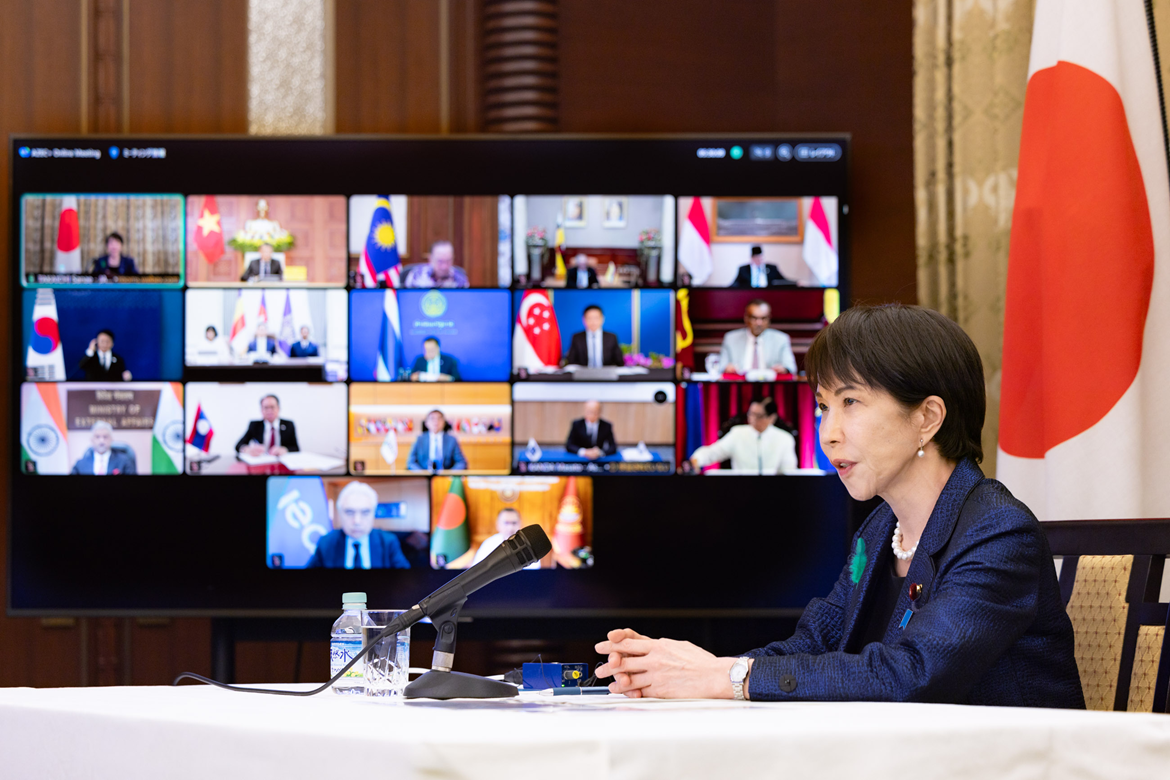
Strengthening regional resilience through the Asia Zero Emission Community (AZEC): Prime Minister Takaichi Sanae addresses Asian leaders during an online meeting on April 15, 2026, announcing the “POWERR Asia” initiative to address energy supply disruptions and bolster economic security.
Photo: Cabinet Public Affairs Office
Against the backdrop of the US-China confrontation, coalitions in support of free trade are becoming increasingly active around the world. Kumagai Satoru reexamines the logic of emerging economies and the approach of the United States, which uses “Trump tariffs” to rein in these countries.
- US-China confrontation presents trade expansion opportunities for many emerging countries.
- China is attempting to deepen relations with the West and emerging countries using “market opening” as its weapon.
- Japan should place greater weight on the future potential and strategic value of ASEAN.
In recent years, countries known as the “Global South” have been increasing their presence in the international community. Behind this shift lie factors such as the US-China confrontation that has continued since 2018 and Russia’s invasion of Ukraine in February 2022. Amid this shift, the dynamics of the international order are changing significantly.
On April 2, 2025, US President Donald Trump announced an unprecedented “reciprocal tariff” policy, declaring the day “Liberation Day.” This measure imposed a baseline tariff of 10% on imports from virtually all countries, with even higher rates applied to roughly sixty countries with which the United States runs large trade deficits. Because it did not spare even friendly nations, this measure shook the very foundation of the postwar free trade system.
The era of globalization since the 1990s has come to an end, and the world is heading toward an era of fragmentation. This article discusses the future of the new order in international trade, the strategic choices of emerging countries, and the economic diplomacy and security policies that Japan should pursue.
Reciprocal Tariffs as the Outcome of the US-China Trade War
When the US-China trade war began under the first Trump administration in 2018, it seemed as if the world was entering an era of a “new East-West confrontation” centered on the United States and China. However, both in the US-China trade war and in Russia’s invasion of Ukraine, countries of the Global South chose to maintain equal distance from both sides rather than align clearly with either camp. According to simulation analyses that my colleagues and I conducted with the IDE-GSM, a world economic model we developed at IDE-JETRO, the deeper the East-West division grows, the greater the gains realized by the Global South, which aligns with neither camp. This is because the benefits of being able to maintain trade relations with both the US and Chinese camps increase in relative terms.
In fact, countries of the Association of Southeast Asian Nations (ASEAN) have attracted foreign direct investment (FDI) from around the world amid the US-China confrontation. The ASEAN region’s share of global inward FDI nearly tripled, expanding from 5.2% in 2015 to 14.9% in 2024. Correspondingly, the presence of ASEAN products in the US market has also grown. A comparison of US import data for 2015 and 2023 shows that China’s import share fell by more than 20 percentage points in 659 product categories at the Harmonized Tariff Schedule (HTS) 6-digit level. These categories together accounted for 11.6% of total US import value. The decline in share was particularly marked in telecommunications equipment and computer-related products.
Of these 659 product categories, 108 saw the ASEAN region’s share of US imports rise by more than 20 percentage points, and together these 108 categories accounted for roughly half of the value of all categories in which China’s share fell. ASEAN countries reaped windfall benefits as bystanders to the US-China confrontation, elevating their position as export bases targeting the US market in place of China. Among regions other than ASEAN, the European Union (EU) and the United Kingdom raised their share by more than 20 percentage points in the largest number of the 659 categories (130), followed by Canada and Mexico (81), South Asia (79), and Japan, South Korea, and Taiwan (35). Import substitution away from China has progressed broadly, centered on US allies and friendly nations.
Here, one can glimpse part of the reason why the second Trump administration resorted to the unprecedented measure of “reciprocal tariffs.” Some may find it puzzling that this tariff policy targets allies and friendly nations such as the EU, Canada, Mexico, Japan, and India. However, if the Trump administration believes these countries are deriving unfair benefits from the US-China confrontation, the logic becomes entirely consistent. Import substitution away from China should be achieved through US domestic production—this is the fundamental belief underlying the Trump administration’s approach.
Moves to Seek a Free Trade System Excluding the United States
However, this stance—which appears to tolerate not even “friendshoring,” the practice of replacing China with friendly countries as production bases—is provoking a strong backlash from various nations. Around the world, efforts are intensifying to preserve a free trade system without the United States, a country that now wields high tariffs as leverage to force deals.
An example of this is the India-EU Free Trade Agreement (FTA), which was concluded in January 2026. Although negotiations began in 2007, they stalled in 2013 due to disagreements over tariffs, market access, intellectual property rights, and other issues. However, after negotiations resumed in June 2022, a deal was reached following roughly four years of talks. This FTA is the largest ever for both the EU and India. Tariffs on over 96% of goods by trade volume will be gradually reduced or eliminated, creating a free trade area of some two billion people.
The timing of the agreement and the circumstances behind it deserve particular attention. India was initially subjected to a 26% reciprocal tariff by the United States. The rate was revised to 25% at the end of July 2025, and in August an additional 25% took the total to 50% because of India’s imports of Russian crude oil. In its FTA with the EU, India agreed to lower tariffs on fully built cars—a sector it had long treated as a “sanctuary”—from 110% to an eventual 10%, albeit with a volume cap. This concession reflects how US pressure pushed India toward closer relations with the EU.
Just six days after the conclusion of this India-EU FTA, President Trump spoke by telephone with Indian Prime Minister Narendra Modi, welcoming India’s intention to suspend purchases of Russian crude oil and announcing the removal of the additional 25% tariff as well as a reduction of the reciprocal tariff rate to 18%. For India, this was a case of omnidirectional diplomacy bearing fruit: it strengthened ties with the EU while negotiating in parallel with the United States.
Similar movements are also evident in Southeast Asia. In October 2025, on the sidelines of the 47th ASEAN Summit in Kuala Lumpur, the China-ASEAN Free Trade Agreement (CAFTA) 3.0 Upgrade Protocol [1] was signed. This protocol significantly expands upon the original agreement concluded in 2002, adding five new chapters including the digital economy, the green economy, and supply chain connectivity. Trade volume between China and ASEAN expanded 2.4 times, from 359.2 billion dollars in 2010 to 864.3 billion dollars in 2024, with the expansion in intermediate goods trade being particularly prominent. CAFTA 3.0 aims to further strengthen these economic ties.
Furthermore, the number of countries applying to join the Comprehensive and Progressive Agreement for Trans-Pacific Partnership (CPTPP) is also growing. The United Kingdom, which applied for accession in 2021 and was approved in 2023, was the first new member. Negotiations are now underway with Costa Rica, and the accession process is set to begin for Uruguay. In addition to China, Taiwan, Ecuador, and Ukraine, countries such as Indonesia, the Philippines, and the United Arab Emirates (UAE) have also submitted applications. Regarding the Regional Comprehensive Economic Partnership (RCEP) Agreement, Hong Kong, Sri Lanka, Chile, and Bangladesh are seeking membership. Taken together, these developments show that multilateral trade agreements excluding the United States are both widening and deepening.
The US Wields the Stick, China Offers the Carrot
The United States is not sitting idly by as these developments unfold. The day after the signing of the India-EU FTA, US Treasury Secretary Scott Bessent criticized the deal in a CNBC interview, stating he was “deeply disappointed.” Pointing out that India imports Russian crude oil and Europe purchases the refined petroleum products made from it, the secretary accused Europe of “prioritizing trade over the people of Ukraine.”
Similar pressure is being exerted on neighboring Canada. In January 2026, Canadian Prime Minister Mark Carney visited Beijing and reached an agreement with China to reduce tariffs. Canada will reduce tariffs on up to 49,000 Chinese electric vehicles (EVs) from 100% to 6.1%, while China will lower tariffs on Canadian canola seeds from 84% to approximately 15%. President Trump pushed back against this, warning on social media that if Canada signed a trade agreement with China, the United States would impose a 100% tariff on all imports from Canada.
A still more coercive instrument is the United States-Malaysia Agreement on Reciprocal Trade, concluded in October 2025 as a result of negotiations surrounding reciprocal tariffs. This agreement includes a clause stating that if Malaysia concludes a new FTA “with a country that jeopardizes essential US interests,” the United States can terminate the trade agreement and reinstate the original reciprocal tariff rates. Furthermore, it contains a clause requiring Malaysia to adopt “measures having an equivalent restrictive effect” if the United States imposes tariffs or import restrictions on third countries for economic security reasons. These provisions have faced strong criticism within Malaysia for severely restricting the autonomy of its foreign policy, yet similar clauses also appear in the US trade agreement with Cambodia and are reportedly being incorporated into agreements with Vietnam and Thailand.
In response to this, China has been moving closer to US allies such as EU member states and Canada, noticeably employing carrots like tariff cuts. Under the China-Canada agreement, China also promised to lift the retaliatory tariffs it had imposed in response to Canada’s 100% tariffs on Chinese EVs. The affected products included Canadian lobster, crab, and peas. Following his meeting with President Xi Jinping, Prime Minister Carney stated that China is now “more predictable than the US.”
Regarding China-EU relations, which had deteriorated after the EU imposed countervailing duties of up to 35.3% on Chinese EVs in October 2024, the two sides reached an agreement in January 2026 on a “guidelines document” aimed at dispute resolution; under it, China would set minimum export prices for EVs. To coincide with British Prime Minister Keir Starmer’s visit to China that same month, Beijing also told the United Kingdom that China would halve tariffs on British whisky and expand visa exemptions for British tourists and business travelers. Furthermore, with respect to the ASEAN countries, China promised through the aforementioned CAFTA 3.0 to deepen cooperation in fields such as the digital and green economies, offering expanded market access.
The Possibility and Limits of “WTO Minus One”
Thus, the new world order has reached a state where multi-layered relationships of friendship and hostility intersect beyond the basic framework of “US-China confrontation,” pushing global economic uncertainty to an unprecedented high. Under these circumstances, emerging economies will likely continue their strategy of maintaining a distance from the US-China rivalry to preserve as many of the benefits they enjoyed under the former free trade system as possible—and, where they can, to reap the windfall of playing both sides. This is because emerging nations simply lack the economic leeway to voluntarily restrict their own trade by choosing only one side, whether the US or China. On the other hand, both the US and Chinese camps will attempt to draw these emerging nations into their respective spheres of influence. In doing so, as noted earlier, the United States appears to be attempting to use the stick to bring emerging countries into line, while China seeks to do so with the carrot.
As seen in the US National Security Strategy announced in December 2025, the United States has promoted the “Donroe Doctrine”[2]—widely regarded as a Donald Trump version of the Monroe Doctrine—and narrowed its focus to security in the Western Hemisphere. These signals suggest that it has lost the will to actively defend free trade and democracy worldwide. If that is the case, it is a natural outcome that movements are emerging to maintain the free trade system premised on the absence of the United States.
If such a trend continues, it would not be surprising if the concept of “WTO minus one”—a movement by countries around the world to maintain the free trade system by excluding only the United States, as discussed in some circles—takes concrete shape. The India-EU FTA, the moves by Canada and the UK toward China, CAFTA 3.0, RCEP, and the expansion of CPTPP membership all point in this direction.
That said, there is no denying that a clear state of confrontation exists between China and Russia on one side, and the Western camp—including the United States—on the other. In the realm of economic security, risk diversification aimed at avoiding overreliance on China will likely remain a key priority. The EU continues to maintain restrictions on China in areas such as advanced semiconductors and critical minerals, and in Japan as well, supply chain restructuring remains a major theme for both the public and private sectors. Considering this, it would be extremely difficult for Europe and Japan to join forces with China and Russia to realize a “WTO minus one” framework that maintains a rules-based free trade system. For some time to come, a complex situation is likely to persist in which non-US countries enter into multi-layered trade agreements in the spirit of “strange bedfellows”—sometimes with allies, and sometimes with potentially unfriendly nations—thereby preserving a partial free trade regime.
Growing Strategic Importance of ASEAN for Japan
The US-led free trade system, which has been maintained for eighty years since the end of World War II, is now facing a major turning point. Under the Japan-US Security Treaty, Japan has long acted as an “ally protected by the United States.” However, the US is stepping down from its role as a hegemon that maintains world order at its own expense, receding instead into the role of a regional power focused on the Western Hemisphere.
In this situation, Japan can no longer count, as it once did, on securing both economic benefits and security simultaneously while profiting from both the US and Chinese markets. Japan is under pressure to forge a new foreign policy strategy—determining which nations to align with and how to strengthen its own position.
For Japan, the ASEAN countries are likely the most reliable partners in the Asian region. Since the Fukuda Doctrine[3] of 1977, Japan has built close ties with ASEAN member states. The eleven ASEAN nations—including Timor-Leste, which joined in October 2025—have a combined population of nearly 700 million. This population remains young, and these economies are rapidly catching up with Japan in terms of GDP scale.
ASEAN nations have seen a significant influx of Japanese companies since the 1985 Plaza Accord,[4] and they have come to serve as vital links in global supply chains. Furthermore, beyond manufacturing, many of these countries are rich in critical resources such as natural gas, petroleum, natural rubber, palm oil, and rare earths. From the perspective of economic security as well, ASEAN member states serve as indispensable partners for Japan.
Since 2023, the Japanese government has been promoting cooperation to achieve carbon neutrality within the region under the framework of the Asia Zero Emission Community (AZEC), which brings together Japan, ASEAN countries, and Australia. In this chaotic geopolitical landscape, building up such steady, practical cooperation to solidify Japan’s partnerships with ASEAN countries is the most realistic and effective strategy available for the immediate future.
Translated from “Beikoku Fuzai no Jiyuboeki-taisei to Gurobaru Sausu no Sentaku (Free Trade Regimes Without the United States and Choices for the Global South),” Gaiko (Diplomacy), Vol. 96 Mar. / Apr. 2026, pp. 120–125. (Courtesy of Jiji Press) [August 2026]
KUMAGAI Satoru
Senior Research Fellow, Development Studies Center, Institute of Developing Economies, Japan External Trade Organization (JETRO)

Born in 1971, he graduated from Keio University in 1994 and earned his MSc in Global Market Economics from the London School of Economics and Political Science in 2004. He specializes in the Malaysian economy, international trade, and numerical simulation analysis. His publications include Mareishia ni Manabu Keizai Hatten Senryaku: “Chu-shotoku Koku no Wana” wo Kokufukusuru Hinto (Economic development strategy learning from Malaysia: Tips to overcome the “Middle Income Trap”) (Co-authored).
[1] CAFTA 3.0 refers to the upgraded China-ASEAN Free Trade Area agreement, which emphasizes cooperation in the digital economy, the green transition, and supply chain connectivity.
[2] The “Donroe Doctrine” refers to an updated, transactional form of the 1823 Monroe Doctrine associated with the Trump administration, prioritizing Western Hemisphere security and American economic dominance while scaling back global security guarantees.
[3] Fukuda Doctrine: Articulated by Japanese Prime Minister Fukuda Takeo in Manila in 1977, the policy pledged that Japan would never become a military power and would build a relationship of mutual trust based on “heart-to-heart” understanding with ASEAN member states, laying the foundation for modern Japan-ASEAN diplomacy.
[4] The 1985 Plaza Accord led to a rapid appreciation of the Japanese yen, prompting many Japanese manufacturers to shift production to ASEAN countries to maintain cost competitiveness.
Keywords
- international trade
- emerging economies
- Trump tariffs
- US-China trade war
- free trade agreements
- WTO Minus One
- ASEAN
Related posts:
 Social Security Reform Over Consumption Tax Cuts
 What Is Meant by Supply Chain Resilience?
 A Society Where People Can Work Even at Age 70
 A Policy Vision Beyond Abenomics
 In Memoriam: Dr. Iriye Akira, Professor Emeritus at Harvard University—The Broad Perspective and Ideals That Championed “The Internationalization of History”