


In Memoriam: Dr. Iriye Akira, Professor Emeritus at Harvard University—The Broad Perspective and Ideals That Championed “The Internationalization of History”
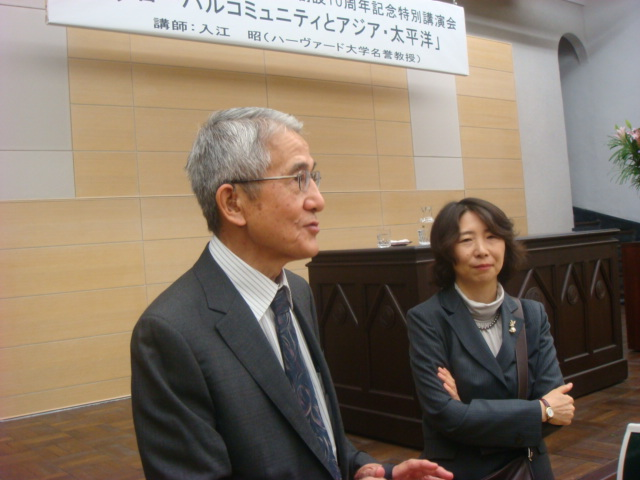
Photo: Dr. Iriye Akira and the author giving a lecture at Waseda University in 2008.
Photo provided by the author
Dr. Iriye Akira, Professor Emeritus at Harvard University, passed away on January 27, 2026. After graduating from high school, Dr. Iriye moved to the United States to study using a scholarship from the Grew Foundation (known as the Grew-Bancroft Foundation). Joseph Clark Grew (1880–1965), after whom the foundation was named, served as the US Ambassador to Japan before World War II and was known for his pro-Japanese stance. The path that Dr. Iriye walked throughout his life seems to overlap with the history of postwar US-Japan relations.
Dr. Iriye’s masterpiece on diplomatic history, Kyokuto Shin-chitsujo no Mosaku (originally published in English as After Imperialism: The Search for a New Order in the Far East, 1921–1931 in 1965), was a pioneering work of multi-archival research based on the collection and rigorous reading of primary sources in multiple languages. Furthermore, by exploring the policies of the relevant countries on an equal footing rather than focusing on the diplomacy of just a single nation, it was also acclaimed as a “History of Equidistant Diplomacy.” Being based in the United States, Dr. Iriye had strong connections with American researchers, which advanced joint research projects between Japanese and American historians. The representative example of this is likely the four-volume Nichibei-Kankei Shi [History of Japanese-American Relations] published between 1971 and 1972 (Hosoya Chihiro, Saito Makoto, Imai Seiichi, and Iriye Akira, eds., Nichibei-Kankei Shi: Kaisen ni Itaru Junen [History of Japanese-American Relations: The Decade Leading to War], 4 vols. Tokyo: Tokyo Daigaku Shuppankai, 1971–1972). In this publication, researchers from both countries contributed chapters on specific themes, such as the Ministry of Foreign Affairs and the Department of State, or public opinion. I believe that bringing together such a gathering of the finest contemporary American historians was largely due to Dr. Iriye’s personal network.
|
Dr. Iriye Akira After graduating from Seikei High School, he moved to the United States in 1953 as a Grew Scholar. In 1961, he completed his Ph.D. in History at Harvard University. Specialized in US diplomatic history and international relations history, he taught at the University of Chicago, Harvard University, and other institutions. His major publications include After Imperialism: The Search for a New Order in the Far East, 1921–1931, Nihon no Gaiko: Meiji Ishin kara Gendai made (Japanese Diplomacy: From the Meiji Restoration to the Present), Cultural Internationalism and World Order, and Global Community: The Role of International Organizations in the Making of the Contemporary World. |
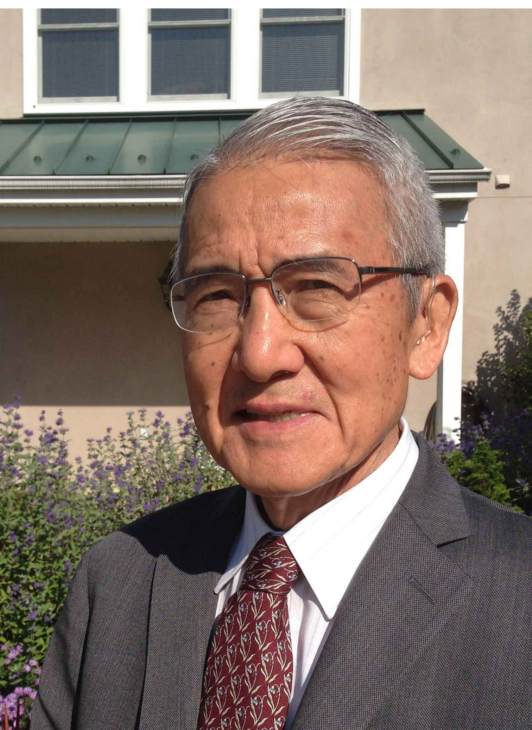 Photo provided by the doctor himself. |
Although Dr. Iriye began with diplomatic history, his research interests subsequently shifted toward a perspective that relativized the state. In Kenryoku Seiji o Koete (1997; Iriye Akira, Kenryoku Seiji o Koete: Bunka Kokusai Shugi to Sekai Chitsujo [Beyond Power Politics: Cultural Internationalism and World Order], trans. Shinohara Hatsue, Tokyo: Iwanami Shoten, 1998), he presented the concept of “cultural internationalism” and described the potential for culture to cross national borders and deepen mutual understanding. Global Community (2006) (Iriye Akira, Global Community: The Role of International Organizations in the Making of the Contemporary World. Berkeley: University of California Press, 2002) focused on the history of transnational activities through NGOs. Interestingly, this broadening of Dr. Iriye’s scope can be said to overlap with trends in international relations theory. In the 1970s, Robert Keohane and Joseph Nye drew attention to transnational actors, and current “Constructivism” emphasizes the role of culture and ideas. Whether as historians or international relations theorists, they directed their attention to phenomena that had been overlooked within international relations. Along with his deep insight as a historian, Dr. Iriye published research that shed light on facets that cannot be fully explained by great power politics.
Dr. Iriye’s research was highly acclaimed in the United States as well, and in 1988, he became the first person born in Asia to be appointed as president of the prestigious American Historical Association (AHA). In his presidential address, titled “The Internationalization of History,” he stated that it is vital to internationalize historical research without becoming confined to a state-centric view of history, noting, “To the extent that we seek to internationalize history, it would be unfortunate if our work merely nationalized it in the sense of stressing the uniqueness of each country’s historical development. Sometimes, it may be necessary to try to denationalize history in order to internationalize it, that is, to find themes and responses common to a plurality of nations rather than those limited to specific subcategories of humanity.” While an AHA presidential address draws the attention of all historians, Dr. Iriye later told me, “I sometimes woke up in the middle of the night wondering what kind of address I should give,” which made me realize that even a scholar of his stature could feel nervous.
As a doctoral advisor, Dr. Iriye was strict but always provided precise guidance. When I was brainstorming a topic for my doctoral dissertation, he advised me that because a vast body of research already existed regarding the Pacific War, it would be better to choose another topic. However, unable to give up on a research theme related to the “road to the Pacific War,” I approached him during our next advisory meeting and proposed, “Japanese and American international law scholars developed differing interpretations regarding the use of force, and I would like to write my dissertation with that as the main subject.” Dr. Iriye looked into space and pondered for a moment, and then replied clearly, “That topic has not been researched yet.” His single remark gave me the push I needed; I successfully completed my doctoral dissertation focusing on historical research into international law scholars, and when my single-authored English book based on that dissertation was published, Dr. Iriye was deeply delighted for me.
Dr. Iriye occasionally mentioned that people called him an optimist, but I have a feeling that he consciously took it upon himself to advocate for the importance of international cooperation. He anticipated that as globalization advanced, nationalism could rise as a backlash against it. Precisely for this reason, he kept warning against state-centric perspectives, emphasizing that attempts at international cooperation must never be allowed to die out. Even amidst the extreme chaos of the current international situation, his convictions would surely remain unchanged, and he would undoubtedly continue to preach the vital importance of maintaining dialogue that transcends national borders.
Articles by Dr. Irie Akira:
https://www.japanpolicyforum.jp/diplomacy/pt201505302300504966.html
https://www.japanpolicyforum.jp/diplomacy/pt201405240254404263.html
https://www.japanpolicyforum.jp/politics/pt20111005134322205.html
Translated from “Tsuito Iriye Akira Habado Daigaku Meiyokyoju: ‘Rekishi no Kokusaika’ni Idonda Hiroi Shiya to Rinen (In Memoriam: Dr. Iriye Akira, Professor Emeritus at Harvard University—The Broad Perspective and Ideals That Championed ‘The Internationalization of History’),” Gaiko (Diplomacy), Vol. 96 Mar. / Apr. 20256, pp. 142–143. (Courtesy of Jiji Press) [July 2026]
Keywords
- Dr. Iriye Akira
- diplomatic history
- Japan-US relations
- cultural internationalism
- internationalization of history
- international law
- scholars
Related posts:
 The Reality Revealed by China’s “War Preparations”: How Far Can the Three Security Documents Go?
 “A World with America” and “A World without America”
 Xi Jinping’s Regime: Political Dynamics of Personal Dictatorship
 Defending Japan’s Sovereignty in the AI Era: Leveraging Linguistic Uniqueness to Build Sovereign AI
 From Support to Participation: The Future of ASEAN-Japan Relations