


Why Did the “Shidehara Initiative Theory” Emerge? Historical Facts and “Myth” Surrounding Article 9 of the Japanese Constitution
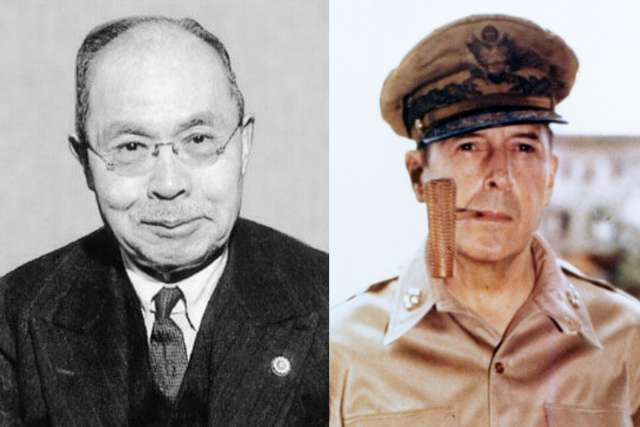
Who was the true initiator of Article 9? Shidehara Kijuro (left) and Douglas MacArthur (right). Despite the academic consensus pointing to MacArthur’s lead, why does the “Shidehara Initiative Theory” continue to resonate so strongly?
Source: Shidehara Kijuro and General Douglas MacArthur, both are in the public domain
The 80th anniversary of the Constitution’s promulgation and the Article 9 debate
The year 2026 marks the 80th anniversary of the promulgation of the Constitution of Japan. Every year on Constitution Memorial Day, May 3, rallies and symposia are held across the country, where advocates of preserving the existing Constitution (gokenha) and constitutional revisionists (kaikenha) engage in passionate debate over the Constitution of Japan, particularly Article 9.
Surprisingly, however, there is no sufficient consensus on who actually initiated Article 9. In fact, the current scholarship based on academic research understands that General Douglas MacArthur presented the original draft of Article 9. Nevertheless, looking at posts on social media and other platforms—and even among some scholars—there are an astonishing number of misunderstandings regarding the drafting process of Article 9. The “Shidehara Kijuro Initiative Theory” has become widely disseminated and remains deeply ingrained. This “Shidehara Initiative Theory,” which has transformed into something of a myth, can be considered a historical perception that still requires reexamination today.
On the other hand, as discussed below, it is also true that Shidehara played a crucial role in the acceptance of Article 9. Below, while introducing the current state and academic standard of historical research, I would like to examine the reasons why the “Shidehara Initiative Theory”—despite differing from historical fact—became so widely spread. On that basis, I intend to reconfirm what the surviving historical sources tell us and reflect on the issues lying between historical fact and “myth,” based on my book Shidehara Kijuro (Chuko Shinsho).
Who came up with Article 9?
The “Shidehara Initiative Theory” is not an argument advanced solely on media platforms such as social networking services; it is also supported by a segment of academic researchers.[1] The “Shidehara Initiative Theory” holds that Shidehara Kijuro[2], who was serving as Prime Minister at the time, introduced not only “pacifism”[3] and the “renunciation of war as an act of aggression” but also the “non-maintenance of war potential”[4] during his meetings with MacArthur on January 24, 1946, or February 21 of the same year, lobbying MacArthur and having these principles reflected in the text of Article 9. Conversely, the “MacArthur Initiative Theory” posits that MacArthur proposed the “non-maintenance of war potential” to Shidehara at the February 21 meeting, and that Shidehara reluctantly acquiesced.
While the issue becomes somewhat complex, there are points on which proponents of both the “Shidehara Initiative Theory” and the “MacArthur Initiative Theory” agree. Namely, that during the meeting on January 24, both figures reached an agreement, at the very least, on the preservation of the Imperial Institution and the importance of “pacifism”—that is, the “renunciation of war as an act of aggression.” Of course, this was not yet at a stage where such ideas were being drafted into constitutional provisions. This point is recorded in the respective memoirs of both Shidehara and MacArthur.[5]
What is crucial here is the distinction between the “renunciation of war as an act of aggression” and the “non-maintenance of war potential.” The renunciation of aggressive war refers to the principle that Japan would not repeat foreign expansion by force, as demonstrated in the Japanese invasion of Manchuria (1931–32) and the Second Sino-Japanese War (1937–45). There was no disagreement between Shidehara and MacArthur regarding the reflection on Japan’s external conduct following the Manchurian Incident and the necessity of preventing its recurrence.
However, when it comes to the “non-maintenance of war potential,” the conversation changes dramatically. The “non-maintenance of war potential” could lead to the denial of the right to exercise self-defense. Proponents of the “Shidehara Initiative Theory” claim that this was brought forward by Shidehara himself, whereas supporters of the “MacArthur Initiative Theory” contend that MacArthur presented it to Shidehara, who then accepted it.
The birth of the “Shidehara Initiative Theory”
As noted above, based on the current standards of academic research, it has become difficult to support the “Shidehara Initiative Theory.” Nevertheless, this theory has transformed into something of a “myth” and remains deeply believed by the general public. Why is this the case?
Here, I would like to introduce two main points relied upon as the “basis” for the “Shidehara Initiative Theory.” The first is the “Hirano Documents,” and the second is the respective memoirs of MacArthur and Shidehara.
The “Hirano Documents” refer to a report of an interview with Shidehara conducted by Hirano Saburo (1912–94), a member of the House of Representatives, titled “On the Circumstances Surrounding the Birth of the Renunciation of War Clause and Other Provisions as Heard from Mr. Shidehara — Recorded by Hirano Saburo.” According to Hirano, it is a document based on an interview he conducted in late February 1951, when he visited Shidehara, then Speaker of the House of Representatives, at his private residence in Okamoto-machi, Setagaya Ward (currently Okamoto 1-chome to 3-chome, Setagaya Ward). The document states: “This is something like the final conclusion I arrived at after long thought. […] Not possessing weapons is the single best guarantee for ending war.”
However, in recent research, serious doubts have been raised regarding the credibility of the “Hirano Documents,” and they are evaluated as being close to a forged or questionable document.[6] The current consensus in academic research holds that the document was a fabrication by Hirano. Yet, this plausibly written document continues to be stubbornly believed in some quarters as a valid piece of evidence.
A similar pattern of belief applies to the memoirs of Shidehara and MacArthur. In MacArthur’s memoir, he states: “The Prime Minister then suggested that when the new constitution was written there be included a so-called ‘no-war’ clause and a clause that at the same time would forbid Japan to maintain any military establishment whatever” (Reminiscences, 1964). Shidehara himself also recounted: “I do not know about others, but as far as I myself was concerned, deciding to include in the Constitution a provision never again to engage in such war for all time and to change our way of politics—that is, to renounce war, completely abolish armaments, and thoroughly adhere to democracy—stemmed from the conviction I mentioned earlier” (Gaiko Gojunen, 1951). The logic goes that because both principal parties involved consistently stated in their respective memoirs that Shidehara was the initiator, the accounts align and it must therefore be an indisputable fact.
In historical research, however, memoirs alone do not constitute definitive evidence to establish historical fact. What is crucial is whether or not they align with other historical sources produced during the same period.
What do the historical sources tell us?
Even though both MacArthur and Shidehara recount in their respective memoirs that Shidehara initiated the “non-maintenance of war potential,” when cross-referenced with numerous other contemporaneous historical sources, major question marks arise regarding their credibility. Let us introduce five representative examples of such historical sources.
The first is the so-called “MacArthur Three Principles.” These refer to the three essential items to be incorporated into the constitutional revision, reportedly formulated on February 2, 1946, between MacArthur and Courtney Whitney, Chief of the SCAP Government Section. The MacArthur Three Principles are also referred to as the “MacArthur Notes.” In Point II of these MacArthur Notes, the renunciation of war, which became the origin of Article 9, is articulated. It explicitly stated the renunciation of “war as an instrumentality for preserving its own security” and that “no army, navy, or air force will ever be authorized,” as follows:
“War as a sovereign right of the nation is abolished. Japan renounces it as an instrumentality for settling its disputes and even for preserving its own security. It relies upon the higher ideals which are now stirring the world for its defense and its protection.
“No Japanese Army, Navy, or Air Force will ever be authorized and no rights of belligerency will ever be conferred upon any Japanese force.”
These Three Principles were hastily drafted by GHQ. On the previous day, February 1, 1946, the secret deliberations within the Japanese government regarding constitutional revision were leaked in a scoop by the Mainichi shimbun. Alarmed by its excessively conservative contents, MacArthur listed the essential items required for Japan to transform into a democratic nation. These items were subsequently incorporated into the constitution draft prepared by GHQ (hereafter, the “GHQ Draft”), which was handed over to the Japanese side on February 13.
Meanwhile, Shidehara at this time was extremely reluctant about constitutional revision. Moreover, this stance had been consistent since the initial formation of his cabinet in October 1945. The second historical source demonstrating this point is The Kido Koichi Diary.[7] On October 9, the day his cabinet was formed, Shidehara exchanged views on the issue of constitutional revision with Kido Koichi (1889–1977). Shidehara was extremely hesitant regarding constitutional amendment. In The Kido Koichi Diary (Vol. 2), the following account appears:
I consulted with Baron Shidehara regarding the issue of constitutional revision. The Baron was extremely passive regarding this issue, arguing that the objective could be achieved depending on how it was operationalized. I shared the Baron’s view on this point, but observed that the United States would not be satisfied with that explanation, and because the U.S. possessed the political intention to liberalize Japan’s constitution by its own hands, Japan would ultimately be forced to revise it. The Baron replied that Japan could not offer armed resistance, and in that event, Japan had no choice but to record its position and submit.
Thus, Shidehara believed that operating the old Meiji Constitution[8] appropriately would suffice. He had not conceived of the “non-maintenance of war potential” in the slightest.[9]
Third, I would like to cite the diary of William Macmahon Ball (1901–1986), the Australian representative for the British Commonwealth on the Allied Council for Japan (ACJ). Although the exact date is unclear, according to his entry, Shidehara asked MacArthur, “What kind of armed forces would Japan be permitted to maintain?” to which MacArthur replied, “None.” Shidehara then pressed for confirmation, asking, “Does that mean the renunciation of war?” This exchange likely took place during their meeting on February 21. Had Shidehara been the true initiator of Article 9, such an exchange could not possibly have taken place.
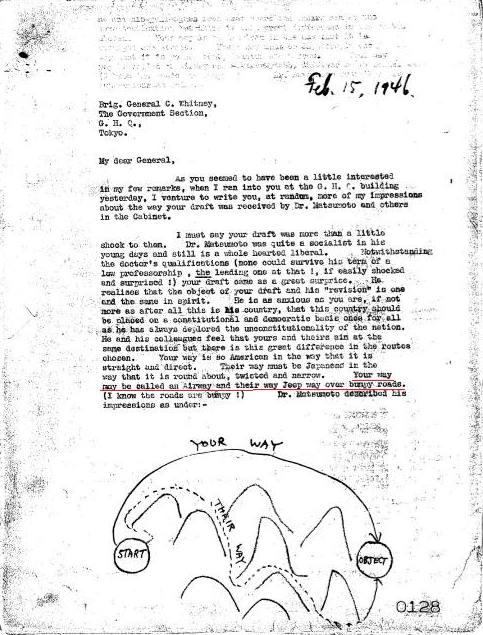
Source: “(no title) / Partition 1” JACAR (Japan Center for Asian Historical Records) Ref. B17070081300, A matter related to the revision of Imperial Constitution / Constitutional amendment draft outline (A’.3.0.0.2-1) (Diplomatic Archives of the Ministry of Foreign Affairs), image 76
Fourth, the so-called “Jeep Way Letter” can be cited. The “Jeep Way Letter” refers to a letter regarding the Japanese side’s constitutional revision that Shidehara dispatched Shirasu Jiro (1902–85), Counselor of the Central Liaison Office, to deliver to GHQ on February 15, 1946. As noted above, the Japanese side had been handed the GHQ Draft two days earlier, on February 13. However, a select few including Shidehara believed they could push back against GHQ. Hence, they sent this letter. Incidentally, the only five people who knew about the GHQ Draft at this point were Foreign Minister Yoshida Shigeru (1878–1967), Minister of State Matsumoto Joji (1877–1954; in charge of the Committee to Study Constitutional Problems), Shirasu Jiro, and an interpreter—all four of whom had attended the meeting with GHQ on February 13—along with Shidehara. For six days until the Cabinet meeting on February 19, Shidehara kept this matter completely secret among these five individuals, without even reporting it to Emperor Showa.
The designation “Jeep Way Letter” derives from a clever metaphor employed by Shirasu. In this letter, Shirasu explained that while GHQ’s path toward constitutional revision (YOUR WAY) was a direct “airway” (flying straight to the goal by airplane), the Japanese side’s path (THEIR WAY) was a winding “Jeep Way” (bypassing obstacles by car), illustrating his explanation with a hand-drawn diagram. Embedded in this was the hope that since both sides shared the same objective and differed only in their mode of arrival, GHQ should respect the Japanese approach and give consideration to the Japanese draft.
In short, the intent was to navigate through the situation by modifying the so-called “Matsumoto Draft” (discussed below). From a present-day perspective, this was an excessively optimistic view, but at the time, the government did not comprehend the gravity of the situation. This was precisely why they issued the “Jeep Way Letter.” Among the five individuals mentioned earlier, Shidehara was the only one who could have made the decision to issue it.
In the first place, Shidehara was in favor of preserving the military. One week prior to sending Shirasu with this letter, on February 8, when Matsumoto Joji, Chairman of the Committee to Study Constitutional Problems, submitted the “Outline of Constitutional Revision” (commonly known as the “Matsumoto Draft”) to GHQ accompanied by two explanatory notes, one of those notes titled “Regarding Changes to the Provisions in the Constitution Concerning the Army and Navy” explicitly specified the existence of the military. Shidehara had supported this as well.
However, Shidehara was swiftly forced to realize the naivety of his own thinking. Upon receiving the “Jeep Way Letter,” Whitney, far from showing interest, was profoundly enraged and summoned Shirasu to berate him furiously. Whitney confronted Shirasu with an ultimatum: respond within 48 hours (by Wednesday afternoon, February 20), or GHQ would make its own announcement. This occurred at 3:30 PM on February 18. Driven into a corner, Shidehara convened a Cabinet meeting the following day, February 19.
The atmosphere of that moment is vividly captured in the fifth historical source, Ashida Hitoshi Nikki (The Diary of Ashida Hitoshi) (Vol. 1).[10] Describing the Cabinet meeting on February 19, where Shidehara presented the constitutional draft proposed by GHQ, the entry notes: “Minister of Home Affairs Mitsuchi Chuzo (1871–1948) and Minister of Justice Iwata Chuzo (1875–1966), agreeing with the Prime Minister’s opinion, stated, ‘We cannot accept this [the GHQ constitutional draft],’ and Minister of State Matsumoto appeared exceedingly agitated.” According to this account, Shidehara was opposed to accepting the GHQ draft that renounced war.
Beyond these, there are numerous other powerful historical sources, including the series of GHQ documents (the State-War-Navy Coordinating Committee, or SWNCC documents), memoirs and personal accounts of GHQ Government Section officials, the “notebook version” of the “Hamuro Memorandum” (notes later written down by Hamuro Michiko at the request of her father, Odaira Komatsuchi, recording what Shidehara had told him), and Kobayashi Ichizo Nikki (The Diary of Kobayashi Ichizo),[11] which corroborates the accuracy of Ashida Hitoshi Nikki. Among researchers supporting the “Shidehara Initiative Theory,” there are those who refuse to acknowledge these sources by claiming they lack foundation, stem from misremembering by the parties involved, or suffer from a lack of credibility, while simply ignoring them or avoiding mention of them altogether. At the same time, they ignore major research findings indicating that the “Hirano Documents” are likely a forged or questionable document, insisting instead that they are trustworthy. Such an attitude is difficult to accept.
The “masterful performance” of the “veteran actor” Shidehara
There is another critical argument that cannot be overlooked. Namely, that while Shidehara placed the utmost importance on preserving the Imperial Institution, he had been unable to conceive the concept of the Emperor as a symbol.
After the Mainichi shimbun scooped the constitutional revision draft under consideration within the government on February 1, 1946, Shidehara met with Takano Iwasaburo (1871–1949), Director of the Ohara Institute for Social Research and his classmate from Tokyo Imperial University, and engaged in the following exchange. Takano, directly asserting that the “Matsumoto Draft” was unacceptable, pressed Shidehara by asking whether having the Emperor engage solely in state ceremonies, rather than retaining sovereign powers,[12] would actually be more conducive to the stability of the Imperial House. In response to Takano’s statement, Shidehara expressed his view that retaining part of the Emperor’s political authority was necessary, remarking, “Having only state ceremonies would indeed be problematic” (Minutes of the 21st Meeting of the Subcommittee on the Process of Enacting the Constitution). Shidehara also remarked that “[to confine His Majesty to] state ceremonies would be presumptuous” (ibid.). It can be said that Shidehara was cautious about—and fearful of—stripping away the sovereign powers of the Emperor. This fact demonstrates that as of early February 1946, Shidehara had not conceived of the Emperor as a symbol.
In fact, this point is closely connected to Shidehara’s inability to conceive the “non-maintenance of war potential.” His insistence on the “maintenance of war potential” was not unrelated to his assumption of the Emperor as the “head of state” and his inability to envision the Emperor as a “symbol.” If the “non-maintenance of war potential” were incorporated into the Constitution, the right of self-defense as state sovereignty could also be denied. Should that vulnerability be exploited and the nation attacked or invaded, the political responsibility of the Emperor as “head of state” would become inescapable. For Shidehara, who could not conceive the Emperor as a symbol and could not shed the image of the Emperor as “head of state,” advocating for the “non-maintenance of war potential”—which would impose political responsibility upon the Emperor—was fundamentally impossible in principle. (See figure.)
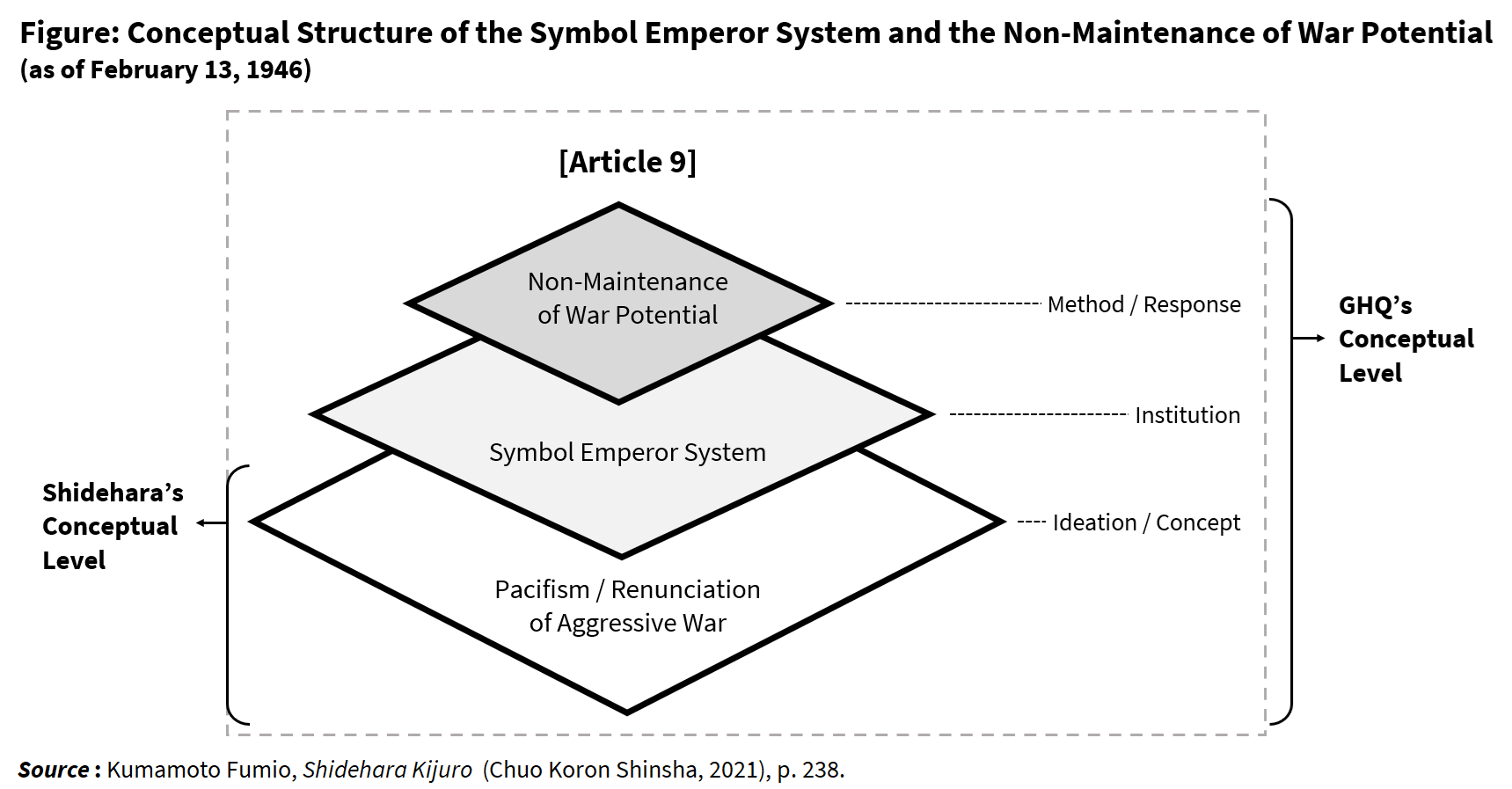
While carefully reading historical sources is naturally important, even more crucial is accurately grasping the structural nature of such underlying thought. It is from this approach that rational and highly probable interpretations can be derived.
In short, as of January 24, 1946, Shidehara—who, while agreeing with the ideals of “pacifism”—understood here as the renunciation of aggressive war—had not yet extended his thinking to codifying the “non-maintenance of war potential” into constitutional text—was brought to realize MacArthur’s true intentions through the “GHQ Draft” presented to the Japanese side on February 13. It seems reasonable to conclude that Shidehara came to understand MacArthur’s true intentions through the GHQ Draft presented to the Japanese side on February13 and, at their meeting on February 21, agreed to incorporate the provision into the Constitution after MacArthur suggested that Shidehara, rather than MacArthur himself, should be regarded as its initiator. As MacArthur had long been concerned, the new constitution had to stem strictly from the free will of the Japanese people and must never originate from GHQ. This was a point with which Shidehara also deeply concurred.
Thus, as of February 21, Shidehara formed the resolve to act as the “initiator” of Article 9. Looking at Shidehara’s words and actions thereafter, it can be considered that he accepted playing the role of the “initiator.” This is nothing other than evidence supporting the “MacArthur Initiative Theory,” which holds that Shidehara’s acceptance of the “non-maintenance of war potential” proceeded under MacArthur’s lead.
In this way, Shidehara had been unable to conceive of either the symbol Emperor system or the “non-maintenance of war potential” until he encountered the “GHQ Draft.” Nevertheless, this does not imply inaction on Shidehara’s part. To be sure, precisely because it contradicted his own initial constitutional vision and convictions, accepting it may have been accompanied by hesitation. However, Shidehara—who placed the highest priority on preserving the Imperial Institution and kept his sight on the nation’s future—formed the resolve to perform as the “initiator” of Article 9. That “performance” became possible only when, pressed by the necessity to unite the domestic political front, he made the firm resolution to shoulder the nation’s destiny. It was a “masterful performance” by the “veteran actor” Shidehara. Shidehara’s greatest achievement lay in fully demonstrating his political fortitude in this scene and resolving to present himself as the “initiator.”
For this reason, Shidehara had no choice in his memoir Gaiko Gojunen (1951) but to state that he himself was the “initiator” of Article 9. MacArthur’s Reminiscences was published in 1964—a full 13 years after Shidehara had passed away and Gaiko Gojunen was published. As an American, MacArthur could hardly publicly declare that he himself had drafted Japan’s constitutional proposal, particularly a provision that could lead to the denial of the right of self-defense. While there remains room for further examination regarding why MacArthur recounted it as such, it is natural to think that he needed to align his account with Shidehara’s recollections. Thus, in the memoirs of both men, the initiator of Article 9 came to be consistently recorded as Shidehara. As a result, the memoirs of both figures acted to reinforce the “Shidehara Initiative Theory.”
The merits and demerits of the “myth”: Beyond the debate over the initiator
The “Shidehara Initiative Theory” was welcomed in the process of postwar Japan reentering the international community, serving to showcase both domestically and internationally its reborn image as a nation of peace. At that time, a narrative was required claiming that the Japanese people had independently pursued “pacifism” and the “renunciation of war and non-maintenance of war potential.” The “Shidehara Initiative Theory” had to be narrated as a “myth” transcending a mere story.
However, eighty years have passed since the end of the war, and the international environment surrounding Japan has altered drastically. Authoritarian states such as China and North Korea are flexing their power. It is an era in which major powers like Russia and the United States openly display national egoism, champion “country first” policies, and initiate wars against other nations. Updating defense concepts and structures for a new era is an urgent task, and strengthening defense capability has garnered a certain degree of public support.
On the other hand, when arguments for constitutional revision are voiced from this trend, it is only natural that advocates of preserving the existing Constitution feel a sense of crisis. For it is also a truth and a lesson of history that expanding military power provokes external tensions and conflict.
Nevertheless, one should be cautious about hastily linking the issue of constitutional revision with the debate over the initiator of Article 9. Among researchers supporting the “Shidehara Initiative Theory,” there are those who write their works driven by a sense of mission (?) that one must uphold the “Shidehara Initiative Theory” in order to oppose constitutional revision.[13] I do not reject the free expression of their principles and ideas. However, starting from such political interests or viewpoints does not justify engaging in arbitrary and self-righteous critical evaluation of historical sources or their interpretation to legitimize one’s own assertions. This reverses the proper order of historical reasoning and is a practice historians should reject. Regardless of who the initiator was, if one believes the current “Peace Constitution” is important, one should simply advocate for protecting the Constitution. What is crucial is to position the Constitution within the context of changing international society and environments, the accurate grasping and interpretation of historical facts, and the lessons derived therefrom, thereby invigorating the debate.
Translated from “Naze ‘Shidehara Hatsuan-setsu’ wa Umaretanoka: Kenpo Dai Kyu-jo wo Meguru Shijitsu to (Why Did the “Shidehara Initiative Theory” Emerge? Historical Facts and “Myth” Surrounding Article 9 of the Japanese Constitution),” Chuokoron, September 2026, pp. 46–55 (Courtesy of Chuo Koron Shinsha) [October 2026]

KUMAMOTO Fumio, Ph.D.
Professor, Faculty of Letters, Komazawa University
Born in 1970, Yamaguchi Prefecture. He holds his Ph.D. in Literature from the University of Tsukuba. Specialized in the diplomatic history of Japan and the study of historical sources, he previously served at the Diplomatic Archives of the Ministry of Foreign Affairs of Japan. His major publications include Taisenkanki no Tai-Chugoku Bunkagaiko (Cultural diplomacy toward China in the interwar period), Kindai Nihon no Gaiko Shiryo o Yomu (Reading diplomatic documents of modern Japan), Shidehara Kijuro (Shidehara Kijuro) and Gaimu Kanryotachi no Daitoakyoeiken (Foreign ministry bureaucrats and the greater East Asia co-prosperity sphere), which received the Kashiyama Junzo Award, the Shiba Ryotaro Award, and the Osaragi Jiro Forum Award.
[1] Representative works by prominent scholars taking the position of the “Shidehara Initiative Theory” include Kasahara Tokushi (1944–), Kenpo Kyujo to Shidehara Kijuro: Nihonkoku Kenpo no Genten no Kaimei [Article 9 of the Constitution and Shidehara Kijuro: Clarifying the Origins of the Constitution of Japan] (Otsuki Shoten, 2020), and Kasahara Tokushi, Kenpo Kyujo Ronso: Shidehara Kijuro Hatsuan no Shomei [The Article 9 Debate: Proof of Shidehara Kijuro’s Initiative] (Heibonsha Shinsho, 2023). While multiple empirical and fundamental critiques have been leveled against Kasahara’s work, he has maintained silence in response. As introducing this controversy is not the purpose of this article, interested readers are referred to the four analytical studies listed in footnote 6.
[2] Shidehara Kijuro (1872–1951) was a Japanese politician and diplomat who served as the 44th Prime Minister of Japan (October 1945–May 1946), the 38th and 40th Minister for Foreign Affairs, and the 40th Speaker of the House of Representatives.
[3] In this article, “pacifism” refers to the rejection of aggressive war. It is distinguished from the separate commitment to the non-maintenance of war potential.
[4] In the MacArthur Three Principles (the MacArthur Notes) referenced below, this was expressed as “No Japanese Army, Navy, or Air Force will ever be authorized.”
[5] Shidehara Kijuro’s memoir is Gaiko Gojunen [Fifty Years of Diplomacy] (1951); Douglas MacArthur’s memoir is Reminiscences (1964).
[6] Sugitani Naoya, book review of Kasahara Tokushi, Kenpo Kyujo to Shidehara Kijuro: Nihonkoku Kenpo no Genten no Kaimei [Article 9 of the Constitution and Shidehara Kijuro: Clarifying the Origins of the Constitution of Japan] (Otsuki Shoten, 2020), in Dorekiken Nenpo, No. 22 (2021); Sugitani Naoya, book review of Kasahara Tokushi, Kenpo Kyujo Ronso: Shidehara Kijuro Hatsuan no Shomei [The Article 9 Debate: Proof of Shidehara Kijuro’s Initiative] (Heibonsha, 2023), in Dorekiken Nenpo, No. 24 (2023); Nakamura Katsuaki, “Kenpo Dai Kyujo = Shidehara Hatsuan-setsu no Saiko” [Reconsidering the Theory That Article 9 of the Constitution Was Initiated by Shidehara], Kanto Gakuin Daigaku Jinbun Gakkai Kiyo, No. 146 (2022); Taneine Shuji, “Kenpo Kyujo Shidehara Hatsuan-setsu no Sai-hitei to ‘Hirano Bunsho’ no Kensho” [A Further Rejection of the Theory That Article 9 of the Constitution Was Initiated by Shidehara and an Examination of the “Hirano Documents”], Kokugakuin Daigaku Kiyo, Vol. 62 (2024). All three scholars offer extremely severe critiques of Kasahara’s arguments.
[7] A historical source in which Showa-era politician Kido Koichi detailed key phases from the Second Sino-Japanese War through the Pacific War and its aftermath (early Showa period through the postwar era).
[8] The Meiji Constitution (Constitution of the Empire of Japan) was modeled after the German (Prussian) Constitution. Promulgated on February 11, 1889, it was in force from November 29, 1890, to May 2, 1947, as Japan’s first modern constitution.
[9] A similar description can also be confirmed in Ashida Hitoshi Nikki [The Diary of Ashida Hitoshi]. Although Minister of State Matsumoto Joji made remarks regarding constitutional revision during the Cabinet meeting on the morning of October 10, Shidehara stated that “even without revising the Constitution, it can be operated in any manner depending on interpretation” (Ashida Hitoshi Nikki, Vol. 1).
[10] Ashida Hitoshi Nikki (The Diary of Ashida Hitoshi) is a published collection of detailed diaries kept from 1905 until shortly before his death in 1959 by Ashida Hitoshi (1887–1959), a prewar diplomat who served as the 47th Prime Minister of Japan.
[11] Diary materials of Kobayashi Ichizo (1873–1957), an entrepreneur and politician who founded Hankyu Railway and the Takarazuka Revues, and served as a cabinet minister before and after the war (Minister of Commerce and Industry, and Minister of State and President of the War Damage Reconstruction Board in the cabinet of Shidehara Kijuro).
[12] Here, the Emperor’s prerogatives refer to the political, military and diplomatic powers vested in him under the Meiji Constitution.
[13] Kasahara, Kenpo Kyujo Ronso, cited above, pp. 397–443; interview article with Kasahara in the Yamanashi regional edition of the Asahi shimbun, May 3, 2021.
Keywords
- Constitution of Japan
- Article 9
- General Douglas MacArthur
- Shidehara Kijuro
- pacifism
- renunciation of war
- Hirano Documents
Related posts:
 New Class Society, Transformation of Hardcore Conservative Base
 “Reforms in the Reiwa Era” in the Age of Populism: The Option of a Multi-Member District System with Proportional Representation
 Reading the Energy Crisis Through Volume, Price, and Environment: Lessons from Fifty Years of Ordeals for “Resource-Poor Country” Japan
 How the “Free and Open Indo-Pacific” Has Evolved: The New Scope of “FOIP 3.0”
 The Strategic Logic of “Autonomy” in Asian Decarbonization: What Should Japan Connect?