


Inside the Hashimoto Administrative Reform Council: New Documents Reveal the Inner Workings 30 Years On
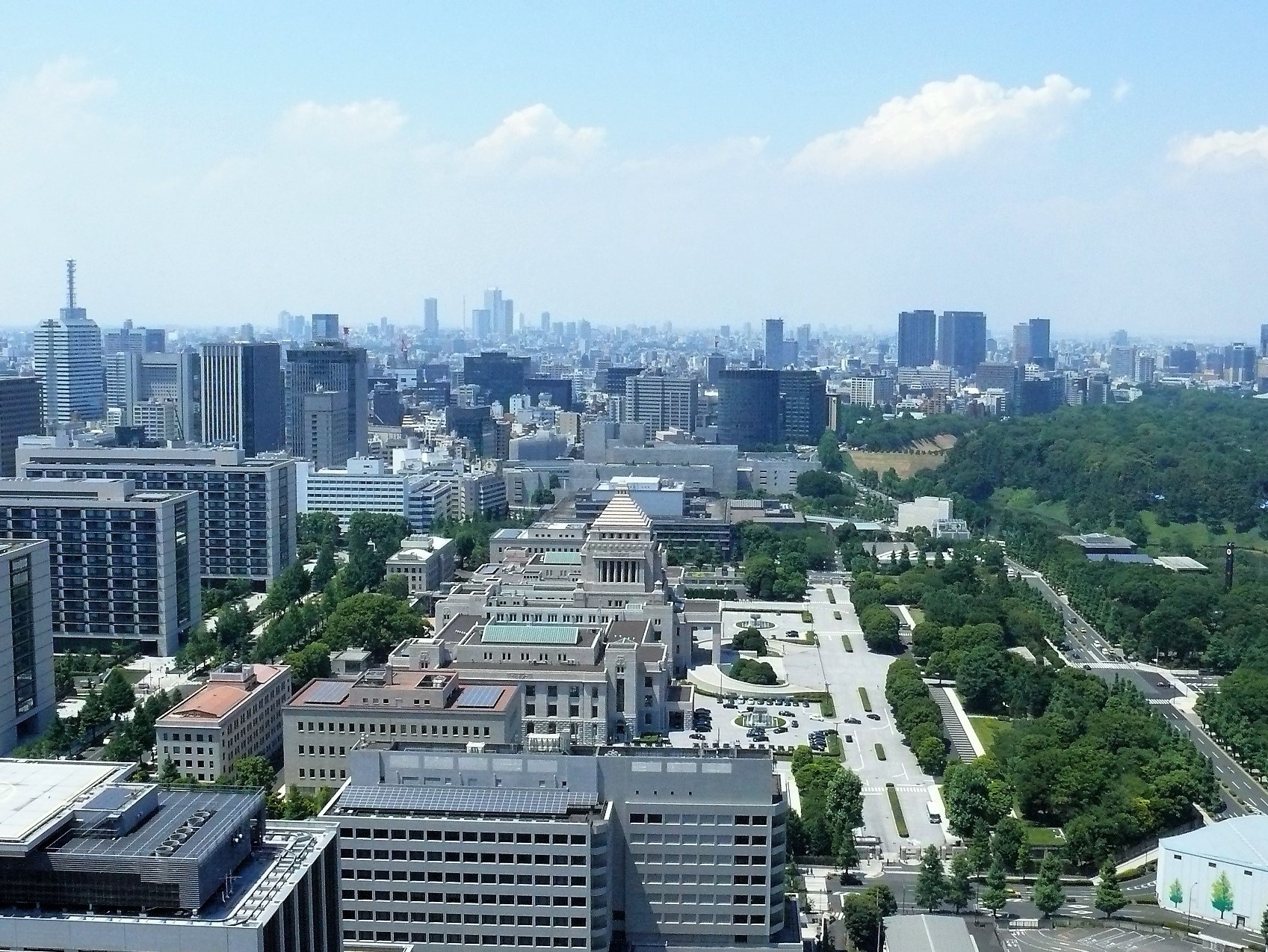
The Administrative Reform Council (ARC), established directly under Prime Minister Hashimoto Ryutaro in November 1996, submitted its final report in December 1997. Based on these recommendations, the cabinet submitted the bill to the 142nd ordinary session of the Diet on February 17, 1998, leading to the enactment of the Basic Law on Central Government Reform in June of that year. Grounded in this legislation, the central bureaucracy was reorganized on January 6, 2001, from one office and twenty-two ministries into one office and twelve ministries, successfully strengthening executive functions.
Photo: Japan Policy Forum
This year, 2026, marks a major quarter-century milestone since the 2001 reorganization of Japan’s central government. It is also precisely thirty years since 1996, when the Administrative Reform Council (ARC)[1] was launched, setting that transformation in motion.
The ARC was an extraordinary council chaired directly by then Prime Minister Hashimoto Ryutaro (1937–2006). Deliberately excluding former bureaucrats, it comprised thirteen appointed private-sector members who conducted forty-five full sessions between November 1996 and June 1998. Most notable were two separate four-day intensive deliberation sessions held in mid-August and late November 1997, which received daily media coverage. Through these heated debates, a major overhaul of Japan’s administrative architecture began to take shape.
The core principle articulated by Chairman Hashimoto was “from the public to the private sector.” Against the backdrop of the Heisei Recession[2] and rapid globalization, the council sought to conduct a fundamental, root-and-branch review of the administrative framework that had formed the backbone of postwar Japan, boldly downsizing the central bureaucracy. Its signature achievements included slashing the administrative apparatus in half—from one cabinet office and twenty-two ministries to one cabinet office and twelve ministries—and establishing Incorporated Administrative Agencies to outsource operational functions.
Many of the issues addressed by the council resurfaced as key points of contention in the political history of the Heisei period. A prominent example was the privatization of the three postal services[3]—enacted in 2005 under the Koizumi Junichiro administration—which provoked intense debate within the ARC. Similarly, the upgrading of the Defense Agency to the Ministry of Defense, realized in 2007, deeply divided council members and was deferred at the time. Demands to bolster executive functions through improved crisis management and intelligence-gathering capabilities also emerged during this period, establishing the origin line for the creation of the National Security Secretariat (NSS) in 2014 and the establishment of the National Intelligence Bureau (NIB) this year.
With the reorganization of the central government in January 2001, the Hashimoto administrative reforms literally stood at the threshold of the twenty-first century, fundamental to shaping the “form of this country” over the subsequent quarter-century.
The unknown reality of the Council
Yet thirty years on, how deeply do we truly understand the reality behind a council that exerted such profound influence? Whenever I speak with officials working in Kasumigaseki[4] or with members of organizations transformed into Incorporated Administrative Agencies during the 2000s, I almost invariably hear discussions regarding the merits and demerits of the Hashimoto administrative reforms. On the other hand, surprisingly few works document in granular detail how the reforms actually unfolded and what specific arguments were exchanged within the ARC. The current state of discourse surrounding the Hashimoto administrative reforms thirty years later appears defined by a deep gap between the administrative officials’ lived experience of these outcomes and the general public’s understanding of the process.
The primary reason for this divide lies in the state of historical documentation surrounding the Hashimoto administrative reforms—specifically, the fact that the council’s verbatim minutes have remained unpublished for the past thirty years.
In reality, to secure public support, the secretary-general held a press conference following each session. Furthermore, summary minutes and meeting handouts prepared by the secretariat were routinely uploaded to the internet, which was still a novelty at the time. Nevertheless, to allow members to engage in “broad, free, and vigorous debate from a fair and neutral standpoint,” the proceedings themselves were held behind closed doors. Draft transcriptions were prepared by the secretariat after each session, but they were kept classified as sensitive, restricted materials.
To be sure, the thirteen private-sector members were subject to a continuous barrage of petitions, briefings, protests, and pressure from the countless stakeholders affected by administrative reform. Under such circumstances, publishing full transcripts immediately after every meeting would have severely constrained candid deliberation among members. At the time, the rationale for keeping the proceedings confidential was entirely sound.
However, nearly thirty years have passed without even the draft transcripts coming to light. This has rendered a detailed tracking of the council’s deliberations impossible, posing a formidable obstacle to historical analysis of the ARC.
For a democratic nation, an inability to reconstruct the debates of a council that wielded such a powerful axe remains deeply problematic. When a body deals with matters of an intensely political nature, its historical record demands multi-layered scrutiny. Considering that even the disclosure guidelines for highly sensitive diplomatic documents operate on a thirty-year rule, the thirty-year mark since the Hashimoto administrative reforms serves as an appropriate benchmark for making these historical records public.
The significance of the “Fujita Tokiyasu materials”
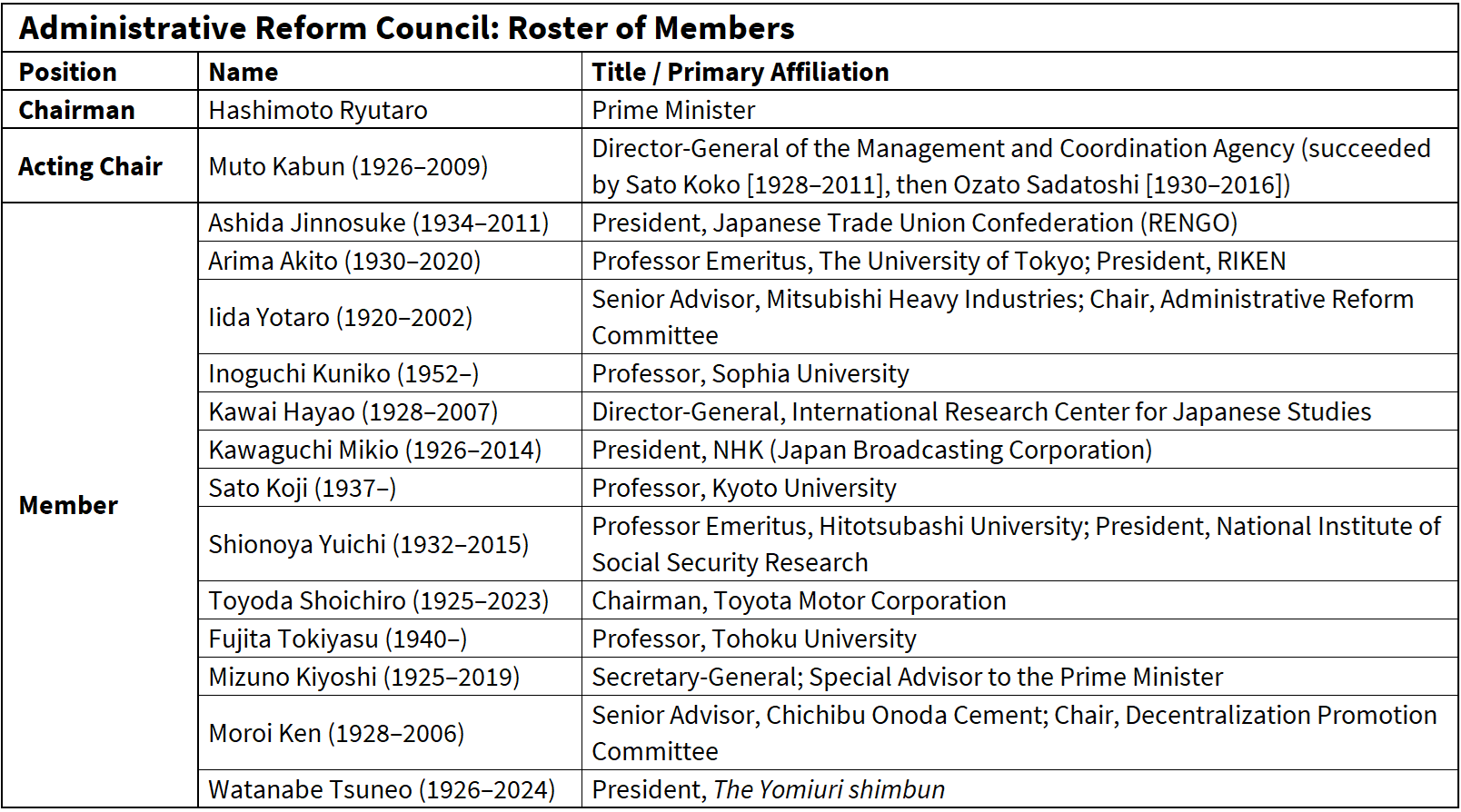
The scholar who participated in the ARC as a member and drafted the grand design for the central government reorganization was Fujita Tokiyasu (1940–), then professor at Tohoku University specializing in administrative law. Operating under a grueling timeline that required a final report within a year of the council’s establishment, two subcommittees were launched within the ARC in July 1997: the Subcommittee on Planning and Systems, tasked with discussing the philosophy of administrative reform, executive functions, and the civil service system; and the Subcommittee on Organizational Issues, assigned to deliberate the structure and composition of the new central ministries. Sato Koji (1937–), then professor at Kyoto University specializing in constitutional law, served as chair of the former, more conceptual subcommittee, while Fujita took charge of the latter, which was responsible for mapping out the concrete vision for reform.
Acutely aware that scholars participating in advisory councils would eventually stand in the courtroom of historical scrutiny, Fujita meticulously preserved a complete set of documents from the ARC and the Advisory Council for the Headquarters for the Promotion of Administrative Reform of Central Government Ministries and Agencies, established during the subsequent legislative process. Upon his appointment as a Justice of the Supreme Court in 2002, Fujita donated these materials en masse to the Research Center for Political and Legal Materials at the Graduate School of Law, Tohoku University. Following years of archival processing, they were released at the end of last year, 2025, by Maruzen-Yushodo Co., Ltd. as the Onrain-ban Fujita Tokiyasu Kyuzo Hashimoto Gyokaku Shiryo (Online edition: Documents on the Hashimoto Administrative Reform formerly possessed by Fujita Tokiyasu).
This digital collection, primarily targeted at research institutions, grants subscribing institutions unlimited access to the archived holdings. It comprehensively covers not only draft minutes and meeting handouts from all full sessions and subcommittees, but also internal briefing documents used in pre- and post-session meetings. Explanatory materials provided by government agencies—designed either to promote or obstruct administrative reform—were also systematically preserved.
By deciphering these records, the inner details of a deliberative process long shrouded in mystery will finally be brought to light before our eyes.
The heavy burden borne by scholar-members
The administration led by Hashimoto Ryutaro, which launched in January 1996 as a three-party coalition comprising the Liberal Democratic Party (LDP), the Social Democratic Party of Japan (SDPJ),[5] and New Party Sakigake (NPS), faced the 41st House of Representatives election on October 20 of that year. In this election—the first conducted under the Parallel Voting System of Single-Member Districts and Proportional Representation,[6] a centerpiece of political reform—the LDP emerged victorious, gaining twenty-eight seats to reach a total of 239. With the Social Democratic Party (SDP) and NPS (both having lost seats) agreeing to cooperate from outside the cabinet, the second Hashimoto cabinet was inaugurated on November 7. Administrative reform, including halving the number of central ministries, had been a core campaign pledge in the lower house election, and ARC deliberations commenced just three weeks later, on November 28.
Following an introductory first session, discussions heated up rapidly at the second meeting on December 19, 1996. Faced with a procedural proposal from the secretariat to focus the early stages on hearings with experts, a series of members argued that, given the tight schedule requiring a finalized proposal within a single year, the council should immediately tackle concrete plans for ministry reorganization. Member Watanabe Tsuneo (then president of The Yomiuri shimbun) voiced a harsh assessment after the meeting, stating that lectures resembling general university coursework were unnecessary. Chairman Hashimoto himself was absent that day, having been consumed since the previous evening by his response to the assault and hostage crisis at the Japanese ambassador’s residence in Peru by leftist guerrillas.[7] Fujita, meanwhile, had to leave the session early to give a lecture at Tohoku University.
Friction also erupted around the time of the third session on January 16, 1997. On the previous day, a front-page article in the morning edition of The Yomiuri shimbun reported that converting national universities into private institutions and privatizing the three postal services were listed among the ARC’s agenda items. Because privatizing national universities was an issue that had barely been discussed, Fujita found the report impossible to overlook and visited Secretary-General Mizuno Kiyoshi prior to the meeting to lodge a strong protest.
Behind the leisurely pace of the early proceedings lay a “deeply calculated timetable” designed by the secretariat. Commencing concrete debates on ministry reorganization while the Diet was in session risked plunging the process into uncontrollable chaos. The secretariat—staffed by handpicked elites from various ministries and private corporations—had devised a meticulous timetable that accounted for the political landscape within both the Diet and the LDP: buying time with hearings until the Diet adjourned, then pushing through a draft all at once during intensive deliberations starting in the summer. Moreover, because a general election had taken place the previous year in 1996, many Diet members were slated to travel abroad during that summer.
For this very reason, as summer approached, the council encountered friction. With the urgent need to rapidly synthesize concrete proposals for ministry restructuring, suspicions arose that the secretariat was unnecessarily manipulating the direction of discussions. At one point during a session, the heavily burdened Chairman Hashimoto admonished the secretariat when its role appeared overly dominant.
Thus, the roles of Subcommittee Chairs Fujita Tokiyasu and Sato Koji underwent a dramatic expansion. The overwhelming burden of crafting a working draft for administrative reform—in an area where accumulated academic knowledge was far from sufficient, while simultaneously shutting out political interference and deflecting bureaucratic resistance—suddenly fell upon the shoulders of the scholar-members under an extremely tight deadline.
Raw Fax Communications
According to one theory, Tohoku University’s Fujita Tokiyasu was selected as the key coordinator partly with the intention of maintaining a physical distance from Tokyo.
Administrative reform invariably inspires the sentiment “support in principle, opposition in detail,” making fierce pushback from ministries facing a reduction in their authority easily predictable. Scholars based in Tokyo would be directly subject to such lobbying efforts. Located in Sendai, Miyagi Prefecture—approximately two hours from Tokyo on the Tohoku Shinkansen Yamabiko service—the setting offered a buffer against such intense petitioning campaigns. Even so, as inquiries began flooding in to his family in Sendai, Fujita retreated into “hiding” elsewhere to quietly forge the blueprints for ministry reorganization.
A daily stream of faxes arrived at Fujita’s desk from various quarters. In an era preceding the widespread adoption of mobile phones and email, these faxes originating from Kasumigaseki detailed sensitive, highly confidential information regarding the council’s delicate proceedings. Had Fujita resided in Tokyo, these communications would likely have been delivered verbally and lost to the historical record forever.
In preparation for the ARC’s intensive deliberations starting on August 18, 1997, each member submitted their opinion paper on the reorganization of government ministries and agencies by August 8. After receiving these submissions from the secretariat and reading through them in their entirety, Fujita submitted his own “Chair’s Draft Proposal” on August 13. However, on the evening of August 14, The Yomiuri shimbun and the Nihon Keizai shimbun (currently the Nikkei) both published articles revealing the details of this strictly confidential proposal. On the morning of August 15, Fujita sent a fax to the secretariat stating, “I have received information that several members are expressing dissatisfaction, feeling that their opinions have been completely ignored and that Fujita is acting unilaterally.” Around the same time, member Watanabe Tsuneo circulated a statement to all council members criticizing the “Chair’s Draft Proposal”—arguing, among other things, that the Defense Agency should be upgraded to a “Ministry of Defense”—and asserting that if Fujita intended to lead the council by promoting his own views despite serving as subcommittee chair, he should resign from that position and speak merely as a standard member. Reading this, a secretariat staff member immediately sent a fax to Fujita expressing deep empathy: “I can well imagine how deeply aggrieved you must feel.”
The raw, unfiltered nature of these exchanges emerged precisely because they transpired over long-distance fax communications—a fortunate circumstance for historical research.
Late-night negotiations with the LDP
Following four days of intensive summer deliberations, the council published its “Interim Report” on September 3. Outlining a concrete plan for one cabinet office and twelve ministries, the report put forward bold policy directions, including separating the financial sector from the Ministry of Finance[8] and splitting both the Ministry of Posts and Telecommunications and the Ministry of Construction. The announcement provoked an immediate and powerful backlash, with fierce opposition erupting first from within the ruling LDP. Given that the process had intentionally proceeded by excluding the influence of Diet members, a degree of pushback at this stage was largely anticipated.
What proved unexpected, however, was the sudden plunge in the Hashimoto cabinet’s approval rating—dropping precipitously from the 50% range to the 30% range in a matter of just three weeks.
From its inception, the ARC suffered from a weak legal foundation. It was established not by a statute passed by the legislature, but by an administrative decree amending the Cabinet Order for the Organization of the Prime Minister’s Office (currently the Cabinet Office), leaving the binding authority of its recommendations ambiguous. The framework sought to ensure political efficacy by having Hashimoto Ryutaro—serving simultaneously as Prime Minister and LDP President—directly chair the ARC.
On September 11, 1997, roughly a week after the publication of the Interim Report, Prime Minister Hashimoto undertook a cabinet reshuffle. He appointed Sato Koko—who had previously been convicted in the Lockheed scandal[9]—from his position as Chairperson of the LDP’s Administrative Reform Promotion Headquarters to Director-General of the Management and Coordination Agency, a post that served as Acting Chair of the ARC. In turn, Muto Kabun, who had been Director-General of the Management and Coordination Agency, assumed the chairmanship of the LDP’s Administrative Reform Promotion Headquarters. This personnel reshuffle was designed to facilitate consensus within the LDP regarding the recommendations of the Interim Report.
However, the move backfired completely. Public opinion harshly criticized Sato’s initial entry into the cabinet, forcing his resignation just twelve days later, on September 22. Plagued by the sharp decline in cabinet approval ratings, opposition to the Interim Report gathered momentum. Against the backdrop of these external headwinds, the ARC continued its deliberations on remaining issues, such as the employment status of personnel at Incorporated Administrative Agencies and the functional design of each ministry. Nevertheless, the focal point of discussion had already shifted to the degree to which compromises could be forged with dissenting voices inside the LDP through Chairman Hashimoto.
During the second round of intensive deliberations beginning November 17, decisions on numerous political issues were left to the “sole discretion of the Chairman.” On the fourth day, November 20, proceedings relocated to the Prime Minister’s Office, where members waited until nearly 11:00 p.m. for the outcome of consultations between the government and the ruling parties. When no agreement was reached, the council convened again the following day, November 21. On that final day, the assembly time was set for 10:00 p.m. After waiting nearly four hours, the session finally commenced at 1:55 a.m. (25:55). Returning from negotiations with the ruling parties, Chairman Hashimoto reported the agreed outcomes: the three postal services would remain unified under state ownership; a new Ministry of Land, Infrastructure, and Transport (MLIT) would be established by combining the National Land Agency, the Hokkaido Development Agency, the Ministry of Transport, and the Ministry of Construction; the future framework for fiscal and financial affairs would remain under continued deliberation among the three coalition parties; and internal party coordination would continue regarding the deferred upgrading of the Defense Agency. The meeting adjourned at 2:30 a.m. (26:30).
Just prior to adjournment, member Watanabe asked, “May I say just one word?” before offering the following reflection:
“While there may be considerable criticism in the media and elsewhere that the final report was substantially gutted or watered down… I personally consider this a substantial success… I recognize this entire reform as the most successful major overhaul of our historical system since the Ito [Hirobumi[10]—author’s note] cabinet… Those who wish to find fault will do so regardless, but I believe we can take pride in how much of the mandate we held as members of the Administrative Reform Council has been realized, which is why I felt compelled to speak.”
Unprompted, voices echoing “agreed” arose from around the room—words that undoubtedly resonated deeply within the hearts of the thoroughly exhausted members and staff.
A turning point in Japanese politics
In this manner, the inner workings of the ARC are being revealed in succession through the release of new materials thirty years on. In particular, the efforts of Subcommittee Chair Fujita and his colleagues who conceptualized the ministry reorganization plans, as well as the struggles of all the council members who earnestly sought the “form of this country” for the twenty-first century, have been etched into the historical record while retaining the vivid heat of that era. It is not difficult to trace the origins of the “political leadership,” “cabinet leadership,” and “Kantei-led policymaking” that came to define the political history of the late Heisei period back to these Hashimoto administrative reforms. These vast historical materials will undoubtedly generate many new debates moving forward.
It was an irony of history that Prime Minister Koizumi Junichiro, who was the first to harvest these fruits in the twenty-first century, forced Hashimoto Ryutaro into the position of “resistance forces” (teiko seiryoku). Utilizing the Council on Economic and Fiscal Policy to further reinforce the trajectory “from the public to the private sector,” Koizumi waged a highly advantageous battle against the “Hashimoto faction” through the privatization of the Japan Highway Public Corporation and the postal services. Following the 2005 “Postal Dissolution” election[11], Hashimoto, who had been elected fourteen consecutive times, decided to retire from politics, and passed away quietly on July 1, 2006. It was a glimpse into the ruthless reality where politicians competing for similar roles, even while aiming for similar reforms, engage in fierce struggles until one side succumbs.[12]
Looking back, 1997, when the ARC commanded intense public attention, may have been a hidden turning point in Heisei political history. The opposition New Frontier Party (NFP),[13] which had struggled in the October 1996 House of Representatives election, suffered a cascade of defections and formally dissolved at the end of 1997. The two-party system envisioned by political reform proponents ran aground less than a year after the first general election under single-member districts. It was also around this same period that current Prime Minister Takaichi Sanae[14] and former Prime Minister Ishiba Shigeru[15] rejoined the LDP. Since then—setting aside the coalition governments centered on the Democratic Party of Japan (DPJ) from 2009 to 2012—coalition governments led by a dominant LDP have accounted for the vast majority of Heisei and Reiwa political history after 1996.
When a ruling party gains command of a massive administrative apparatus, its political advantage becomes overwhelming, making smooth power transitions between political parties difficult to achieve. This was a chronic affliction that prewar Japanese party politics frequently encountered. The process of holding a general election as quickly as possible after taking power to secure a vast majority for the ruling party was likewise repeated in the prewar era. Reflecting on this history, the time has come to reexamine once more the progress and significance of the Hashimoto administrative reforms from thirty years ago.
Translated from “‘Fujita Tokiyasu Shiryo’ ga Tsutaeru Nekki: 30-nenme no Shin-shiryo de Akasaresu Hashimoto Gyokaku Kaigi no Uchimaku (Inside the Hashimoto Administrative Reform Council: New Documents Reveal the Inner Workings 30 Years On),” Chuokoron, August 2026, pp. 134–141 (Courtesy of Chuo Koron Shinsha) [November 2026]
FUSHIMI Taketo, Ph.D.
Professor, Graduate School of Law, Tohoku University
Born in Niigata Prefecture in 1979. He received his Ph.D. in Law from the Graduate Schools for Law and Politics at the University of Tokyo in 2011. Specializing in the political and diplomatic history of modern Japan, he currently serves as Dean of the Graduate School of Public Policy and Professor at the Graduate School of Law, Tohoku University, having previously served as Associate Professor at the same university. His publications include Kindai Nihon no Yosan Seiji 1900–1914 (Budgetary Politics in Modern Japan, 1900–1914) (University of Tokyo Press, 2013) and the co-edited volume Jiminto Seiken no Naisei to Gaiko (Domestic Politics and Foreign Policy under LDP Rule) (Minerva Shobo, 2023).
[1] Established within the Prime Minister’s Office (now the Cabinet Office) from November 21, 1996, to June 30, 1998, the Administrative Reform Council under Prime Minister Hashimoto Ryutaro deliberated on executive functions and central government reorganization. Based on its final report submitted on December 3, 1997, the Basic Law on Central Government Reform was enacted, leading to the reorganization of the central bureaucracy from 1 office and 22 ministries/agencies into 1 office and 12 ministries/agencies in January 2001.
[2] The Heisei Recession refers to the prolonged economic stagnation in Japan that began with the collapse of the bubble economy in 1991 and lasted for about 11 years until January 2002 (often referred to as the “Lost Decade”). Note that Heisei is the Japanese era name corresponding to the period from 1989 to 2019.
[3] The “three postal services” comprise mail delivery, postal savings, and postal life insurance, all of which were managed by the state at the time.
[4] Kasumigaseki is a district in Chiyoda Ward, Tokyo, where Japan’s central government ministries (such as the Ministry of Foreign Affairs, Ministry of Finance, and Ministry of Economy, Trade and Industry) are concentrated. The term is also used metonymically to refer to the Japanese bureaucracy and executive branch as a whole.
[5] The Social Democratic Party of Japan (SDPJ) officially changed its Japanese name to Shakai Minshuto and its English name to the Social Democratic Party (SDP) on January 19, 1996. Because the first Hashimoto cabinet took office eight days earlier, on January 11, the original text retains the party’s historic designation (SDPJ) for that specific moment of formation, while reflecting its updated name (SDP) for the subsequent cabinet reorganization following the October 1996 general election.
[6] Established by the 1994 political reform, the system combines single-member districts (SMDs) and proportional representation (PR) in a parallel structure, replacing the former multi-member district system.
[7] On December 17, 1996, members of a leftist guerrilla group (the Túpac Amaru Revolutionary Movement, MRTA) stormed the Japanese Ambassador’s residence in Peru and took hundreds of people hostage. The crisis lasted for over four months until a military rescue operation was executed in April 1997.
[8] As a result of the 2001 administrative reforms, the Ministry of Finance (formerly Okurasho) was reorganized into Zaimusho. While its Japanese title changed, the official English designation—Ministry of Finance (MOF)—was retained.
[9] The Lockheed scandal refers to the major post-World War II political corruption scandal in which the US defense contractor Lockheed Corporation paid large-scale bribes to Japanese political and business figures to secure aircraft sales in Japan.
[10] It refers to the reforms led by the first Ito Hirobumi cabinet (1885–1888), which established modern Japan’s cabinet system and laid the foundational legal and administrative architecture of the Meiji state. Watanabe Tsuneo compared the Hashimoto Administrative Reform to this historical milestone to emphasize its unprecedented scale in reshaping the central government.
[11] Following the rejection of the postal privatization legislation by the Upper House in August 2005, Prime Minister Koizumi initiated the “Postal Dissolution” (Yusei Kaisan) of the Lower House. Pledging to “destroy the LDP” (Jiminto wo bukkowasu) if it opposed reform, he aggressively targeted party opponents as “resistance forces” (teiko seiryoku). His impassioned rhetoric captured public enthusiasm, yielding an overwhelming electoral triumph in September 2005 that effectively neutralized internal party opposition and enabled the historic privatization of the postal services.
[12] Prime Minister Koizumi, who took office in April 2001 immediately following the central government reorganization, fully utilized the newly created administrative apparatus. By leveraging the Council on Economic and Fiscal Policy (CEFP), he shifted the initiative in policymaking and budget allocation—traditionally dominated by bureaucrats—entirely into the hands of the Prime Minister’s Office (Kantei); this was the very “fruit” of Kantei-led leadership. Under the banner of “Structural Reform without Sanctuary,” Koizumi spearheaded the privatization of the Japan Highway Public Corporation and the postal services. Fiercely opposing these reforms was the Hashimoto faction, the LDP’s largest faction at the time, which exercised formidable influence over the former Ministry of Construction and Ministry of Posts and Telecommunications through policy-tribe legislators (zoku giin). Koizumi deployed the CEFP—the very mechanism established under Hashimoto—to bypass both bureaucrats and zoku giin, framing the Hashimoto faction as “resistance forces” obstructing reform to rally overwhelming public support. In short, Hashimoto became the primary victim of the very system he had created to consolidate executive power.
[13] The New Frontier Party (NFP) was formed on December 10, 1994, through the grand coalition of several opposition parties, including the Japan Renewal Party (Shinseito), Komeito, the Democratic Socialist Party (Minshato), and the Japan New Party (Nihon Shinshu). With 214 lawmakers at its inception, it emerged as a massive opposition force aimed at establishing a two-party system following the collapse of the 1955 System. However, after losing seats in the October 1996 general election, internal strife and a wave of defections led to its dissolution on December 27, 1997.
[14] Takaichi Sanae was first elected to the House of Representatives as an independent in 1993, and after serving in the Liberals, the Liberal Reform Alliance, and the New Frontier Party, she joined the Liberal Democratic Party in 1996.
[15] Ishiba Shigeru was first elected to the House of Representatives as a Liberal Democratic Party candidate in 1986, and after leaving the party in 1993 to serve in the Japan Renewal Party, the New Frontier Party, and as an independent, he rejoined the Liberal Democratic Party in 1997.
Keywords
- Administrative Reform Council
- Hashimoto Ryutaro
- privatization
- Koizumi Junichiro
- Fujita Tokiyasu
- Watanabe Tsuneo
- Liberal Democratic Party
Related posts:
 Why Did the “Shidehara Initiative Theory” Emerge? Historical Facts and “Myth” Surrounding Article 9 of the Japanese Constitution
 The LDP Faces Tectonic Shifts in Japanese Politics
 From Tomiichi Murayama to Sanae Takaichi: Thirty Years After the Cold War—The Present Location of Japanese Politics
 “Reforms in the Reiwa Era” in the Age of Populism: The Option of a Multi-Member District System with Proportional Representation
 Is This the Potential of Japan Escaping the “Deflationary Trap”?