From Tomiichi Murayama to Sanae Takaichi: Thirty Years After the Cold War—The Present Location of Japanese Politics
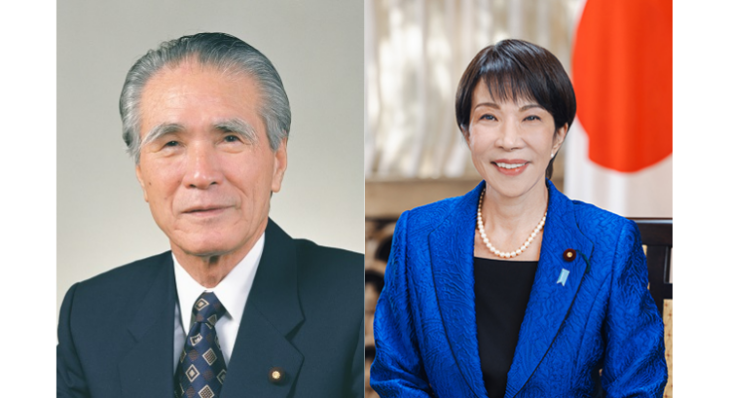
Murayama Tomiichi (left), who led the LDP-JSP-Sakigake coalition in 1994, and Takaichi Sanae (right), Japan’s first female Prime Minister inaugurated in 2025.
Photos: Cabinet Public Affairs Office
On October 21, 2025, the Takaichi Sanae administration was inaugurated. It goes without saying that Takaichi is the first female Prime Minister in Japan’s constitutional history. Furthermore, the coalition between the Liberal Democratic Party (LDP) and Komeito, which began in 1994, was dissolved, leading to a realignment of the coalition between the LDP and the Japan Innovation Party (JIP).
Just four days prior to this, it was reported that former Prime Minister Murayama Tomiichi had passed away at the age of 101. In 1994, the “acrobatic” coalition in which the LDP installed Murayama, the Chairman of the Japan Socialist Party (JSP), as Prime Minister served to inform the world that the “1955 System,” which had long persisted throughout the postwar era, had truly come to an end in both name and reality.[1]
Nearly thirty years have passed since the Murayama administration was established in 1994. The inauguration of the Takaichi administration at this milestone, marked by the inauguration of the Takaichi administration, seems to once again call into question the transitions and significance of Japanese politics during this period. In this article, I would like to examine the “present location” of Japanese politics under the Takaichi administration by looking at the developments of the past thirty years through four perspectives: historical recognition, gender (female politicians), coalition politics, and the international environment.
Developments in the Issue of Historical Recognition
The first perspective to consider is the issue of historical recognition. Chief among the accomplishments of Prime Minister Murayama is likely the “Murayama Statement,” issued in August 1995 on the 50th anniversary of the end of World War II. By articulating Japan’s past negative aspects more clearly than ever before—using terms such as “colonial rule and aggression,” “deep remorse,” and “heartfelt apology”—the statement had a profound impact and has since been frequently cited as the official position of the Japanese government.
At that time, the government was a three-party coalition consisting of the LDP, the JSP, and New Party Sakigake. Upon the Cabinet’s decision on the Murayama Statement, Minister of International Trade and Industry Hashimoto Ryutaro (1937–2006), who was also the chairman of the Japan War Bereaved Families Association, accepted the statement after offering only the opinion that “the end of the war” (shusen) should be replaced with “defeat in the war” (haisen). At the time, the “conservative mainstream” (hoshu honryu) following the lineage of Yoshida Shigeru was the dominant force within the LDP. For this mainstream, including Hashimoto, the historical view presented in the Murayama Statement was broadly acceptable, even if their acceptance was partly motivated by the desire to maintain the coalition with the JSP.
However, there were forces within the LDP who reacted strongly against the historical recognition presented here. One such individual was Abe Shinzo (1954–2022), a young lawmaker first elected to the Lower House in 1993. His opposition to the Murayama Statement—along with issues such as the North Korean abductions and visits to Yasukuni Shrine—became a focal point through which Abe expanded his influence. As will be discussed later, Takaichi is among those who shared this critical stance.
Regarding Abe, who held a strong fixation on historical recognition, his mentor, former Prime Minister Mori Yoshiro, remarked: “He is not a right-winger. He is a shinjinrui (new breed) in a good sense.” Mori explained that “shinjinrui simply refers to new young people born after the war” (Mori Yoshiro and Tahara Soichiro, “The Inside of the Inside of Japanese Politics”).
Upon becoming Prime Minister, Abe released the “Abe Statement” on the 70th anniversary of the end of the war. In his phrasing—“We must not let our children, grandchildren, and even the generations to come, who have nothing to do with that war, be predestined to apologize”—one can see the underlying sentiment: “Why should we, who were not parties to the war, have to do this?”
The issue of historical recognition has evolved through the combination of the power center’s shift from the “conservative mainstream” to the Seiwakai (the lineage of Kishi Nobusuke [1896–1987], including Abe and Koizumi Junichiro) and the rise of the “postwar generation” represented by Abe. How, then, is Takaichi, now Prime Minister, to be positioned within this trajectory?
Takaichi Sanae has shown a strong commitment to criticizing the Murayama Statement and visiting Yasukuni Shrine. However, taking actions as Prime Minister to embody those convictions may be difficult in the current international environment. As Japan-China relations remain tense due to her own remarks regarding the possibility of a Taiwan contingency, and as China takes the offensive in the international community from its position as a victor of World War II, any action by a Japanese Prime Minister that could be perceived as historical revisionist risks providing China with ideal propaganda material.
When Abe Shinzo proceeded with his long-held ambition of visiting Yasukuni Shrine upon the inauguration of his second administration (December 2012), it drew discomfort not only from China and South Korea but also from the United States under the Obama administration. Even for the current President Trump, there would likely be no reason to view a Yasukuni visit favorably. Seen in this light, the era when Koizumi Junichiro repeatedly visited Yasukuni every year as Prime Minister—to demonstrate his “unwavering” stance with an eye toward the power struggle with “conservative mainstream” forces—now seems almost peaceful by comparison.
Furthermore, it should be noted that the issue of historical recognition includes the contemporary and global challenge of settling the accounts of colonialism. In the process of drafting the Murayama and Abe Statements, there was strong pushback along the lines of: “Have Western nations, which engaged in colonial rule on a far larger scale, not failed to apologize?” However, today, more than 70 years after the Bandung Conference (1955) where the newly independent nations of Asia and Africa gathered, the situation is changing significantly due to the rise of the Global South. Western countries themselves are being pressured to settle the accounts of their past colonial rule in various ways.
Japan has long grappled with this difficult problem, starting with the negotiations to normalize diplomatic relations with South Korea. There is also the history of colonialism with North Korea, with which Japan has no diplomatic ties. While a sense of futility sometimes drifts on the Japanese side, there must be insights derived from these years of effort. It is important to grasp the issue of historical recognition between Japan and South Korea within such a global scope.
Prime Minister Takaichi lists cooperation with the Global South as a key diplomatic priority, but if she adopts a hardline stance on historical recognition, it could lead to discomfort even among the countries of the Global South. It is to be hoped that Prime Minister Takaichi will maintain a restrained posture on this issue based on strategic judgment.
Lineage and Evolution of Female Politicians
In 2021, I published an edited volume titled Heisei no Saisho-tachi: Shidousha 16-nin no Shozo (Prime Ministers of the Heisei Era: Portraits of 16 Leaders). For the cover design, we lined up illustrations of the prime ministers. It goes without saying that they were all men in suits and ties; some readers might have even found it difficult to distinguish one from another. This remains a somber memory rather than a humorous one. Now that we have entered the Reiwa era (2019–), a female prime minister has finally joined their ranks. While one might say “at last” compared to broader societal trends, the birth of a female prime minister is nonetheless of great significance.
Looking back thirty years to the Murayama administration, the representative female politician of that era was undoubtedly Doi Takako (1928–2014), who was then the Speaker of the Lower House. Doi suddenly became the darling of the era during the 1989 Upper House election. Under her leadership as chairwoman, the JSP—which had fielded many female candidates—achieved a massive breakthrough, resulting in a reversal of power between the ruling and opposition parties in the upper chamber. Doi’s words at the time, “The mountain has moved,” remain one of the most famous quotes in postwar political history. This phrase originated from a line in a poem by Yosano Akiko, which expressed a desire for women’s liberation.[2] On the other hand, the fact that this surge was dubbed the “Madonna Whirlwind” (Madonna Senpu) reflects how much the media of the time was shrouded in a male-centric gaze.
The backdrop to this JSP victory included the introduction of the consumption tax and the Recruit scandal. While a consumption tax directly affecting daily life was being introduced, major LDP politicians were profiting effortlessly from unlisted shares of a Recruit-related company. This incident ignited anger over plutocratic corruption, and Doi received strong support from female voters and others. There are many episodes of women being inspired by Doi’s dignified presence, feeling that “women, too, are allowed to speak up.”
Doi served as the Chairwoman of the JSP, Speaker of the Lower House, and, after stepping down as Speaker, returned as the leader of the Social Democratic Party (SDP) (renamed from the JSP in 1996). All of these were heavy responsibilities that Doi accepted only because she felt she could not refuse. Particularly after her tenure as Speaker, many supporters argued that instead of returning to the fragmented SDP, she should use her prestige as the first female Speaker to engage in activities from a broader, more elevated perspective.
However, in every instance, Doi ultimately accepted the roles. Her concern was that if she refused, people would say, “That’s why women are no good.” It is said that she was determined to avoid such a characterization. Despite her immense national popularity as “O-Taka-san,” she occasionally confessed, “I wonder how long I will continue to be called the ‘first woman’ for everything.”
Meanwhile, within the LDP, the center of power shifted from the Takeshita faction—the so-called “conservative mainstream”—to the Seiwakai. The major turning point was the 2001 LDP presidential election, where Koizumi Junichiro shouted, “I will destroy the LDP!” and defeated former Prime Minister Hashimoto Ryutaro. The key figure behind this victory was Tanaka Makiko.
As the eldest daughter of former Prime Minister Tanaka Kakuei, she possessed an immense popularity driven by her eloquent speech, said to be inherited from her father. Tanaka joined the Koizumi camp’s campaign and considered herself the “godmother” of the Koizumi administration. After the administration’s inauguration, Tanaka became the first female Foreign Minister, but she repeatedly clashed with the bureaucracy and was eventually dismissed by Prime Minister Koizumi to end the chaos (it was Koizumi’s 2002 surprise visit to North Korea that managed to recover his plunging approval ratings).
Doi and Tanaka Makiko garnered voter support because they were perceived as fresh presences not yet co-opted by existing politics—in other words, precisely because they were political outsiders. Doi, a former constitutional scholar, maintained her distance from factional politics within the JSP, a party where major labor unions held power and factional infighting intensified by ideological conflict was constant. Meanwhile, Tanaka won public acclaim for her uninhibited remarks that were unconstrained by the common sense of the party or the political world.
While the popularity of Doi and Tanaka is sometimes categorized as a transient boom, both visualized the fact that existing politics had reached a deadlock and that a tectonic shift was underway.
Female Politicians Under the “Post-1955 System”
The end of the 1955 System and the rise of Seiwakai-affiliated forces within the LDP brought new faces to the political world, and a new lineage of female politicians began to take shape. Among them, the prominent example of a female politician who entered politics following the formation of new parties is Koike Yuriko. After working as a newscaster, Koike was elected from the Japan New Party, and subsequently moved through the New Frontier Party and the Liberal Party before joining the LDP. In 2017, while serving as the Governor of Tokyo, she formed the Party of Hope (Kibo no To), signaling her intent to return to national politics.
On the other hand, female politicians who rose to prominence alongside the expansion of Seiwakai’s influence within the LDP include Inada Tomomi and Takaichi Sanae. While Takaichi initially ran as an independent and later joined the LDP after a stint in the New Frontier Party (having had her application for endorsement rejected by New Party Sakigake), Inada, a former lawyer, caught the attention of Abe Shinzo during a trial related to the Nanking Massacre and entered politics with his strong backing.
Inada was appointed to key positions such as Minister of Defense under Prime Minister Abe, and at one time was hailed as a “candidate for the first female prime minister,” especially after Abe remarked that he wanted her to “aim to be the first female premier.” However, reports of a rift between her and Abe—as well as his supporters—began to emerge due to her liberal-leaning stances on issues such as fiscal reconstruction and sexual minority rights. [3]
In contrast to Inada, it was Takaichi who increasingly aligned herself with Abe. While Takaichi had shown opposition to separate surnames for married couples around the time she joined the LDP in 1996, some observers suggest that she may have further emphasized her conservative positions to differentiate herself from the relatively liberal Noda Seiko, while publicly declaring her ambition to become “the first female prime minister.” Within Takaichi’s political identity, conviction and strategy appear inextricably linked. After Abe’s passing, Takaichi emphasized her commitment to carrying on his legacy, gaining support from intra-party forces and further increasing her presence.
Female politicians who rose to prominence under the “post-1955 System,”[4] such as Takaichi, Inada, and Koike, frequently adopt conservative stances on constitutional, security, and historical recognition issues. In contrast, there are female politicians with relatively strong liberal leanings, such as Noda Seiko and Obuchi Yuko. However, both Noda and Obuchi are hereditary politicians who possess solid electoral bases capable of withstanding significant political challenges.
Looking globally, while female politicians who take liberal stances often face backlash, there are numerous examples of women improving their political standing by adopting right-wing positions. For Takaichi, who is not a hereditary politician and has faced difficult electoral contests, her shift toward a conservative stance may have been a strategic path to prominence within the powerful Seiwakai faction, which produced successive prime ministers like Koizumi and Abe.
Compared to the era of Doi Takako, one can now identify several influential female politicians across various parties. In that sense, the potential emergence of a figure like Takaichi as a candidate for the premiership is viewed by some as a result of long-term shifts in the political landscape. Although their proportion in the political world remains low, female politicians can no longer be characterized as outsiders.
At the same time, the issue of “politics and money,” which once propelled Doi onto the center stage, continues to impact the political world and public trust. Whether they possess the will to address these systemic issues and regain public confidence is a challenge now confronting the current generation of female politicians who have become established insiders.
International Environment and Coalition Realignment
Of the four perspectives, I will treat the remaining two—coalition politics and the international environment—together, focusing on the link between them.
In October last year, when Takaichi Sanae received the news of Murayama Tomiichi’s passing, she had just been elected President of the LDP but was immediately facing the departure of Komeito from the ruling coalition. When asked by reporters for her thoughts on Murayama’s death, Takaichi remarked: “Within the framework of the LDP-JSP-Sakigake administration, he made a very significant policy shift and must have struggled greatly to persuade those within the Social Democratic Party. Now, I find myself in a similar position” (Asahi Shimbun, October 17, 2025).
For Takaichi, who was in the midst of pinning her hopes on a coalition with the JIP to break through her predicament, the name Murayama likely immediately brought to mind the hardships surrounding the establishment of a coalition.
While the “post-1955 System” is characterized by changes in government, it was also simultaneously an era of coalitions. As seen below, the shifting combinations of these coalitions were deeply influenced by the fluid international environment of the post-Cold War era.
The non-LDP coalition governments of Hosokawa Morihiro and Hata Tsutomu, which brought an end to the 1955 System, included everyone from Ozawa Ichiro’s Japan Renewal Party—which advocated for Japan becoming a “normal country”—to the JSP, which held the largest number of seats within the administration. However, the North Korean nuclear crisis, which became apparent at that time, greatly shook the framework of the coalition.
Ozawa, a powerful figure in the coalition, maneuvered behind the scenes to orchestrate a political realignment by excluding the JSP and bringing in a portion of the LDP, using crisis management for a potential Korean contingency as his “golden banner” (nishiki no mihata). Reacting against Ozawa’s attempt to “exclude the JSP,” the party withdrew from the coalition. In response, Prime Minister Hata, who hoped for the JSP’s return to the coalition, placed importance on information suggesting that North Korea also wished to avoid a crisis.
As a result, the crisis was averted through a meeting between former US President Jimmy Carter, who was staying in North Korea, and President Kim Il-sung. Immediately following this, the LDP installed JSP Chairman Murayama as Prime Minister and managed to launch the Murayama administration through a coalition of the LDP, JSP, and New Party Sakigake. Had the nuclear crisis—described at the time as the “greatest crisis since the Korean War”—continued without subsiding, contingency response would naturally have become the top priority in the coalition agreement, making a deal between the LDP and JSP difficult. It was the temporary subsiding of the crisis that made the birth of the Murayama administration possible.
That LDP-JSP-Sakigake coalition eventually collapsed when the Social Democratic Party (SDP) withdrew over the handling of the Okinawa base issue. Figures like Nonaka Hiromu of the LDP looked to Komeito as a replacement coalition partner. However, since Komeito had previously operated as a non-LDP force, they requested a “cushion” in between, leading to the formation of the LDP-Liberal-Komeito coalition, which included the Liberal Party founded by Ozawa Ichiro.
At this time, one of the LDP’s greatest national tasks was the “Guidelines Legislation.”[5] With the situation surrounding North Korea remaining unpredictable despite the temporary lull, the United States was strongly urging Japan to develop a legal framework to make defense cooperation effective in the event of a contingency. During the LDP-JSP-Sakigake coalition, the LDP had been cautious out of deference to the SDP, but it was being forced to move forward in response to continuous requests from the United States.
During the process of enacting the Guidelines Legislation, the LDP adopted a stance of responding as much as possible to Komeito’s requests. The legislation was ultimately enacted in May 1994 with the support of the LDP, the Liberal Party, and Komeito—which at that point had not yet joined the coalition.
In this process, Komeito, having strengthened its cooperation with the LDP, decided to enter into a coalition with the LDP and the Liberal Party in the autumn of the same year. At the time, within Komeito—whose support base is Soka Gakkai, an organization with a strong pacifist orientation—there was significant opinion that the party should partner with the Democratic Party of Japan (DPJ) given the proximity of their policies. However, the DPJ itself lacked unity on security issues. Furthermore, the LDP’s readiness to relentlessly pursue the issue of the separation of church and state—a sensitive point for Komeito—likely made the party keenly aware of the risks of opposing the LDP.
In any case, Komeito’s decision to enter into a coalition with the LDP at this juncture meant the formation of a central axis in subsequent Japanese politics. This stands in stark contrast to the DPJ’s side, which underwent repeated transformations and fragmentation, including the departure of the Social Democratic Party from the coalition during the Hatoyama Yukio administration and the eventual split of the DPJ itself.
The Pitfalls of Proactive Diplomacy
As described above, the realignment of coalitions under the “post-1955 System” was set against the backdrop of the fluid international environment surrounding Japan. Furthermore, as outlined earlier, it can be said that these realignments were fundamentally passive in nature.
Whether it was Ozawa Ichiro, who orchestrated a political shake-up by advocating for “contingency response” during the North Korean nuclear crisis, or the LDP leadership under the Obuchi Keizo administration, which managed to form a coalition through cooperation with Komeito to secure a stable majority in the Diet for the development of the Guidelines Legislation—their primary aim was the establishment of a domestic political foundation to respond to the destabilizing security environment around Japan (it goes without saying that elements of a power struggle within domestic politics to seize the initiative were also present).
Furthermore, while the coalition with Komeito stabilized the LDP-led administration, the policy distance between the LDP—which came to be led by the Seiwakai—and Komeito was not necessarily close regarding constitutional and security policies. Regarding the Cabinet decision on the “Three Security Documents” in 2022, LDP Vice President Aso Taro even criticized Komeito as having been “the biggest obstacle (cancer) that wouldn’t move.”
In contrast, the coalition (extra-cabinet cooperation) between the LDP and the JIP under Prime Minister Takaichi shares much common ground in the fields of security and historical recognition, making it a “cleaner” combination compared to previous ones. Will this function positively in advancing the strengthening of Japan’s diplomatic and security systems?
It is true that under the LDP-JIP coalition, the momentum for launching more proactive diplomatic and security policies is already building. It appears that symbolic and attention-grabbing policies, such as a partial review of the “Three Non-Nuclear Principles,” will be considered. In terms of the domestic policy-making process, there may be evaluations that the LDP-JIP coalition will realize more rational and rapid politics.
However, if Japan shifts from its traditional passive stance to launch proactive policies, it is necessary to fully consider the impact this will have on East Asian international politics. Highlighting a review of the “Three Non-Nuclear Principles” (though the possibility of “introduction” had already been suggested in the Diet testimony of Foreign Minister Okada Katsuya under the DPJ administration) will further stimulate nuclear armament arguments not only in China and North Korea but also in South Korea.
In the first place, for Japan, whose fiscal situation is prominently worse among major nations, an arms race involving massive fiscal spending is an overwhelmingly disadvantageous arena. Even regarding relations with China, the strengthening of deterrence must proceed in tandem with persistent efforts to stabilize relations, including strengthening communication at the political level. Such voices do not seem to be heard much from the LDP-JIP coalition.
Prime Minister Takaichi admires former British Prime Minister Margaret Thatcher and does not hide her adoration for former Prime Minister Abe. That very Thatcher, behind her “Iron Lady” persona, possessed a strength in her seasoned political stance that did not shy away from compromise (Ikemoto Daisuke, Saccha: “Tetsu no Onna” no Jitsuzo [Thatcher — The reality of the “Iron lady”]). As for Abe, his first administration ended prematurely because he put only “Abe colors” to the fore; from that lesson, he acquired flexibility and breadth in his second administration. To what extent can she learn from these two predecessors? The future of Prime Minister Takaichi likely depends on that point on her ability to do so.
Translated from “Murayama kara Takaichi e: Reisengo 30-nen, Nihon Seiji no Genzaichi (From Murayama Tomiichi to Takaichi Sanae: Thirty Years After the Cold War—The Present Location of Japanese Politics),” Sekai, February 2026, pp. 35–40. (Courtesy of Iwanami Shoten, Publishers) [March 2026]
 MIYAGI Taizo, Ph.D.
Professor, Faculty of Law, Chuo University
Born in 1968. After working as an NHK reporter, he completed a doctoral course at Hitotsubashi University Graduate School of Law. He has a Ph.D. (law). His publications include Sengo Ajia chitsujo no mosaku to Nippon (The search for postwar Asian order and Japan) (Sobunsha, Suntory Prize for Social Sciences and Humanities, Nakasone Yasuhiro Award), Gendai Nihon gaikoushi (Contemporary History of Japanese Diplomacy) (Chuko Shinsho), and his edited works include Heisei no Saisho-tachi: Shidousha 16-nin no Shozo (Prime Ministers of the Heisei Era: Portraits of 16 Leaders) (Minerva Shobo).
[1] Refers to the 1994 coalition government formed by the LDP, the Japan Socialist Party (JSP), and New Party Sakigake, which installed JSP Chairman Murayama Tomiichi as Prime Minister. This unexpected alliance between long-time rivals effectively marked the end of the “1955 System,” characterized by the ideological confrontation between the conservative LDP and the progressive JSP.
[2] Derived from a passage in the poem “Sozorogoto” written by Yosano Akiko in 1911 for the inaugural issue of the literary magazine Seito. Originally a declaration of the awakening and liberation of women, the phrase “The mountain has moved” gained political fame in 1989. It was famously quoted by Doi Takako, Chairwoman of the Japan Socialist Party, to celebrate their landslide victory in the Upper House election. This expression came to symbolize the tectonic shifts in Japanese politics that eventually led to the collapse of the “1955 System.”
[3] In Japan, the term “liberal” primarily refers to political forces and intellectuals who are non-conservative and non-communist, often advocating for post-war democratic values, gender equality, and social welfare.
[4] Refers to the Japanese political landscape following the collapse of the “1955 System” in 1993. The 1955 System was characterized by the dominance of the conservative LDP and the opposition JSP. The “post-1955” era is marked by a shift from ideological confrontation to a period of pragmatic coalition governments, as well as significant electoral reforms that paved the way for potential changes in power among multiple parties.
[5] The Guidelines Legislation (Act on Measures to Ensure the Peace and Security of Japan in Situations in Areas Surrounding Japan): A legal framework established to allow the Self-Defense Forces (SDF) to provide rear-area support to US forces during contingencies near Japan (“situations in areas surrounding Japan”), based on the 1997 Revised Guidelines for US-Japan Defense Cooperation. The development of this legislation was driven by the lessons learned from the 1994 North Korean nuclear crisis, during which Japan was unable to provide effective support, and was formally enacted in 1999.
Keywords
- Tomiichi Murayama
- Sanae Takaichi
- historical recognition
- gender
- coalition politics
- international environment
- post-1955 System