


From Support to Participation: The Future of ASEAN-Japan Relations
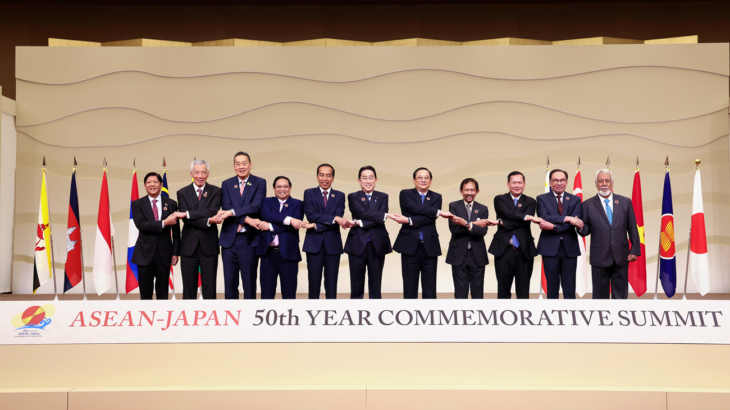
Commemorative Summit for the 50th Year of ASEAN-Japan Friendship and Cooperation (December 2023, Tokyo). Leaders gathered to reaffirm their commitment as “Trusted Partners” for future peace and prosperity.
Photo: Cabinet Public Affairs Office
As the international order faces upheaval, ASEAN-Japan relations require a timely upgrade. Professor Suzuki Sanae explores the key points and future directions of this partnership.
- Expand opportunities for Japan to deepen its understanding of ASEAN.
- Foster proactive participation in ASEAN cooperation projects.
- Lead Indo-Pacific cooperation through inclusivity and the rule of law.
In 2023, Japan and ASEAN celebrated the 50th anniversary of their friendship and cooperation. The relationship traces its origins back to 1973, the year the Japan-ASEAN Synthetic Rubber Forum was held. This forum was convened at the request of the ASEAN side to discuss the economic damage faced by natural rubber-producing and exporting countries, such as Indonesia and Malaysia, due to the expansion of Japan’s synthetic rubber exports. In the 1970s, ASEAN nations harbored deep-seated distrust toward Japan, fueled by postwar reparations, the influx of Japanese companies tied to official development assistance, and concerns over Japan’s potential re-emergence as a military power. Intense anti-Japanese riots even broke out during the visit of then-Prime Minister Tanaka Kakuei (1918–93).
Amidst such circumstances, the “Fukuda Doctrine” announced by Prime Minister Fukuda Takeo (1905–1995) in 1977 was a manifestation of Japan’s intention to dispel this distrust and build friendly relations with Southeast Asia. It declared that Japan refrains from having a military power, aims to build a relationship of mutual confidence and trust based on “heart-to-heart” understanding, and will contribute to the mutual trust and regional stability of both ASEAN and the Indochinese countries.
In 2023, marking the 50th anniversary, Japan and ASEAN issued a “Joint Vision Statement” titled “Trusted Partners.” Following the spirit of the Fukuda Doctrine, the statement identified “Heart-to-Heart Partners across Generations” as one pillar of cooperation, alongside two new pillars: “Partners for Co-creation of Economy and Society of the Future” and “Partners for Peace and Stability.”
This article provides an overview of post-Cold War ASEAN-Japan relations and examines the nature of cooperation being pursued under the three pillars set forth in the 2023 Joint Vision Statement and its challenges. In a dynamic international order, there is much that Japan and ASEAN can do for cooperation in the Indo-Pacific region. Now that two years have passed since the 50th anniversary of ASEAN-Japan friendship, re-examining the challenges to achieving these goals holds significant meaning for considering the future of Japanese diplomacy. Notably, this article views ASEAN-Japan relations not as relations between Japan and individual Southeast Asian countries, but as relations with ASEAN as a regional organization.
Transformation of ASEAN-Japan Relations after the Cold War
After the Cold War, Japan supported the building of relations between ASEAN and the Indochinese countries by expanding not only economic cooperation, such as infrastructure development, but also intellectual support, including policy cooperation and human resource development, for the Indochinese countries. After these Indochinese countries and Myanmar joined ASEAN in the late 1990s, this cooperation continued as a means for reducing the regional economic gap and supporting Mekong region development. Human resource development included the dispatch of policy advisors and the acceptance of trainees to Japan, which also encouraged people-to-people exchanges. Following the Ministry of Foreign Affairs (MOFA), the Ministry of International Trade and Industry (now the Ministry of Economy, Trade and Industry [METI]) also began holding the ASEAN Economic Ministers – Ministry of Economy, Trade and Industry (AEM-METI) Consultation from 1992 onward, initiating industrial cooperation with the Indochinese countries and Myanmar.
Efforts to deepen “heart-to-heart” understanding were concentrated on youth exchange. In addition to one-off exchange events, Japan established exchange programs for university and high school students in ASEAN countries. To support the reduction of regional disparities and youth exchange, the Japan-ASEAN Integration Fund (JAIF) was established at the ASEAN Secretariat in 2006. JAIF has become the financial foundation for cooperation with ASEAN, supporting projects implemented in response to requests from ASEAN countries. The scope of this support has expanded, and additional contributions have been made frequently. On the occasion of the 50th anniversary of friendship in 2023, an additional contribution was made with a new goal of supporting ASEAN’s initiatives in the Indo-Pacific region. In cooperation areas such as infrastructure development, policy cooperation, human resource development, and youth exchange, emphasis is placed on Japan providing various forms of support to ASEAN countries.
On the other hand, Japan and ASEAN have established an equal relationship such as through free trade agreements (FTAs). As Japan shifted from a focus solely on trade liberalization through the World Trade Organization (WTO) to aiming for the conclusion of bilateral or regional FTAs, and ASEAN moved in a similar direction, the ASEAN-Japan Comprehensive Economic Partnership (AJCEP) Agreement was concluded in 2008. Although it contains elements of economic cooperation, the conclusion of this FTA symbolized an equal relationship between the two as trading partners. In addition to Japan, countries such as China, Australia, New Zealand, and India have concluded similar FTAs with ASEAN, which are referred to as “ASEAN+1 FTAs.”
Furthermore, Japan and ASEAN have cooperated on wider regional cooperation and the stability of the regional order, moving beyond just the bilateral ASEAN-Japan relationship. In the 2010s, momentum grew to integrate multiple ASEAN+1 FTAs into a single, wide-area FTA, and in 2020, the Regional Comprehensive Economic Partnership (RCEP) Agreement was concluded, with the participation of ASEAN countries, Japan, China, South Korea, Australia, and New Zealand.
The Ministry of Finance (MOF) also began to play an active role in Asian financial cooperation in collaboration with ASEAN. In the wake of the 1997 Asian Financial Crisis, Japan announced the Asian Monetary Fund (AMF) Initiative and the New Miyazawa Initiative (proposed by then-Finance Minister Miyazawa Kiichi [1919–2007]), and led the agreement on the Chiang Mai Initiative (CMI) within the framework of ASEAN and Japan, China, and South Korea (ASEAN+3) to enable emergency currency swaps. Furthermore, to resolve the “double mismatch”—borrowing short-term in foreign currency from abroad and lending long-term domestically in local currency—Japan has actively participated in efforts aimed at developing bond markets to issue bonds denominated in local currencies.
Japan and ASEAN have also begun to discuss the regional order. These discussions center on Japan’s Free and Open Indo-Pacific (FOIP) and the ASEAN Outlook on the Indo-Pacific (AOIP). They identified commonalities between the two visions.
“Heart-to-Heart Partners” and Promoting Japan’s Understanding of Southeast Asia
The 2023 Joint Vision Statement, under the pillar “Heart-to-Heart Partners across Generations,” declared that mutual understanding would be promoted through exchanges of youth, students, and faculty staff, as well as through joint research in fields such as culture and arts, sports, tourism, education, and science and technology. Additionally, the promotion of the mobility of skilled labor was identified as a key component.
Exchange programs for ASEAN and Japanese youth have been implemented for years. These programs are characterized by fostering trust among young people through relatively short-term visits to Japan and ASEAN countries, where they work together on common issues. For example, the “Partnership to Co-create a Future with the Next Generation: WA Project 2.0,” implemented by the Japan Foundation, is a project where students interested in solving social issues gather for discussion. Long-term initiatives include Japanese language education and scholarship programs for students from ASEAN countries.
While short-term projects are easier to implement, it is difficult for the exchange among participating students to continue afterward (although follow-up projects are being implemented). Furthermore, because many of these programs take the form of attending conferences or taking well-organized field trips, there are few opportunities for participating students to deepen their understanding by moving freely around the local area using public transport.
On the other hand, long-term initiatives may be limited in the number of students they can accommodate, but the Japanese language skills acquired during such periods become the intellectual property of the students. By staying in Japan for a long time, it is expected that they will deepen their understanding of Japanese society, culture, and politics through interaction with various people. However, a challenge in these projects is that Japanese students have few opportunities to stay in Southeast Asian countries for extended periods to learn about local societies and interact with the people. The economic situation for Japanese students is difficult, and even if they are interested in Southeast Asian countries and wish to learn their society, politics, or economy, they may be forced to give up due to financial reasons. Could some form of financial or institutional support be considered for such students within the framework of ASEAN-Japan relations?
For mutual understanding, it is necessary not only for people in Southeast Asian countries to know Japan but also for people in Japan to know Southeast Asian countries. The enhancement of Japanese language education has not only helped Southeast Asian countries understand Japan but is also effective in meeting the growing demand for skilled labor as Japan’s population declines. On the other hand, it is difficult to say that sufficient efforts have been made to increase the number of “Japanese who are Southeast Asia experts.”
Co-creation of Economy and Society and Japan’s Growth and Development
The second pillar is “Partners for Co-creation of Economy and Society of the Future.” This pillar covers a fairly wide range of areas, including connectivity in infrastructure, smart cities, innovation in small and medium-sized enterprises (SMEs), trade, public health, finance, energy, the environment, disaster management, agriculture, and the labor environment.
It characterizes the continuation of the traditional ASEAN-Japan relationship, where Japan supports ASEAN countries. Japan certainly possesses assets in terms of technology and expertise, and the idea of sharing these with ASEAN countries to help solve economic and social problems remains important. There are several fields where Japan excels, such as high-quality infrastructure investment, innovation, competitiveness in the next-generation automobile industry, development finance, and expertise in disaster management.
However, compared to the past, the Japanese economy has been less competitive, and Japan has suffered from domestic issues such as falling average incomes and widening inequality. To revitalize the economy, the economic power of ASEAN countries is essential. The AJCEP and RCEP, mentioned earlier, can be viewed as efforts toward this end.
Furthermore, in “enhancing air connectivity between Japan and ASEAN Member States,” the ongoing negotiations toward the conclusion of the ASEAN-Japan Regional Air Services Agreement since 2014 suggests an intention to strengthen Japan’s economic power by having Japan participate in cooperation initiated by ASEAN. Connectivity is a project started by ASEAN to enhance physical, institutional, and people-to-people connectivity within the region, thereby increasing Southeast Asia’s attractiveness as a single market and production base. Japan and other extra-regional countries have supported this initiative. Enhancing air connectivity between Japan and ASEAN means that Japan is not only supporting but also participating in ASEAN Connectivity Projects.
Such an attitude should be found in other projects. The smart cities project was also initiated by ASEAN, aiming to build a network among cities in ASEAN countries and share knowledge and experience to solve urban problems. China participated in this project. In 2019, China and ASEAN agreed to promote exchanges between local governments and to strengthen ties between cities in ASEAN and China, identifying participating Chinese cities such as Nanning, Xiamen, Hangzhou, Jinan, Kunming, Shenzhen, Nanjing, and Chengdu.
In contrast, Japan does not participate in this project. Rather, Japan supports its implementation. According to documents from the Ministry of Land, Infrastructure, Transport and Tourism (MLIT), the goal is to support the expansion of Japanese companies into ASEAN cities to contribute to their development and to transfer the technology and experience held by those companies. The idea of connecting local cities in Japan with cities in ASEAN is weak there. Just as with “air connectivity between Japan and ASEAN Member States,” would it not be possible to revitalize the local economies in Japan by participating in this project and drawing on the economic vitality of ASEAN cities?
Maintenance and Formation of Order in Peace and Security
The final pillar is “Partners for Peace and Stability.” This pillar places particular emphasis on the Indo-Pacific region, stipulating the deepening of cooperation in areas such as maritime security, disarmament and non-proliferation, the thorough implementation of the rule of law, human rights, democracy, and good governance, as well as gender equality, the peaceful resolution of conflicts, terrorism, and transborder crime.
Japan and ASEAN have respectively announced the FOIP and the AOIP. In 2020, they released the statement confirming that the FOIP and the AOIP share relevant fundamental principles. At the core of these fundamental principles are inclusiveness and the rule of law.
The United States’ Indo-Pacific Strategy and China’s Belt and Road Initiative have been regarded as competing visions. They adapt a logic of exclusion. Japan and ASEAN must distance themselves from such logic and uphold the principle of open regional cooperation. Specifically, an approach that incorporates and includes China is necessary.
On the other hand, the rule of law encompasses not only democracy, human rights, and good governance, but also the respect for international laws. Given that maritime security cooperation is a priority area, it is necessary to continue discussions on what measures are best to respect the rule of law facing China’s actions in the South China Sea.
Relatedly, the maintenance of the free trade order is also a critical issue. Amidst the protectionist movements seen under the Trump administration in the United States, Japan and ASEAN are expected to continue demonstrating the importance of this order by appropriately implementing the AJCEP and the RCEP.
ASEAN seeks to advance Indo-Pacific regional cooperation through ASEAN-led mechanisms. The East Asia Summit (EAS) is frequently mentioned as a representative framework for this, but others such as ASEAN+3 also exist. Rather than perceiving these multilateral frameworks as being in conflict with ASEAN-Japan relations, efforts must be made to position ASEAN-Japan cooperation at the core of these multilateral efforts. Such efforts are being practiced through financial cooperation within ASEAN+3. What kind of cooperation should be advanced in the EAS or ASEAN+3? Japan and ASEAN’s ability to make concrete proposals and lead the agenda-setting will result in enhancing the value of the ASEAN-Japan relationship.
Translated from “Shien kara Sanka e: Nichi-ASEAN Kankei no Henyo to Tenbo (From Support to Participation: Transformation and Outlook of ASEAN-Japan Relations),” Gaiko (Diplomacy), Vol. 95 Jan. / Feb. 2026, pp. 120–125. (Courtesy of Jiji Press) [March 2026]
 SUZUKI Sanae, Ph.D.
 Professor, The University of Tokyo
She received her Ph.D. from the Graduate School of Arts and Sciences, the University of Tokyo. Before assuming her current post, she was a researcher at the Institute of Developing Economies (IDE), Japan External Trade Organization (JETRO), a visiting researcher at the Institute of Strategic and International Studies (ISIS) Malaysia and the Centre of Strategic International Studies (CSIS) in Jakarta. Her publications include “ASEAN no Seiji (Politics in ASEAN)” (The University of Tokyo Press, 2024).
Keywords
- ASEAN-Japan
- Indo-Pacific cooperation
- exchange programs
- peace and stability
- smart cities
- FTAs
- rule of law
Related posts:
 Reading China’s Tactics Aiming to Change the Status Quo
 Defending Japan’s Sovereignty in the AI Era: Leveraging Linguistic Uniqueness to Build Sovereign AI
 The Dynamics of the “Coalition of the Willing” in the Indo-Pacific
 Japan’s Strategy as a Pioneer in Central Asian Diplomacy: Observations from the First “Central Asia plus Japan” Dialogue Summit
 Afghanistan Earthquake: Relief Activities by Peace Japan Medical Services and Peshawar-kai