


The Dynamics of the “Coalition of the Willing” in the Indo-Pacific
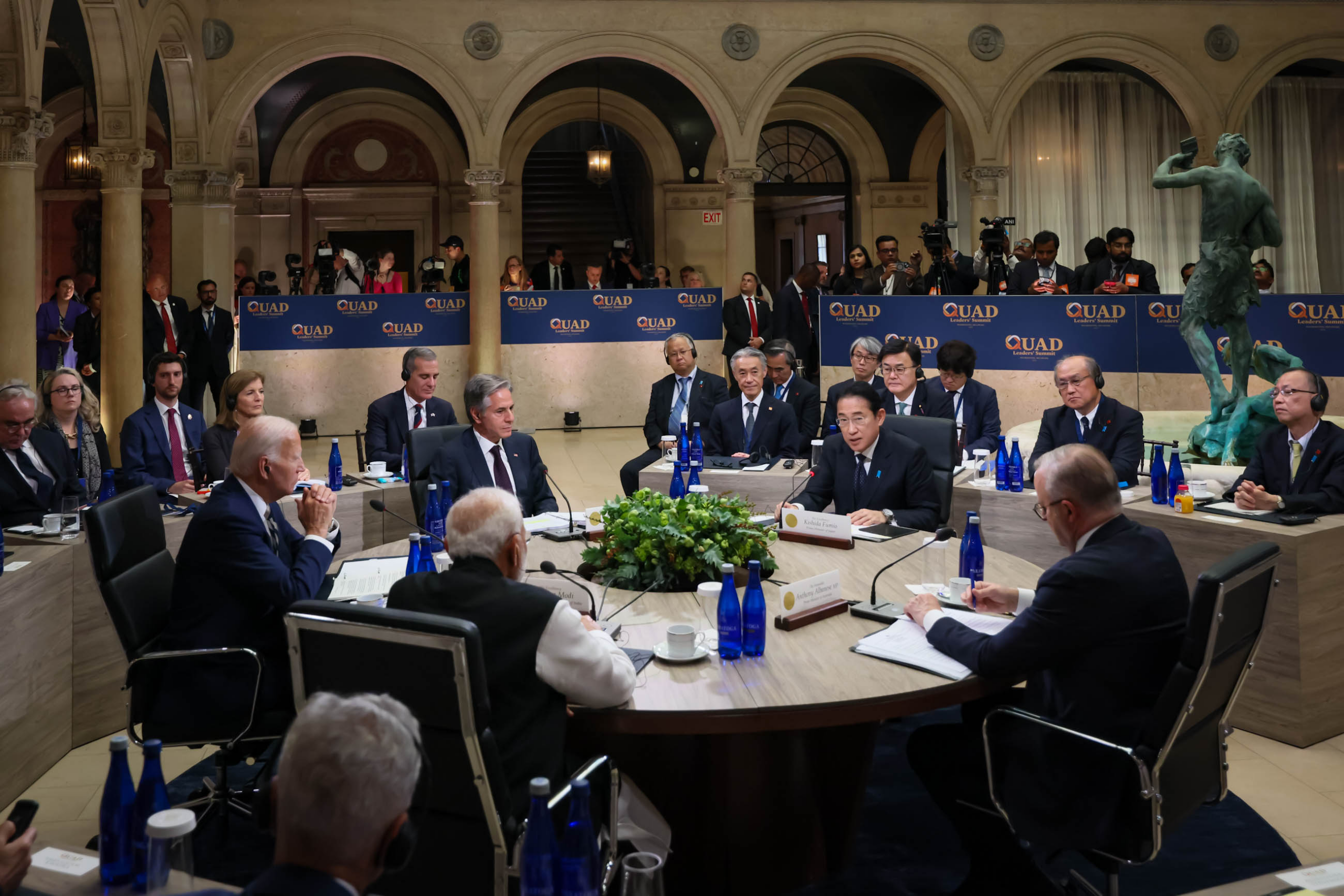
Leaders of the Quad (Japan, the United States, Australia, and India) meet in Wilmington, Delaware, in September 2024. Japan’s then-Prime Minister Kishida emphasized a steadfast commitment to a “Free and Open Indo-Pacific” (FOIP). This gathering solidified the Quad’s role as a transparent, minilateral framework that respects the centrality of regional institutions like ASEAN, PIF, and IORA—a critical precursor to the strategic re-calibration observed in 2025 and 2026.
Diplomatic diversification is advancing among US allies. What possibilities do various minilateral frameworks offer?
- “Hedging-based cooperation” is expanding as a means to mitigate excessive strategic and economic dependence on the United States.
- Efforts are underway to restructure the Quad’s agenda, while new frameworks that do not include the United States are simultaneously emerging.
- Regional actors are increasingly seeking to “engage” in shaping a multilayered order, rather than being compelled to make a binary “choice” between competing systems led by the United States and China.
In 2025, international politics reached a critical inflection point. Most significantly, the United States—Japan’s sole ally and the long-standing anchor of stability in the Indo-Pacific—has clearly begun to reorient its diplomatic course toward an “America First” policy under the second Donald Trump administration, emerging as a force that shakes the very foundations of the existing international order.
However, the destabilization of the international order did not emerge abruptly. Since the 2008 Global Financial Crisis (GFC), the instability of the US-led unipolar system has steadily intensified against the backdrop of China’s military and economic rise and the repeated break-out of regional conflicts. Nevertheless, the post-Cold War international order remained anchored in the US diplomatic posture rooted in democratic values and the market economy. Allies and partner countries therefore pursued the construction and management of international norms and rules on that basis.
In East Asia, the US-led “hub-and-spoke” alliance network has underpinned this order. Within this framework, alliances—while rooted in military deterrence—evolved into comprehensive bilateral relationships encompassing economic and diplomatic fields, and cooperation among these alliances also progressed.
However, under the second Trump administration in 2025, these underlying assumptions were significantly shaken. As the United States strengthened its view that incorporating China and Russia into the existing international order was no longer viable, it also intensified its focus on rectifying trade and defense burden-sharing disparities, rather than necessarily viewing allies and partner countries as strategic assets. Furthermore, the second Trump administration demonstrated a readiness to reduce its involvement in or withdraw from multilateral frameworks whenever it determined that they did not serve US national interests. As a result, the United States has distanced itself from the liberal international order (LIO) it once constructed.
In this transitional moment for the international order, US allies and partner countries are exploring a variety of countermeasures. Among the most important is the development of multilateral cooperation among like-minded countries, including through minilateral frameworks.
“Like-Minded” Coalitions under US-China Strategic Competition
However, cooperation frameworks in the Indo-Pacific region are not new. Since the Barack Obama administration, the goal of maintaining and enhancing the international order has been consistently embedded in US national security strategy, and the broad approach was inherited by both the first Trump administration and the Joe Biden administration. At the same time, as the post-Cold War balance of power in East Asia shifted, notably with the rise of China, the two pillars that had supported the regional security order—namely, the US-led “hub-and-spoke” alliance network and the Association of Southeast Asian Nations (ASEAN)-led multilateral mechanisms that emphasize confidence-building through dialogue—have become less capable of preserving regional stability than they once were.
The result was the emergence of “strategic minilateralism,” a framework of interstate cooperation typically consisting of three to six countries and aimed to maintain the balance of power or shape regional order. This is distinct from “functional minilateralism,” which is limited to specific forms of practical cooperation, such as the “Malacca Straits Patrol (MSP)” among Indonesia, Malaysia, and Singapore, or the “CLV Development Triangle” among Cambodia, Laos, and Vietnam for socioeconomic development. Strategic minilateralism, in contrast, is characterized by the efforts to advance national security and strategic interests through military cooperation and the creation of norms and rules.
Notable examples include the “Quad”—Japan, the United States, Australia, and India—which was revitalized after 2017, and AUKUS, the security partnership formed in 2021 by the United States, the United Kingdom, and Australia. In the contemporary international environment, where no clear-cut bloc division comparable to that of the Cold War exists, the formulation of alliances that explicitly define China or Russia as threats carries a high risk of intensifying confrontation. Accordingly, strategic minilateralism adopts an approach of incrementally expanding military, economic, and diplomatic cooperation while keeping threat perceptions officially ambiguous. It is thus best understood as part of a broader hedging strategy under conditions of profound international uncertainty.
Specifically, AUKUS is designed to sustain the regional balance of power through the joint development of nuclear-powered submarines, defense technology, and defense industrial cooperation. On the other hand, the Quad, under the Biden administration, deliberately minimized its security profile and pursued norm formation more indirectly, advancing rules and standards informed by liberal principles through functional cooperation in areas such as vaccine supply, disaster relief, and standardization in critical and emerging technologies.
However, in the second Trump administration, the values-based strategic posture that once underpinned US foreign policy is clearly receding. Trump himself regards “liberalism” and the “rules-based international order” as discursive instruments through which allies and partner countries have extracted economic and security benefits from the United States. At the same time, his administration views these frameworks as having facilitated China’s rise and thus stresses their cost and contradictions. Trump, who has originally long favored a transactional and highly pragmatic approach to international cooperation, has made this stance even clearer in his second term by surrounding himself with loyal advisers and further consolidating the administration’s core decision-making structure.
In other words, “De-valorization of Foreign Policy”—a shift away from a diplomatic posture that places values at the forefront—is highly likely to continue under the Trump administration. This transformation of US foreign policy is forcing allies and partner countries to recalibrate their long-standing strategic assumptions.
Hedging Strategies Against New Risks of Uncertainty
As a new US foreign policy takes shape, China and Russia are seeking to reshape the international or regional order on their own terms, while tactically exploiting a more transactional United States. For US allies and partner countries—many of which have benefited greatly from the existing international order—the central challenge is how to maintain and enhance that order when full-scale US support can no longer be assumed. Meeting that challenge will require a restructuring of strategy in response to at least two risks.
First, the prospect of US foreign policy returning to a traditional form of liberal internationalism is becoming increasingly limited—or at the very least, more uncertain. One striking feature of recent US foreign policy, as seen in the transitions from the first Trump administration to the Biden administration and then to the second Trump administration, has been the wide swing between “values-based diplomacy” and “de-valorized diplomacy,” even as the underlying structure of US-China strategic competition has remained largely unchanged. As a result, it has become difficult to assume a consistent US commitment to shaping the international order, leaving allies in a position where they must recalibrate their mode of cooperation with each successive administration.
Second, allies must prepare for scenarios in which the balance of power deteriorates and the risks of US “abandonment” or “entrapment” become more pronounced. Under such conditions, retaining sufficient strategic flexibility to ensure at least a minimum level of national security has become increasingly necessary. From this perspective, it may not be wise to rule out, at least in principle, options other than the United States—namely, the possibility of negotiation or limited cooperation with China and Russia. Maintaining a degree of strategic distance that preserves room for direct or indirect engagement therefore emerges as a realistic option.
One possible response to these two risks is so-called “strategic hedging.” Pursuing such a strategy requires that interstate cooperation not be anchored in any single framework, but instead be organized across multiple layers. In practice, this means combining three forms of cooperation in parallel: first, “strategic cooperation” in fields where core national interests align; second, “hedging-based cooperation” to prepare for uncertainty; and third, “functional cooperation” in areas less likely to trigger political confrontation. Through this multilayered approach, many countries are currently attempting to secure flexible and sustainable strategic space while diversifying policy options available to them as the international environment continues to evolve.
The Three-Layers of Cooperation in Hedging Strategy
The first layer, “strategic cooperation,” refers to formal alliance relationships or military cooperation directly linked to national security. Concrete examples include the Japan-US alliance, the US-Australia alliance, the US-Philippines alliance, and the various military agreements, including those between the United States and Singapore. In all of these cases, the primary objective has been to ensure national security on the basis of the US security commitment. However, in East Asia, where the degree of US involvement has traditionally been exceptionally high, the effect of recent shifts in US strategy has been particularly significant. Consequently, the need to avoid the strategic risks of both “abandonment” and “entrapment” has become increasingly salient. At the same time, there is no realistic military alternative to the United States in the short-to-medium term. As such, it has become essential to pursue stronger ties and policy adjustments on the premise of maintaining this strategic framework.
The second layer, “hedging-based cooperation,” is designed to reduce dependence on the United States over the medium-to-long term while maintaining and strengthening ties with the US as far as possible. In this context, “strategic minilateralism,” built around a US-centered balance of power, provides an effective means to anchor US involvement through cooperation among like-minded countries. In particular, a framework like AUKUS is particularly important because it delivers clear strategic benefits to the United States itself, making US commitment easier to sustain over time. In fact, against the backdrop of growing convergence in views on China strategy, the US Department of Defense review released in December 2025 also signaled support, strengthening expectations of the continuity of this cooperative relationship.
By contrast, although the “Quad” is a framework that places greater emphasis on shaping the international order, it is likely to become more difficult under the Trump administration to advance agendas centered on the provision of international public goods, such as “climate change” or “global health.” Meanwhile, there remains ample room for cooperation in areas with more direct strategic significance, including advanced technology and maritime security, and the framework is thus likely to be reoriented around such agendas. Furthermore, within the Japan-US-Australia-Philippines cooperation framework—known as the “Squad”—Japan, the United States, and Australia have reaffirmed their commitment to strengthening military cooperation with the Philippines, expanding capacity-building support, and promoting the transfer of defense equipment and technology.
Yet these frameworks are not a panacea. As the postponement of last year’s Quad summit demonstrated, strategic minilateralism remains highly vulnerable to fluctuations in bilateral relations among participating states—in this case, the deterioration of US-India ties. For that reason, a further deepening of hedging-based cooperation will require greater emphasis on frameworks among likeminded countries that do not necessarily include the United States.
In the economic sphere, the “Comprehensive and Progressive Agreement for Trans-Pacific Partnership” (CPTPP)—from which the United States remains absent as it distances itself from the principles of multilateral free trade—has emerged as a strategic economic framework, not least for bolstering supply-chain resilience. The “Regional Comprehensive Economic Partnership” (RCEP), meanwhile, serves to ensure that economic engagement with China is not completely severed. In diplomacy and security, Japan has expanded cooperation with Australia, South Korea, the Philippines, and the European Union (EU), while also participating in broader groupings such as Japan-Australia-New Zealand-ROK (IP4). Together, these cooperative frameworks among like-minded countries are beginning to play a role as “alternative anchors” for maintaining, strengthening, or building international norms and rules even in the absence of the United States.
The third layer, “functional cooperation,” consists of frameworks among like-minded countries that are already well established. One example is the “Digital Economy Partnership Agreement” (DEPA) led by Singapore, New Zealand, and Chile. Because it does not carry direct strategic implications, its immediate impact on the strategic environment remains limited. Over the long-term, however, norm- and rule-making in such specific issue areas is highly likely to influence the broader trajectory of the international order.
Functional cooperation also exists in the military sphere. The case in point is the Indo-Pacific Logistics Network (IPLN) of the Quad (Japan, US, Australia, India), which includes transport cooperation during natural disasters and is not formally integrated into the Quad itself. Although limited in scope, such arrangements enhance military interoperability and may acquire greater strategic significance in the future. Likewise, cooperative relationships with regional organizations composed largely of countries that do not necessarily have alliance relationships with the United States—such as the Association of Southeast Asian Nations (ASEAN), the Global South, and furthermore the Gulf Cooperation Council (GCC), the Indian Ocean Rim Association (IORA), and the Pacific Islands Forum (PIF)—also possess the potential to shape the future regional order of the Indo-Pacific.
Strengthening of the Japan-US Alliance While Expanding Strategic Options
The transformation of US foreign policy unfolding under the second Trump administration has reduced the credibility of the alliance, weakened the predictability of the international order, and profoundly shaken the assumptions underpinning Japan’s security and diplomatic strategy. A strategy that depends excessively on the alliance with the United States, premised on continued US unipolarity, is no longer sustainable. Japan, like many allies and partner countries, is thus required to recalibrate its strategy around a multilayered form of hedging capable of preserving a wide range of policy options. In practice, this means keeping the Japan-US alliance at the core while also expanding cooperation among like-minded countries through strategic minilateralism in preparation for unforeseen contingencies, and steadily accumulating functional cooperation to preserve strategic space under the future uncertainty.
Such a risk-diversifying strategy, however, also carries dangers of its own. From the outside, it could send the mistaken diplomatic signal that the alliance with the United States is gradually hollowing out. Japan therefore needs to engage, more than ever, in consistent strategic communication that presents alliance enhancement and strategic diversification not as contradictory goals, but as mutually reinforcing ones.
In this transitional period for the international order, Japan’s central challenge is not to “choose” a single order, but to determine how best to “weave” multilayered forms of engagement into the process of order formation in the context of an increasingly fluid international environment. The year 2026 marks the 10th anniversary of the “Free and Open Indo-Pacific” (FOIP) initiative. At a time when no clear driving force behind order formulation is in sight, Japan will be called upon to play a leading role in updating existing frameworks and articulating a new vision, centered on cooperation among like-minded countries.
Translated from “Indo Taiheiyo Yushikoku-rengo no Dainamizumu (The Dynamism of the ‘Coalition of the Willing’ in the Indo-Pacific),” Gaiko (Diplomacy), Vol. 95 Jan. / Feb. 2026, pp. 50–55. (Courtesy of Jiji Press) [March 2026]

© Photography by Lionel Lin
KOGA Kei, Ph.D.
Associate Professor, Public Policy and Global Affairs Programme, School of Social Sciences, Nanyang Technological University (NTU)
Completed his Ph.D. in International Relations in 2012 from the Fletcher School of Law and Diplomacy at Tufts University, specializing in international political theory and international security. Since 2013, he has held his current position, where his research focuses on the intersection of institutional change and great power politics. He is the author of Reinventing Regional Security Institutions: Power Shifts, Ideas, and Institutional Change in Asia and Africa (Routledge, 2017); Managing Great Power Politics: ASEAN, Institutional Strategy, and the South China Sea (Palgrave Macmillan, 2022); and Japan’s Grand Strategy: Liminal Power in an Uncertain World (Oxford University Press, 2026) [with Saori N. Katada].
Keywords
- Indo-Pacific
- minilateralism
- strategic cooperation
- hedging-based cooperation
- functional cooperation
- the Quad
- like-minded coalitions
Related posts:
 Reading China’s Tactics Aiming to Change the Status Quo
 Defending Japan’s Sovereignty in the AI Era: Leveraging Linguistic Uniqueness to Build Sovereign AI
 Japan’s Strategy as a Pioneer in Central Asian Diplomacy: Observations from the First “Central Asia plus Japan” Dialogue Summit
 From Support to Participation: The Future of ASEAN-Japan Relations
 “A World with America” and “A World without America”