


Are Young People Really Becoming “Conservative”? Current Perspectives from a Junior High School Consciousness Survey

Are young people truly becoming “conservative”? In considering this question, the author emphasizes that social attitudes are not always simple, and points out that “children and youth stand at the intersection of multiple vector forces operating both inside and outside of school.”
Photo: ringoame / PIXTA
“Youth Conservatization” Discussed from Both Left and Right
In recent years, there has been a surge of media coverage and commentary surrounding youth and politics. Among these topics, “conservatization” is by far the most popular. High support among young people for political parties such as Sanseito[1] and for the Takaichi Sanae administration is often discussed with surprise or a sense of crisis, sparking various speculations regarding the underlying reasons. Explanations range from arguments that youth have become more submissive to authority to claims that they simply do not study history. On the other hand, critics argue that raising such concerns is itself a biased perspective held by the left (or the old media). This represents one typical scene in recent political discourse.
This discussion has also spilled over into the realm of education, where the influence of conservative educational reforms is sometimes cited. Recent educational reforms have followed the trajectory of the “Education Rebuilding” line[2] under the Abe Shinzo administration. Consequently, some commentators view the apparent conservatization of today’s youth as a direct outcome of these policies.
This article does not seek to directly test that hypothesis. Rather, several questions warrant consideration before addressing that issue. First, are young people truly becoming “conservative”? Does a relatively high level of support for conservative political parties among youth necessarily imply that they are steeped in conservative consciousness?
In considering this question, one must keep in mind that social attitudes are not always neatly packaged. We frequently assume two contrasting sets of values—“democracy, multiculturalism, internationalism, tolerance, gender equality, and support for sexual diversity” versus “authoritarianism, xenophobia, nationalism, intolerance, misogyny, and homophobia”—and consider which side an individual falls into. Although this dichotomy has intellectual and historical roots, reality is rarely so cleanly divided.
Through his analysis of political attitudes, political sociologist Matsutani Mitsuru notes that only a small minority holds extreme right-wing (or left-wing) views across all items. Instead, most people offer diverse responses depending on the specific issue—for example, holding a critical stance toward China while simultaneously supporting same-sex marriage. By viewing others merely as possessors of a packaged set of values, we risk closing off meaningful dialogue. When discussing youth, we must pay attention to these complexities and ambiguities in social consciousness.
Clarifying “liberal” and “conservative”
The subject of this study is not young people as voters, but rather junior high school students who are at a stage prior to franchise. Thus, political consciousness and party support cannot be analyzed directly. On the other hand, this focus offers distinct advantages when considering the relationship with education. Below, by reconstructing longitudinal survey data on junior high school students, I examine whether their social consciousness can be said to be turning conservative, shifting toward liberalism, or exhibiting a mixture of opposing vectors. Before doing so, however, it is necessary to clarify what “conservative” and “liberal”—terms used rather loosely thus far—refer to in this article.
First, the concept of “liberal” requires explanation. In Japan, “liberal” is often conflated with the left wing in general.[3] Globally, however, it more commonly denotes a “moderate left” as distinct from socialism or Marxism, representing a stance that supports liberal democracy. Although this liberalism relates to “liberal” thought, rather than interpreting it through the Anglo-American ideological context of economic liberty and the pursuit of self-interest, it is more consistent with standard usage to understand it—as suggested by Helena Rosenblatt and Uno Shigeki—as an ideology that emphasizes tolerance of diversity and individual autonomy. Therefore, the following survey focuses on three elements as indicators of liberal orientation: democratic orientation, tolerance, and autonomy orientation.
On the other hand, regarding “conservative,” as Uno points out, its original antonym should be “progressive” or “radical,” rather than “liberal.” However, in recent Japanese usage—mirroring American parlance—“conservative” and “liberal” have frequently been employed as equivalent opposing concepts, much like “right-wing” and “left-wing.” Following this convention, this study focuses on three variables considered conservative or right-wing: authoritarianism, emphasis on patriotism, and xenophobia-related consciousness, collectively designating them as conservative and right-wing orientation.
In addition to these, in relation to conservative and right-wing orientation, this article also examines “rule strictness”—the refusal to tolerate those who break rules. This concept sits on a different axis from the liberal/conservative spectrum. Literally standing at the opposite pole of tolerance, it appears non-liberal on the surface. On the other hand, rule compliance has historically served as a prerequisite for managing a fair society by restraining arbitrary uses of power, thus forming an essential element of liberalism. This is also linked to constitutionalism, having played a key role for the left as well in various forms, such as refusing to tolerate “slush-fund lawmakers.”[4]
Furthermore, this norm appears to have gained increasing influence in daily life. Over the past two to three decades, there has been a growing tendency to strictly punish rule infractions—such as underage drinking—that might previously have been tolerated with some ambiguity. This sensibility seems to be spreading independently of the left-right axis. How this normative consciousness relates to conservative and right-wing orientation is a point this article will also examine supplementarily.
Trends in liberalization and conservatization revealed by the data
The data used in this study are drawn from longitudinal questionnaire surveys administered to all students across 10 public junior high schools in a single municipality within the Tokyo metropolitan area (sample sizes vary by year but hover around 2,000). The survey continuously asks several question items, enabling us to trace shifts in consciousness over time. Although the subject group is naturally limited and cannot be broadly generalized, it serves as valuable material for discussion given the absence of other comparable surveys.
The specific survey items used are as follows. Regarding conservative and right-wing orientation, to measure authoritarianism, we use the statement, “I should follow the instructions of teachers and seniors rather than my own thoughts.” For emphasis on patriotism, we use, “I think it is important to love one’s country.” For xenophobia-related consciousness, taking negative appraisals of an increasing foreign population as an indicator, we use the reverse-coded statement, “An increase in the number of foreigners living in Japan will bring many benefits to society.”
On the other hand, regarding liberal orientation, for democratic orientation, we use, “Rules should be decided through everyone’s discussion”; for tolerance, “I can accept people with different ways of thinking”; and for autonomy orientation, “It is important to stay true to oneself in any situation.”
Finally, rule strictness is measured by, “People who do not follow rules should be severely punished.” All items are measured on a four-point Likert scale (Strongly agree / Somewhat agree / Somewhat disagree / Strongly disagree), with higher values indicating affirmative responses.
Not every question was asked every year, resulting in several missing data points. Based on these available data, graphs were generated by plotting the percentage of affirmative responses (Strongly agree + Somewhat agree) over time. Figure 1 shows the items related to liberal orientation along with rule strictness. Since affirmative responses for democratic orientation and tolerance both hover around 90%, the trends for strongly affirmative responses (Strongly agree only) are also presented alongside them.
As shown in Figure 1, the three liberal-orientation items (democratic orientation, tolerance, and autonomy orientation) have shown an overall upward trend. Affirmative responses for democratic orientation and tolerance have reached over 90%, with “Strongly agree” accounting for 60% and 40% respectively—making it the most common response choice. In other words, both democracy and tolerance have come to be viewed as almost self-evident values among junior high school students. However, since 2021, these numbers have hit a ceiling and stagnated, with tolerance even showing a slight decline. On the other hand, autonomy orientation has continued to grow, rising by 11 percentage points between 2018 and 2025. Another item that increased after 2021 is rule strictness, which expanded significantly from 70.8% in 2022 to 79.3% in 2025.
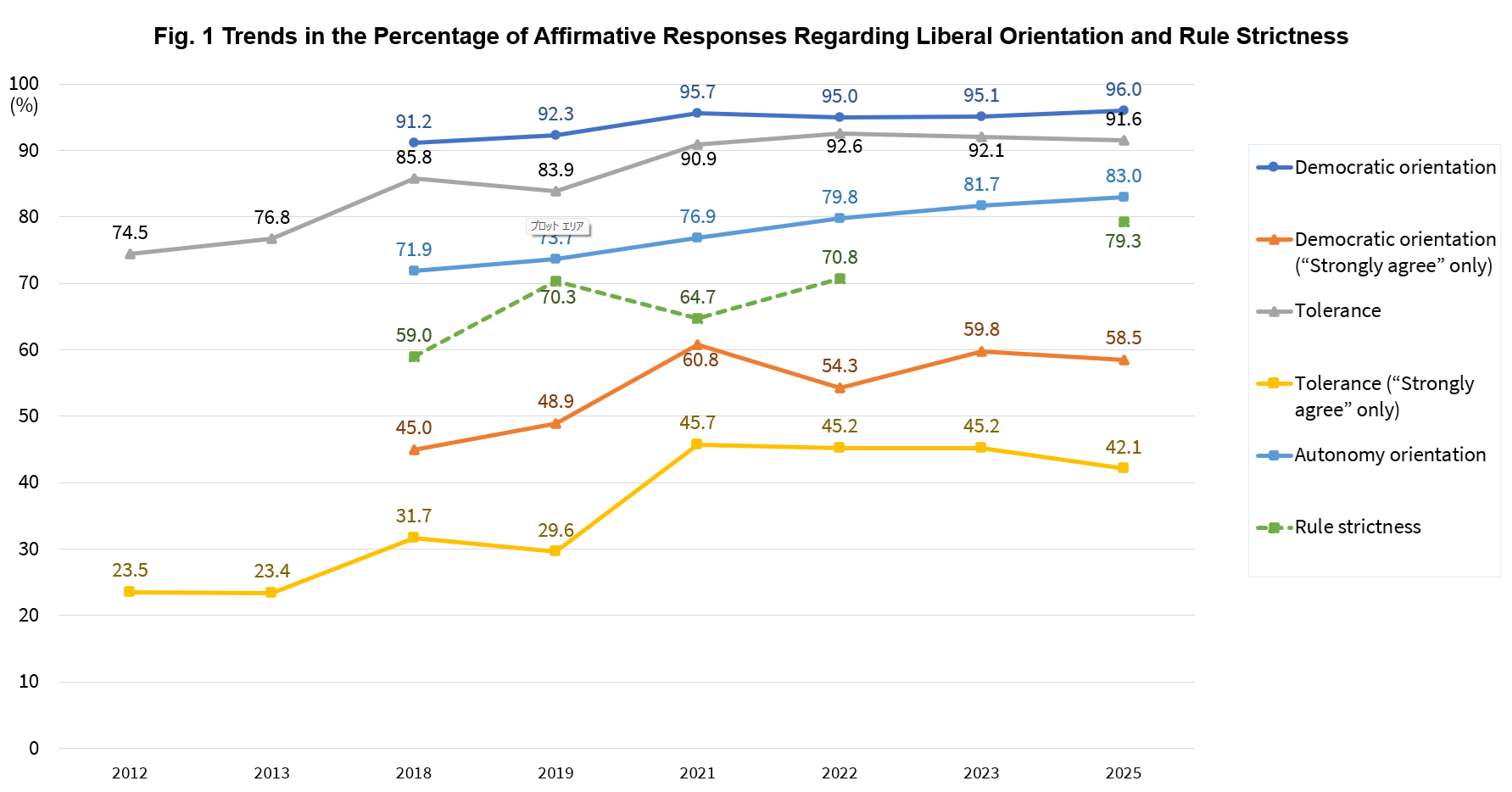
In short, democratic orientation and tolerance expanded even during the period of educational reform under the Abe administration in the 2010s. The momentum stalled after 2021, precisely when the conservative hue of education policy began to wane. Conversely, what surged sharply during this same timeframe was rule strictness. It is therefore difficult to support the simplistic narrative that conservative education policies directly brought about the conservatization or rightward shift of junior high school students.
Next, let us examine the changes in authoritarianism, emphasis on patriotism, and xenophobia-related consciousness. Figure 2 presents trends that contrast sharply with the items related to liberal orientation. Until around 2022, all three items were on a downward trajectory, after which they reversed course and climbed rapidly. The growth between 2023 and 2025 is particularly pronounced for emphasis on patriotism and xenophobia-related consciousness. In other words, while these attitudes moved in opposition to conservative educational ideals during the Abe administration, their sharp rise in 2025 coincides chronologically with the spread of right-wing populist political discourse.
To summarize these findings: first, while liberalization has slowed down in recent years, it can broadly be said to have progressed. This result diverges both from the right-wing argument that young people have come to reject liberal values and from the left-wing argument that educational reforms under the Abe administration instilled conservative attitudes in them.
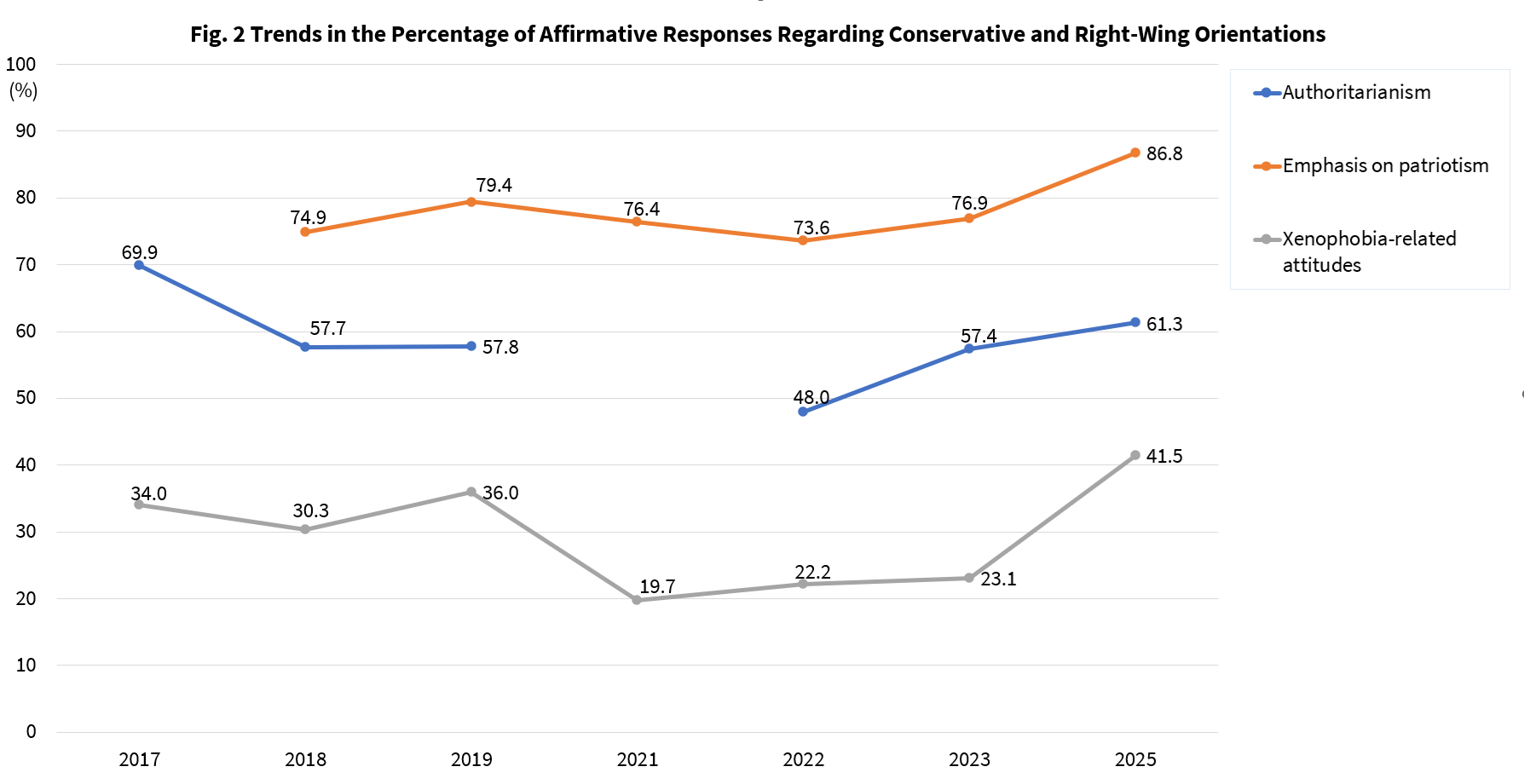
On the other hand, conservative and right-wing orientations, which had previously been declining, have surged rapidly since around 2022. While this could be termed “conservatization,” summarizing it as such would be an oversimplification, as liberal attitudes have not declined. This complexity lies at the heart of why current youth consciousness remains so difficult to decipher.
Factors associated with “conservatization”
Next, taking authoritarianism, emphasis on patriotism, and xenophobia-related consciousness as dependent variables, we examined their associations with democratic orientation, tolerance, autonomy orientation, rule strictness, and school adjustment through multiple regression analysis.[5] This approach investigates whether students holding stronger positions on these attitudes also exhibit higher levels of authoritarianism or xenophobia-related consciousness, while controlling for differences such as academic performance, social class, gender (female dummy), and school adjustment. Furthermore, to examine whether these connections altered specifically in 2025, interaction terms with a 2025 dummy variable were added. Note that school adjustment, included as a control variable, indicates the degree to which a student engages positively with school life and maintains stable peer relationships and self-worth within the school setting.[6] Yearly data were used exclusively from 2018, 2019, 2022, and 2025, for which data on all included variables were available.
The results are presented in the table below. The values in the table represent partial regression coefficients, and asterisks indicate that the explanatory variable is statistically significantly associated with the dependent variable.
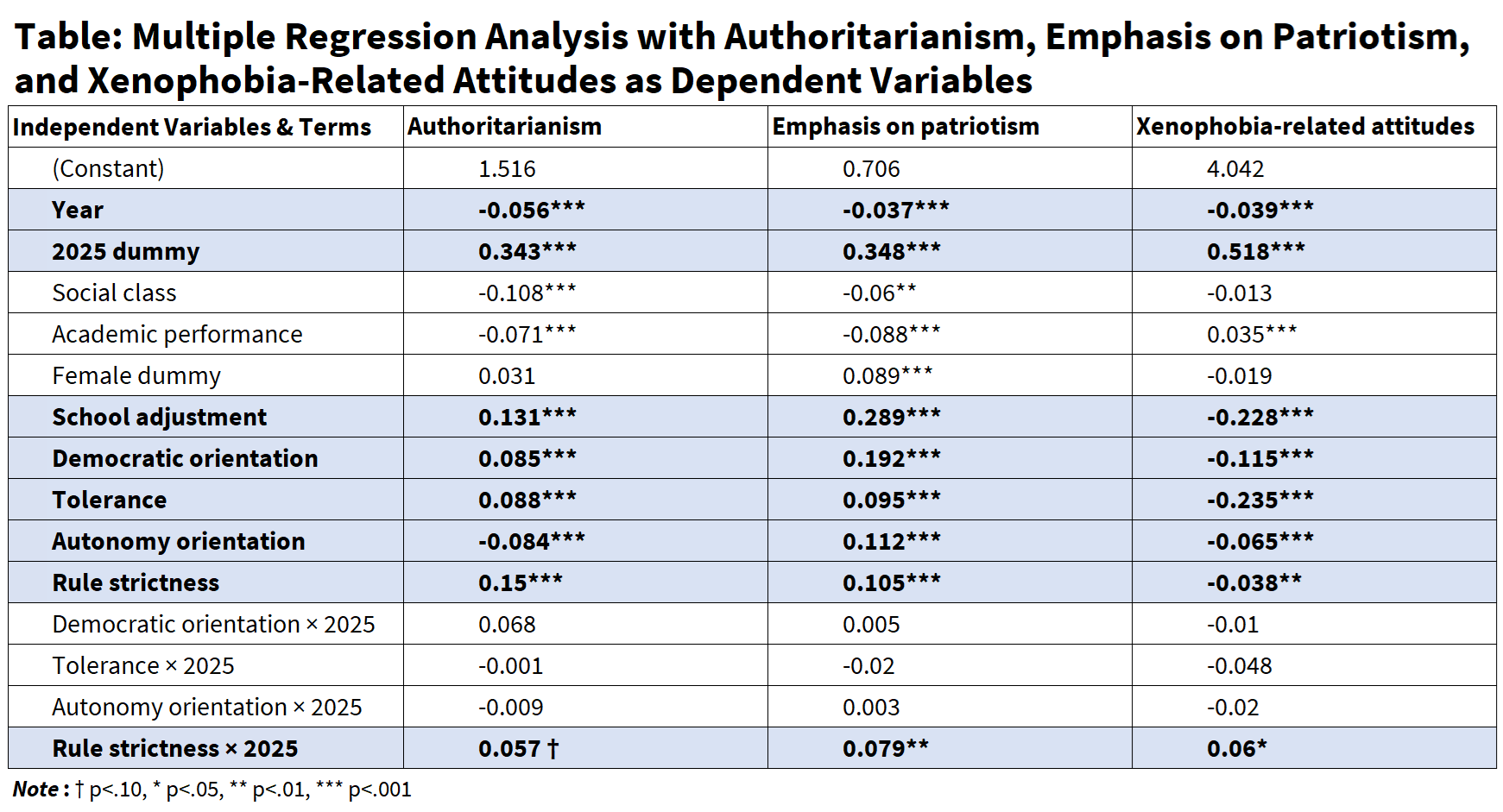
Several insights emerge from these findings. First, the year variable shows a statistically significant negative association across all models, indicating that authoritarianism, emphasis on patriotism, and xenophobia-related consciousness were on a downward trend after 2018. On the other hand, the 2025 dummy shows a positive coefficient in every model. In other words, despite the overall declining trend, an upward shift occurred in 2025.
Second, factors positively associated with authoritarianism were school adjustment, democratic orientation, tolerance, and rule strictness. Of particular interest is that even for liberal orientation items such as democratic orientation and tolerance, students holding more affirmative views also exhibited a higher tendency toward authoritarianism. While democracy and authoritarianism are typically conceptualized as opposing constructs, the two can coexist within the junior high school context.
Furthermore, rule strictness was the factor most strongly linked to authoritarianism. Conversely, autonomy orientation showed a significant negative association, suggesting that the drive for self-expression may run counter to authoritarian attitudes.
Third, emphasis on patriotism demonstrated positive relationships with all three liberal-orientation variables, as well as with rule strictness and school adjustment. This indicates that an emphasis on patriotism is not tied to school maladjustment or anti-liberal attitudes; rather, it overlaps with values highly endorsed in school environments, such as adjustment to school life, democracy, tolerance, autonomy orientation, and rule compliance. However, academic performance had a negative effect, revealing a slight tendency where students with higher grades exhibited lower levels of patriotism. Examining relative magnitudes reveals that school adjustment had the strongest association with emphasis on patriotism. This suggests that rather than alienated students gravitating toward nationalism, it is adaptation to school that aligns more readily with norms emphasizing patriotism.
Fourth, in stark contrast, xenophobia-related consciousness showed negative associations with nearly all explanatory variables (with the exception of academic performance, which was positive), tending to link with school maladjustment, low tolerance, and low democratic orientation. The negative correlation with tolerance was particularly strong: students with higher acceptance of others with different views showed lower levels of xenophobia-related consciousness. Yet, even after controlling for these variables, a large effect from the 2025 dummy remained, demonstrating that xenophobia-related consciousness surged in 2025.
What warrants further attention is the interaction term between rule strictness and the 2025 dummy. The main effect of rule strictness on xenophobia-related consciousness was negative, indicating that students who place higher importance on rules usually exhibit slightly lower levels of xenophobia. However, its interaction with the 2025 dummy was positive, signifying that this buffering relationship weakened. In other words, in 2025, the capacity of rule-abiding attitudes to curb xenophobia-related consciousness appears to have diminished, making it more easily connected to negative attitudes toward foreign residents than in the past.
While we have examined the results of the multiple regression analysis up to this point, this approach does not clarify the background behind the rise in conservative and right-wing orientation in 2025. Therefore, a Blinder-Oaxaca decomposition[7] was additionally conducted. This statistical method decomposes the mean differences between 2018–2022 and 2025 into compositional effects (changes in the distribution of explanatory variables), coefficient effects (changes in coefficients), and interaction effects. Although detailed results are omitted here, compositional changes in students’ social attitudes and school adjustment contributed to some extent to the increases in authoritarianism and emphasis on patriotism. Specifically, an increase in students who are strict about rules and well-adjusted to school acted in a direction that pushed up authoritarianism and emphasis on patriotism.
In contrast, the mechanism driving the rise in xenophobia-related consciousness was different. Compositional shifts in democratic orientation, tolerance, and school adjustment all functioned in a direction that should have lowered it. Nevertheless, xenophobia-related consciousness rose in 2025, suggesting that this change cannot be fully accounted for by the variables included in this model and is likely related to broader shifts in the societal context and discourse environment.
Beyond a “simplified image of youth”
Have junior high school students become conservative? The answer is neither a simple “yes” nor a “no.” Liberal orientation has risen, while conservative and right-wing orientation had been on a declining trend until recent years. On the other hand, it is also true that conservative orientations surged between around 2022 and 2025. Yet this rise has not come as a packaged set with a decline in liberal values; rather, the two continue to coexist.
Based on these findings, we need to distance ourselves from the narrative that “today’s youth are shifting to the right because they do not understand the importance of democracy or diversity.” For the vast majority of these young people, the importance of such values is self-evident. Indeed, they may perceive intolerance precisely in the critical attitudes of adults who dismiss them as ignorant.
Of course, some might fiercely argue that liberal values coexisting seamlessly with authoritarianism and patriotism are merely superficial. In fact, in a survey conducted by the author in April 2025 targeting adult survey panelists, 54% responded affirmatively to democratic orientation and 48% to diversity orientation (with negative responses under 10%) while more than half of those who answered affirmatively also answered affirmatively to statements such as, “Even if ideals like diversity and human rights are championed, I do not think they work in reality,” and “I feel that the respect for diversity and rights has gone too far, making today’s world suffocating.” Junior high school students, too, may simply be giving socially desirable answers while actually growing weary of the self-evidence of those values.
Even so, this does not mean that the values promoted in schools are meaningless. Among the variables examined in this study, the most contentious is xenophobia-related consciousness. Demonstrating a strong negative association against it were liberal orientations—most notably, tolerant attitudes. On the other hand, the value that “rules should be strictly observed”—an eminently school-like norm that has spread in recent years across the left-right spectrum—has become more easily connected to xenophobia than in the past. This implies that even an individual with liberal inclinations in other respects could easily shift toward foreign avoidance when exposed to news, for instance, about rule infractions by foreign residents.
Children and youth stand at the intersection of multiple vector forces operating both inside and outside of school. Feeling and understanding this complex magnetic field as fellow members of the same society—while resisting the urge to paint an overly simplified image of youth—must serve as the starting point for our discussion.
Translated from “Wakamono wa Hontoni ‘Hoshuka’ shiteiru noka: Chugakusei Ishikichosa kara Mieru Genzaichi (Are Young People Really Becoming “Conservative”? Current Perspectives from a Junior High School Consciousness Survey),” Chuokoron, July 2026, pp. 160–167 (Courtesy of Chuo Koron Shinsha) [October 2026]

NIHEI Norihiro, Ph.D.
Professor, Graduate School of Education, The University of Tokyo
Born in Ibaraki Prefecture in 1975. Completed doctoral studies at the University of Tokyo Graduate School. Holds a PhD in Education. Specializes in sociology. His publications include “Borantia” no Tanjo to Shuen (The birth and demise of “volunteers”) (winner of the Sompo Japan Memorial Foundation Award and the Japan Sociological Society [JSS] Encouraging Award) and co-edited works such as Rodo Saishin: Kea, Kyodo, Anpeido Waku (Labor re-examination: Care, collaboration, and unpaid work), Heisei-shi (A history of the Heisei era), Shimin Shakai-ron (Theories of civil society), 1990-nendai-ron (Discourses on the 1990s), Kyoikugaku Nenpo (Annual report of pedagogy).
[1] Sanseito, founded in 2020, uses “Party of Do It Yourself” (DIY) as its official English name, framing itself as a grassroots party. Meanwhile, domestic and major international media outlets often describe the party within the frameworks of “right-wing populism,” “ultra-conservatism,” and “anti-globalism,” based on its policy stance.
[2] Refers to a series of Prime Minister-led educational reform initiatives launched by the Abe Shinzo administration starting in January 2013. Its primary pillars included fostering patriotism and respect for traditional values, improving academic standards, and preparing students for globalization.
[3] See, for example, Oguma Eiji, “‘Liberal’ and Pacifism in Postwar Japan—Their Given Conditions and Historical Background,” Japan Policy Forum (March 27, 2024).
[4] “Slush-fund lawmakers” refers to members of the National Diet involved in the scandal surrounding fundraising party revenues organized by factions within the Liberal Democratic Party. These lawmakers allegedly received kickbacks for sales exceeding their quotas without reporting the income in their political finance reports.
[5] Supplementary analysis using ordinal logistic regression was also conducted, yielding overall consistent directional results for key findings. However, because the proportional odds assumption was rejected, it is treated as supplementary.
[6] Specifically, it uses the mean score of five items: “I work hard in school classes,” “I am interested in studying,” “I get along well with school friends,” “I feel confident in myself,” and “I can be myself in class.” Internal consistency of the scale has been verified.
[7] The Blinder-Oaxaca decomposition is a statistical method used to decompose differences or changes between groups (or time periods) into explained components attributable to demographic or individual characteristics and unexplained components attributable to structural factors.
Keywords
- youth
- liberal
- conservative
- conservatization
- liberalization
- authoritarianism
- democratic orientation
Related posts:
 Expos as Sites of Experimentation: Considering the Architecture of Expo 2025
 How Should We Respond to Successive Incidents? Understanding through a Culture of Coexistence: Bears and the Japanese People
 How the “Free and Open Indo-Pacific” Has Evolved: The New Scope of “FOIP 3.0”
 The Strategic Logic of “Autonomy” in Asian Decarbonization: What Should Japan Connect?
 Is This the Potential of Japan Escaping the “Deflationary Trap”?