


The Reality Revealed by China’s “War Preparations”: How Far Can the Three Security Documents Go?
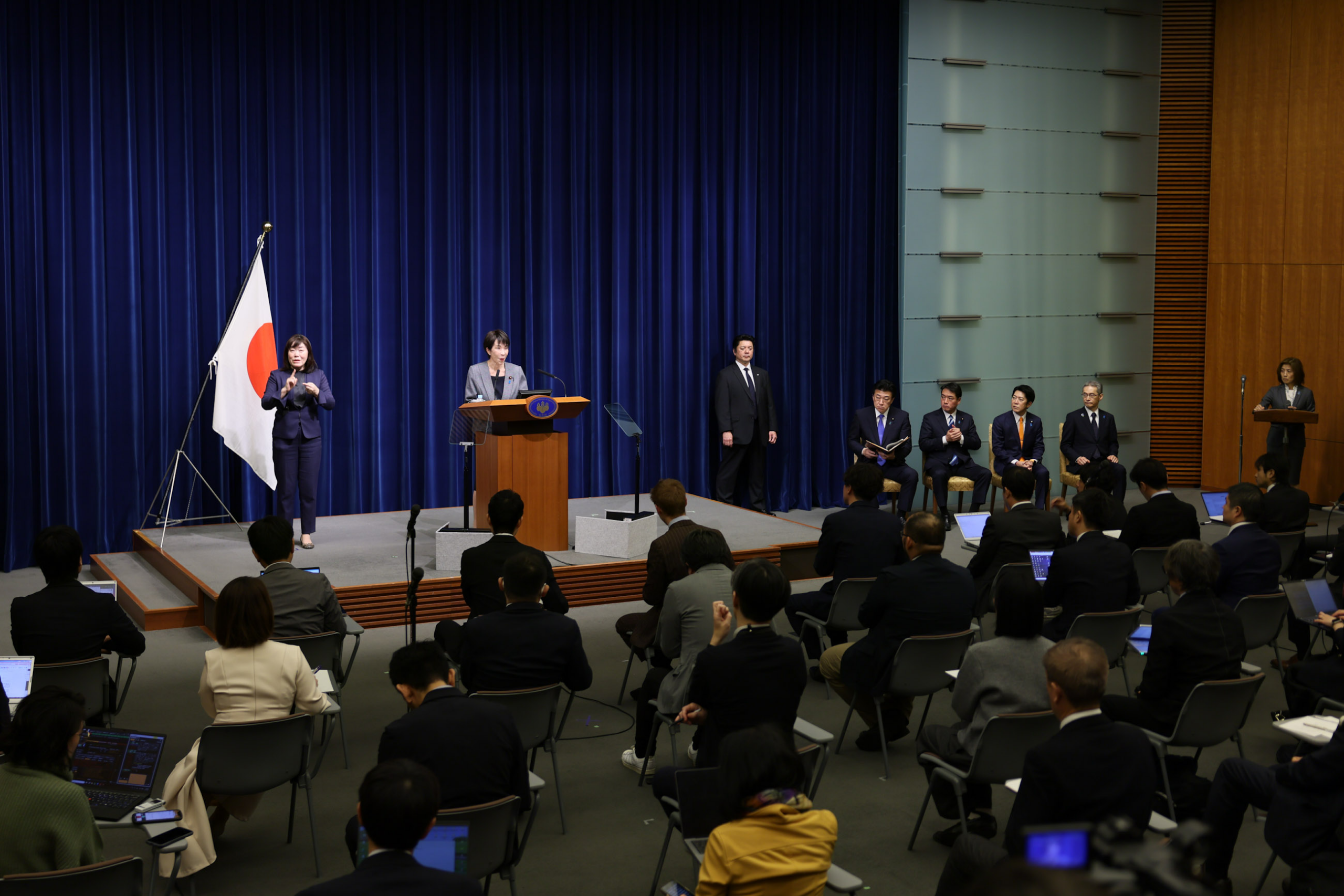
Prime Minister Takaichi Sanae stated at a press conference held at the Prime Minister’s Office on December 17, 2025, that “Given the rapidly changing security environment, we must implement a fundamental reinforcement of our defense capabilities in accordance with Japan’s sovereign discretion. To that end, we will accelerate discussions focused on revising the ‘Three Strategic Documents’ by the end of 2026. In addition, the enactment of the supplementary budget allocating 1.1 trillion yen for security-related expenditures, in combination with the initial budget for fiscal 2025, has resulted in us attaining a level of defense spending equivalent to 2 percent of GDP, as stipulated in our National Security Strategy.”
Photo: Cabinet Public Affairs Office
China is attempting to redesign the entire nation, including its economy and governance, into a form capable of withstanding conflict. Rather than obsessing over predictions regarding when a war might break out, Japan should address the pressures accumulating in peacetime and enhance the resilience of government decision-making and private infrastructure.
What is the essence of China’s “preparation for war”?
The “preparation for war” being pursued by China’s Xi Jinping administration does not directly imply an invasion of Taiwan tomorrow. However, it would also be a mistake to dismiss it as an empty political slogan. What is currently underway within the Chinese leadership is the process of restructuring peacetime governance, military operations, industrial policy, and national mobilization into a framework that can easily transition to a contingency setting. What Japan must observe is not predictions of dates regarding “when China will attack,” but rather the extent to which China is establishing the conditions that allow it to choose war as an option.
In that sense, the shifts in the discipline and operations of the Chinese military are symbolic. In recent years, China has revised even basic rules such as internal affairs, discipline, and formation, clarifying its direction toward placing combat readiness at the center of daily management. The newly revised “Regulations on the Internal Affairs of the Chinese People’s Liberation Army (PLA),” promulgated in February 2025 and implemented in April of the same year, explicitly mandates the establishment of regular combat readiness, training, work, and living order, while stipulating emergency assembly drills at least once every six months at the brigade and regimental levels. What is crucial is the fact that preparation for war is no longer a special state activated only during exercises or large-scale mobilizations, but is becoming embedded in the very operation of the military during peacetime.
The PLA Daily, the official newspaper of the Chinese military, also frames recent joint operational exercises by stating, “Exercise preparation is itself operational preparation, and the exercise state itself is the operational state.” If combat readiness, training, work, and living order are treated as a continuous stream of management, the Chinese military will shift from an organization that fights during a contingency to one that operates during peacetime under an order close to that of a contingency. This is not merely military expansion, but a change in the very nature of the military itself.
Moreover, this shift is not confined to the military itself. In China’s policy documents, military affairs are not treated as an independent field isolated from the economy or society, but are discussed within the same context as development policies. A prime example is how the “centenary goal” of military building for 2027, the strengthening of combat readiness, the enhancement of military capabilities, and the construction of an integrated national strategic system and capabilities are aligned within the framework of “balancing development and security.”
On March 12, 2026, the Fourth Session of the 14th National People’s Congress (NPC) approved The Outline of the 15th Five-Year Plan, which explicitly stipulated implementing national defense requirements in major infrastructure, adhering to “the integration of the military and civilians, and the integration of peacetime and wartime,” and accelerating the enhancement of national defense mobilization capabilities. This is not an approach that singled out the military alone. It is a concept aimed at making the entire nation resilient to an era of strategic confrontation and reconstructing a system capable of transitioning to a contingency if necessary. What the Chinese leadership is pursuing should be viewed not merely as military modernization, but as a design change toward a nation capable of withstanding war.
Military purges and the real meaning behind the 2027 Taiwan contingency theory
From this perspective, the meaning of the military purges conducted in China in recent years also changes. While it is easy to understand the dismissal and downfall of high-ranking military officers as the strengthening of Xi Jinping’s dictatorship, that alone is insufficient. What is more important is that China is trying to build a structure that transmits the will of the Chairman of the Central Military Commission down to the joint operational field without any distortion. Here, factions, personal networks, turf wars between military services, and traditional command cultures are all easily treated as obstacles.
The core of the “anti-corruption” campaign pursued by China lies less in the pursuit of corruption in general than in the removal of elements that impair the CMC Chairman Responsibility System and hinder the unified operation of the military. That is precisely why it is closer to reality to understand the military purges not merely as power struggles or warnings to others, but as part of a process to restructure the military into a command system that functions during a contingency. At least within the scope of publicly available information, conclusive evidence confirming recent dismissals as manifestations of attempted military coups or widespread military defection has not been presented; rather, what can be verified are moves toward strengthening control and reorganizing the command structure.
However, such restructuring in China also creates friction in the short term. Personnel vacuums, declining morale, evasion of responsibility, and disruptions in procurement place a burden on readiness and decision-making speed in the field. If field units shrink back in fear during the process of strengthening control and reporting is delayed, operational flexibility may also be compromised in the short term. Therefore, military purges do not immediately mean that it has become easier for China to conduct a war. It is necessary to discern the dual nature of short-term confusion and medium-term reintegration.
What should be clarified here is the so-called 2027 Taiwan contingency theory. While 2027 is a symbolic milestone marking the centenary of the founding of the People’s Liberation Army (PLA), leaping to the conclusion that China will immediately invade Taiwan from that point is a stretch. A more reasonable interpretation is to view 2027 as a milestone by which China aims to raise its military modernization and the reliability of its joint operations to a higher level. In other words, 2027 is not a prediction of when China will start a war, but a benchmark for enhancing the effectiveness of its options, including the use of force. Asserting 2027 as the definitive year of a Taiwan invasion turns the discussion sensational, whereas assuming that a war will definitely not occur leads to overlooking the progress in capacity building. What is needed is not a gamble over dates, but tracking changes in the Chinese military’s capabilities, command, logistics, mobilization, and peripheral activities.
Pressures and complex crises ahead of a full-scale invasion
In addition, the methods China is more likely to employ first are not a full-scale invasion itself, but coercive measures short of such an invasion. What recent exercises targeting Taiwan demonstrate is the reality that elements such as encirclement, port blockades, land and maritime strikes, and the deterrence of external intervention are being systematized as peacetime exercises. Particularly in the “Strait Thunder 2025A” exercise in April 2025, confirmation and identification, warning and expulsion, and interception and detention were designated as key subjects, and the verification of capabilities in area control, joint blockade, and precision strikes came to the forefront. This indicates that prior to any immediate decision on a full-scale PLA amphibious landing, means such as blockades, coercion, economic pressure, psychological disruption, and the severance of external support are being prepared in a form that can be used incrementally. Furthermore, cognitive warfare utilizing disinformation and AI cannot be ignored. What China finds easiest to employ for the time being is not the highest-intensity war, but options that shake the opponent’s decision-making through such coercive measures.
This point is particularly important for Japan. A Taiwan contingency does not begin on the day an amphibious landing starts. If maritime blockades, pressure on sea lines of communication, airspace restrictions, coercion using the China Coast Guard (CCG) and civilian vessels, information disruption, and cyber interference overlap, Japan’s transport, the operations of US Forces Japan, vigilance in the Nansei Islands, and private economic activities will be severely affected from a prior stage. In other words, starting Japan’s crisis management after the outbreak of war is confirmed will be too late. The phase in which low-intensity coercion accumulates prior to the outbreak of war will constitute the first critical phase.
What cannot be overlooked in this context is China’s narrative linking Japan’s strengthening of defense capabilities and its references to Taiwan to “neo-militarism” and “remilitarization.” In Regular Press Conferences on April 17, 20, and 22, 2026, the Ministry of Foreign Affairs of the People’s Republic of China criticized Japan’s Taiwan-related statements and security policies by linking them to “remilitarization” and “neo-militarism.” This is not merely a matter of historical perception. At least in terms of its function, it operates as a double standard that masks China’s own preparations for war while painting only Japan’s preparedness as dangerous, and it has the potential effect of shaking the legitimacy of defense strengthening and involvement in a contingency within Japanese public opinion. Furthermore, should Japan become involved in a Taiwan contingency scenario, it could also be utilized by the Chinese side as a political resource to denounce that involvement as a “resurgence of militarism.” China’s preparation for war and its narrative offensive against Japan should not be viewed in isolation.
The interpretation of the aforementioned 15th Five-Year Plan should be framed in the same way. It is not appropriate to conclude that China has become wholly consumed by preparations for war. What China is simultaneously prioritizing includes boosting consumption, technological innovation, maintaining advanced manufacturing, investing in research and development, and strengthening the domestic market. More accurately, rather than war preparations swallowing up economic policy, it should be viewed as the logic of security and contingency responsiveness having penetrated more deeply into development policies than before.
In recent years, as demonstrated by the fact that commercial RORO ferries—civilian vessels for carrying vehicles in China—have been modified with structures suitable for amphibious operations and deployed in military exercises, the true threat lies precisely in the establishment of a military-civil fusion system in which the military and the economy become inseparable. The issue for Japan does not lie in the single point that China is expanding its military, but in the point that China’s economy, technology, industry, data, and military are being restructured on the premise of a confrontational environment.
Crises spilling over into the periphery of Japan and the true challenge of the three security documents
What is urgent for Japan is that this shift in China is not limited to the Taiwan Strait alone. In the waters around the Senkaku Islands, activities by the China Coast Guard (CCG) continue with high frequency, and intrusions into Japan’s territorial waters as well as approaches to Japanese fishing vessels are repeatedly occurring. On May 3, 2025, a vessel-based helicopter launched from a CCG ship violated Japanese airspace near the Senkaku Islands. Furthermore, in June 2025, the Ministry of Defense confirmed the simultaneous activities of two Chinese aircraft carriers, revealing that one of them operated in the waters east of Iwo Jima for the first time. These facts demonstrate that tensions in the Taiwan Strait and military activities around Japan are not separate, but closely linked. The sea and air space surrounding Japan itself has already become the front line of crisis management.
Moreover, the problem is not limited to the increase in China’s volume of activity. On the front lines, the accumulation of close approaches, tailing, communication failures, and differing interpretations of dangerous actions could turn an accidental encounter directly into a political crisis. What Japan should assume first is not a full-scale attack by China, but rather limited coercion, expulsion actions, and accidental collisions in the areas surrounding the Senkaku Islands, the southwestern airspace, and surrounding maritime and airspaces linked to a Taiwan contingency. If the CCG, navy, air force, UAVs (drones), and even civilian vessels operate in a multilayered manner, Japan’s initial response will require the simultaneous execution of law enforcement by the Japan Coast Guard (JCG), surveillance and monitoring by the Self-Defense Forces, government crisis management, and alliance coordination. A delay in decision-making here allows China to build up faits accompli, whereas moving precipitously risks escalating the conflict.
That is precisely why a Taiwan contingency and an accidental Sino-Japanese collision must be treated not as separate events, but as a single continuous crisis. For China, applying pressure on the Taiwan front and expanding points of contact around Japan are not isolated actions. In a phase aimed at deterring US and Japanese involvement in Taiwan, incentives naturally arise on the Chinese side to increase coercion and the frequency of contact around Japan. If Japanese policymakers overlook this linkage, crises will be handled as separate issues, resulting in a loss of the overall picture of the Chinese side.
From this perspective, the meaning of revising the three security documents also changes. What is currently being called into question is not merely a quantitative debate over how much to increase defense spending or what equipment to procure and in what quantities. The Three Security Documents of 2022 presented a framework that placed the National Security Strategy at the highest level, under which the National Defense Strategy and the Defense Buildup Program are layered. However, on December 17, 2025, the government declared, “we will accelerate discussions focused on revising the ‘Three Strategic Documents’ by the end of 2026,” stated the necessity of an early revision on January 19, 2026, and in the Policy Speech on February 20, 2026, explicitly announced that it would revise the three security documents ahead of schedule within this year. In the background are the emergence of new ways of warfare and the necessity of preparing for prolonged conflict. In the next revision, what is required is a practical design that handles peacetime contacts, limited coercion, gray-zone situations, localized conflicts, cyber disruption, and resident evacuation along a single continuum.
The revision of the three security documents must not be a rewriting of philosophies from a blank slate, but a redesigning that checks how far the 2022 design can withstand China’s current actions and fills in the missing pieces. What is truly being called into question is not an abstract theory of whether to strengthen deterrence. It is whether state functions can be maintained even in a scenario where deterrence fails.
For example, when suffering an initial strike in the Nansei Islands, for how many days can units remain operational? To what extent can ports, runways, fuel, ammunition, communications, electricity, medical care, and resident evacuation be maintained? In the process of transitioning from law enforcement by the Japan Coast Guard (JCG) to responses by the Self-Defense Forces, and further to US-Japan joint operations, within how many hours, under what authority, and what information must be shared? A revision that cannot answer these questions cannot be said to be practical, no matter how strong the language lined up in it.
Japan needs national endurance and redesigned crisis management
What is essential here is not to confine the three security documents as documents for the Ministry of Defense alone. What China is advancing is not war preparations by the military alone, but raising the wartime responsiveness of the nation as a whole. If that is the case, Japan must also reinterpret the three security documents not as documents that remain merely defense capability development plans for the Self-Defense Forces, but as connecting documents for responses across the entire government—encompassing law enforcement agencies, local governments, ports, airports, communications, electricity, medical care, logistics, and cyber defense. In the initial stages of a crisis, every incident emerges at the boundary between military and non-military, law enforcement and security, and domestic administration and external deterrence. Without a design that spans those boundaries, Japan cannot withstand an actual crisis.
At the same time, the revised three security documents should explicitly demonstrate not just what Japan possesses, but how to use it and how to endure. Debating only the presence or absence of counterstrike capabilities will not enable Japan to deal with China’s multilayered pressures. What the Chinese leadership employs is not the navy alone, nor the air force alone. It is a complex pressure involving the China Coast Guard (CCG), UAVs (drones), information warfare, cyber disruption, and civilian vessels, and China’s aim is not merely to land physical strikes, but to exploit delayed decisions and institutional divisions on the Japanese side. Therefore, what Japan must prepare goes beyond missiles and naval vessels alone. A legal framework capable of transitioning from peacetime to a contingency without delay, information sharing, consistency of command, civil protection, and the resilience of civilian infrastructure—these constitute the very substance of defense capability.
Here, what separates the success or failure of policy is not the novelty of philosophies, but the specificity of implementation guidelines. Who moves first during a crisis? At what stage does the transition to which situational determination occur? Where is the threshold at which an incident of contact on the front lines switches from mere law enforcement to a security response? How can the institutional disruption occurring between law enforcement and a defense dispatch be bridged to achieve a seamless transition? How quickly can the same situational awareness be shared among Japan’s central and local governments, the civilian sectors and the uniformed personnel, and the Japanese government and the US military? As long as these areas remain ambiguous, no matter how magnificent a national strategy is written, it will not function in an actual crisis. What is being called into question in the next revision of the three security documents is not the updating of philosophies, but the design of the speed and endurance of national decision-making.
Therefore, what Japan must prepare against China’s war preparations is not counter-slogans. What is needed is to reconnect deterrence, crisis management, operational sustainment, civil protection, private infrastructure protection, and economic security into a single national strategy. Prior to starting a war itself, China is transforming itself into a nation capable of choosing war. That is precisely why Japan cannot stop at merely asking whether a war is coming. Japan must ask what will happen before it arrives, and whether state functions can be maintained afterward. What is truly being tested in the revision of the three security documents is not the addition of equipment, but how far national endurance and crisis management can be recreated in line with reality. Whether Japan can address this core issue will mark the next turning point for Japan’s security.
Translated from “Tokushu 1 ‘Senso no Jidai’ no Boei Senryaku: Chugoku no ‘Sensojunbi’ ga Tsukitsukeru Genjitsu — Anpo Sanbunsho wa Dokomade Fumikomeruka (Special Feature 1: Defense Strategies in the ‘Age of War’: The Reality Revealed by China’s “War Preparations”: How Far Can the Three Security Documents Go?),” Voice, July 2026, pp. 98–105. (Courtesy of PHP Institute) [July 2026]
TSUCHIYA Takahiro, Ph.D.
Professor at the Institute for Liberal Arts and Sciences, Kyoto University of Foreign Studies

He graduated from the Faculty of Environment and Information Studies at Keio University, earned a master’s degree from the Graduate School of Economics at Hitotsubashi University, and completed the doctoral program at the National Defense Academy’s Graduate School of Security Studies, receiving a Ph.D. in security studies. He previously served as a researcher at the Consulate-General of Japan in Hong Kong and as an associate professor in the Faculty of Economics and Business Administration at Kyoto University of Advanced Science. His coauthored books include Shu Kinpei no Gunji Senryaku: “Kyogun no Yume” wa Jitsugen suruka (Will Xi Jinping’s military strategy of “strong military dream” be realized?) (Fuyo Shobo, 2023) and Beichu no Keizai Anzen Hosho Senryaku: Shinko Gijutsu wo Meguru Aratana Kyoso (US-China economic security strategy: New competition over emerging technologies) (Fuyo Shobo, 2021).
Keywords
- war preparations
- combat readiness
- Taiwan contingency
- three security documents
- crisis management
- peacetime
- national endurance
Related posts:
 In Memoriam: Dr. Iriye Akira, Professor Emeritus at Harvard University—The Broad Perspective and Ideals That Championed “The Internationalization of History”
 “A World with America” and “A World without America”
 Xi Jinping’s Regime: Political Dynamics of Personal Dictatorship
 Defending Japan’s Sovereignty in the AI Era: Leveraging Linguistic Uniqueness to Build Sovereign AI
 From Support to Participation: The Future of ASEAN-Japan Relations