


Social Security Reform Over Consumption Tax Cuts
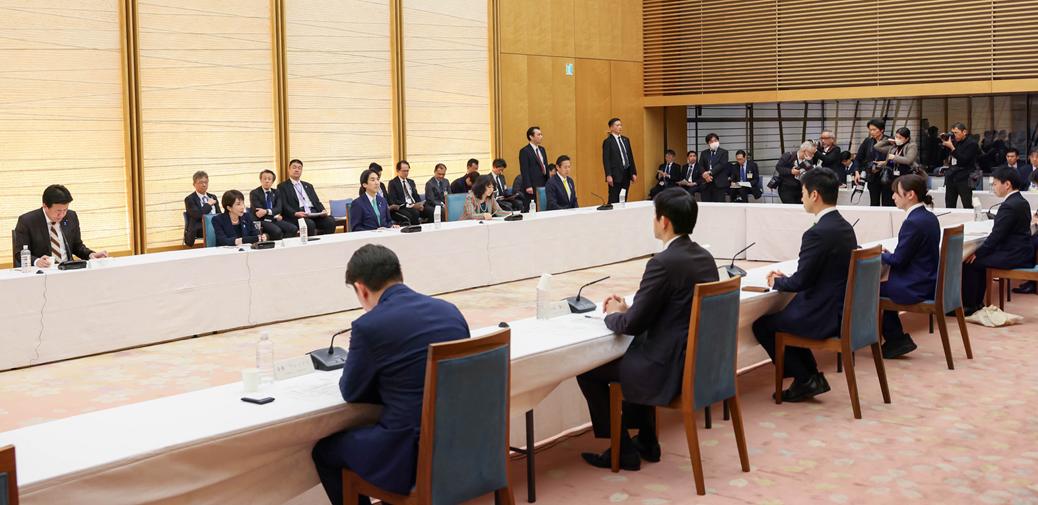
On February 26, 2026, Prime Minister Takaichi Sanae held the first meeting of the National Council on Social Security at the Prime Minister’s Office. Prime Minister Takaichi stated, “We need to proceed with discussions on comprehensive reforms of social security and taxation systems, including designing a system for refundable tax credits as the main focus,” and outlined a direction toward “without relying on deficit-financing bonds, a two-year zero-rate consumption tax on food and beverages currently subject to the reduced tax rate.” Discussions have continued since then.
Photo: Cabinet Public Affairs Office
Is a Consumption Tax Cut Necessary?
In her policy speech to the Diet (February 20, 2026), Prime Minister Takaichi Sanae announced that, in order to alleviate the burden on middle- and low-income households “struggling with tax and social insurance burdens as well as rising prices,” the government will proceed with discussions within a bipartisan “National Council on Social Security” (hereinafter “National Council”) regarding “comprehensive reforms of social security and taxation systems, including designing a system for refundable tax credits.” At the same time, she stated that as a transitional measure until the implementation of a refundable tax credit system, the reduced tax rate on food and beverages would be set to zero. The resulting revenue loss, which amounts to over 5 trillion yen annually, will be managed “without relying on deficit-financing bonds,” and the tax cut period will be implemented “for a limited duration of two years.” On that basis, she declared that the government would “accelerate the examination of various issues toward its realization, such as the schedule and funding sources,” aiming to submit legislation related to the consumption tax cut to the extraordinary Diet session in the autumn. Following the two-year tax cut measure, the tax rate on food items is intended to revert to the current 8%[1] (Prime Minister’s response at the Budget Committee of the Lower House [February 27]).
Initially, the National Council included the ruling coalition (Liberal Democratic Party [LDP] and Japan Innovation Party [JIP]), as well as the Democratic Party for the People (DPP) and Team Mirai. Although it has been decided that a refundable tax credit system and a consumption tax cut will be discussed in parallel, the intentions of each party do not necessarily align. The DPP initially demanded a uniform consumption tax cut. On the other hand, Team Mirai is negative toward the consumption tax cut itself and argues that priority should be given to reducing social insurance premiums. Regarding the refundable tax credit system as well, the DPP advocates for “resident tax deductions with social insurance premium refunds.”
Academic economists are critical of these moves toward a consumption tax cut. According to an Economics Panel survey released at the end of January prior to the Lower House election by the Japan Center for Economic Research (JCER) and Nikkei, approximately 90% of respondents expressed a negative view regarding a zero-percent consumption tax on food items. Reasons cited include concerns over the worsening of the nation’s fiscal situation and the negative impact on industries such as the food service sector that would not be covered by the tax cut.
Furthermore, there is no guarantee that the tax cut will remain limited to two years. Raising the zeroed-out consumption tax rate on food items back to 8% all at once is politically unrealistic. Economically as well, concerns over last-minute demand rushes and subsequent reactions would likely emerge. In 1999, a “proportional tax cut,” which deducted a fixed percentage (20%) from the income tax amount, was introduced as an economic stimulus measure. What was intended as a temporary tax cut measure was not completely abolished until 2007. This shows that restoring a once-reduced tax rate to its original level requires considerable “political energy.” If so, the 5 trillion yen tax revenue decrease could very well become prolonged.
Questions also remain regarding the economic effects of the tax cut. In the first place, food prices are determined by the market balance between supply and demand, so even if the consumption tax rate is reduced to zero, it does not necessarily mean that a food item priced at 1,080 yen including tax will drop to 1,000 yen. This is because if demand increases due to the tax cut but production (supply) cannot keep pace, the market price (excluding tax) will rise. This would be all the more so if demand shifts from dining-out services[2] —which are not eligible for the tax cut—to groceries.
This is also evident from international cases. Following the 2008 Global Financial Crisis (GFC), France temporarily reduced the value-added tax (VAT) on restaurant dining, but much of the benefit is said to have accrued to business owners. Time-limited tax cuts were also implemented in countries such as the UK during the COVID-19 pandemic (2020). In the UK, hotels and restaurants were subject to the tax cut, and while the benefit was passed on to consumers in the form of lower hotel rates, the effect is said to have dissipated after about two months.
Is a Consumption Tax Cut Immediately Effective?
The government intends for the consumption tax cut to serve as a “bridge” until the introduction of a refundable tax credit system. However, tax cuts cannot be implemented swiftly, either. While there are active debates in public over whether modifying store registers will take more than a year or can be done quickly, the issue is not limited to retailing. The consumption tax is levied not only at the retail stage, such as convenience stores and supermarkets, but on all transactions, including production and wholesale. For instance, fertilizer and fuel purchased by farmers are also subject to the consumption tax. Consumption tax is also levied when agricultural products are sold to businesses such as supermarkets.
At this point, there is an “input tax credit” system under which the amount of consumption tax paid when purchasing fertilizer or fuel is deducted from the amount of consumption tax collected on sales. Suppose a farmer purchases 100,000 yen worth of fertilizer (excluding tax) and sells agricultural products for a base price of 150,000 yen. Since the consumption tax on fertilizer is 10%, the consumption tax paid equals 10,000 yen (100,000 yen × 10%). On the other hand, because the consumption tax rate on sales is 8%, this farmer adds 12,000 yen (150,000 yen × 8%) of consumption tax to the 150,000 yen base price for sale. The payable amount of consumption tax becomes 2,000 yen (12,000 yen – 10,000 yen), obtained by deducting the 10,000 yen paid from the 12,000 yen collected. From the farmer’s perspective, since the paid consumption tax is refunded in this manner, no tax burden arises. But what if the tax rate on food items is reduced to zero here? Since consumption tax would still be levied on purchases, a new process for refunds would become necessary.
What becomes particularly problematic is the “simplified tax system[3]” chosen by many small and medium-sized farmers. This is a system in which a fixed percentage of sales is deemed as purchases and deducted. In the case that a farmer’s sales are 150,000 yen and the deemed purchase ratio is 80%, the taxable amount is calculated by multiplying 30,000 yen (150,000 yen – 150,000 yen × 80%) by the 8% tax rate. If this tax rate becomes zero, the deduction for purchases also disappears. Similar issues will also occur at supermarkets and other businesses that specialize in food items. Devising measures to address these issues regarding consumption tax refunds and the simplified tax system is bound to take time. If so, a consumption tax cut is unlikely to serve as an immediately effective measure against rising prices.
How to Handle Funding Sources?
In the Lower House election of February 2026, in which the Takaichi-led LDP won a major victory, the Prime Minister advocated for “overcoming the spell of excessive fiscal austerity” while appealing that cutting the consumption tax on food items was a “long-cherished desire.” In this way, the assertion appeared to gain the “will of the public.” However, even if the public’s approval is obtained, market “confidence” is not necessarily secured. Government bond yields (10-year bonds) continue to fluctuate above 2%. In the foreign exchange market, the yen has also been depreciating, trading in the 158-yen level against the US dollar (as of April 10). Market confidence is not determined by a majority vote in an election. For the time being, the current administration will likely find itself “caught in the middle” between politics (the public will?) calling for tax cuts and expanded spending, and markets concerned about fiscal deterioration. The so-called “loss of confidence” in government bonds and currency due to fiscal worsening is not a matter of sentiment among investors. Rather, unlike during periods of deflation, it can be said to be the result of the government bond and foreign exchange markets functioning “normally” in response to fiscal deficits and increased government bond issuance.
Of course, neither the ruling nor opposition parties rely solely on fiscal deficits. In the Lower House election, various parties cited the review of special taxation measures and subsidies, as well as the utilization of surplus funds from the Foreign Exchange Fund Special Account (FEFSA), as funding sources for the consumption tax cut. Special taxation measures for corporate enterprises are estimated at approximately 2.9 trillion yen for fiscal 2023. However, 1.2 trillion yen of that amount—derived from reviewing R&D tax incentives and wage-increase tax incentives—is allocated to fill the shortfall resulting from the abolition of the provisional gasoline tax rate, among other things. Furthermore, while the FEFSA surplus funds reached over 5 trillion yen in fiscal 2024, 3.2 trillion yen was carried over into the fiscal 2025 budget, with about 1 trillion yen of that directed toward defense spending. Once the prospective portions of special taxation measures and surplus funds are used, they cannot be allocated elsewhere. Although there may be expectations for natural growth in tax revenue, a natural increase of 6 trillion yen has already been factored into the initial budget for fiscal 2026. Further increases in revenue seem difficult to expect.
There may also be a backlash against political intentions—such as a consumption tax cut—being bound by the market. However, the financing systems of modern states have been built upon market economies. The so-called “Truss shock” that occurred in the UK (September 2022) remains fresh in our memory, and it was precisely an attack from the market against politics that treated fiscal discipline lightly. Even if politics attempts to break free from the “spell” of fiscal discipline, it cannot escape the “discipline” of market confidence. If so, accepting this as a constraint and doing one’s best within that framework can be said to be the mark of a “wise government.”
What is tax cut populism?
The consumption tax has long been disliked by both the public and politicians. According to a questionnaire survey conducted by the author at The Tokyo Foundation for Policy Research, while academic economists evaluated the consumption tax as an efficient tax that serves as a stable revenue source with little distortion to investment and employment, the general public held a negative view, seeing it as adverse to the economy and regressive. Why is this? The consumption tax is said to carry a stronger sense of tax burden compared to other taxes. Indeed, many retail stores, such as supermarkets, display both tax-excluded prices and tax-included prices (total amount display). While the display of tax-included prices became mandatory in April 2021, with concurrent listing of tax-excluded prices permitted, consumers cannot help but be conscious of the consumption tax that constitutes the difference. This stands in contrast to income tax and social insurance premiums, which are automatically deducted from compensation without one’s knowledge unless checked personally on pay slips or payment statements.
Of course, the pain of paying taxes (tax awareness) is not inherently bad. It provides an opportunity for the public to pay attention to national finances and demand fiscal discipline to avoid wasteful spending. However, politicians tend to seek funding sources that carry no sense of burden—including fiscal deficits—so as to evade such discipline. Here, a distinction should be made between “visible burdens” and “invisible burdens.” The consumption tax is a typical example of the former, while fiscal deficits—namely, the increased issuance of government bonds—exemplify the latter. In recent years, so-called “tax-cut populism” has become prevalent in politics. Tax-cut populism gains political support by appealing to immediate burden reductions while leaving the securing of financial resources for those reductions ambiguous. If the financial resources for tax cuts are ultimately funded through fiscal deficits, market discipline will come into play, potentially encouraging interest rate hikes and inflation in the future. Alternatively, forced fiscal austerity could place a strain on public life through tax increases or benefit cuts. However, it remains uncertain when and how these effects will materialize. Tax-cut populism may simply be shifting the burden from a “visible burden” to an “invisible burden” such as a fiscal deficit.
Another characteristic of tax-cut populism is that the group that passionately supports tax cuts does not coincide with the group that actually benefits from them. If the consumption tax rate on food items and other goods is lowered, high-income earners with larger consumption expenditures receive greater tax savings. High-end ingredients such as matsutake mushrooms and caviar would also be subject to the tax cut. Nevertheless, because the slogan of “tax cuts” appeals easily to low-income groups, tax-cut populism tends to gain broad political support, including from the high-income earners who ultimately reap the largest practical benefits.
Reducing social insurance premiums is the core issue
Behind such tax-cut populism lies the dissatisfaction of the working-age generation, particularly among low-income groups. For them, the heavy burden is not the consumption tax or income tax, but rather social insurance premiums. Unlike income tax, social insurance premiums—which lack deductions—account for a larger proportion of annual income in lower-income working households. The proportion of their annual income reaches an average of over 15% (or roughly 30% when combined with the employer’s share under equal split between employer and employee). In addition to creating the “¥1.06 million and ¥1.3 million barriers”[4] that discourage work, this burden increases corporate labor costs and negatively impacts regular employment. Conceptually, social insurance premiums entail corresponding benefits, but in reality, they are redistributive and function much like a tax. In the case of health insurance (Health Insurance Societies and Japan Health Insurance Association), over 40% of total expenditures are allocated to medical care for the elderly and other expenses. More than 60% of Employees’ Pension Insurance premiums represent transfers to Basic Pension contributions and related costs.
In addition, amidst the increasing liquidity and diversification of employment, social insurance premiums that differ depending on employment status are not neutral toward individual employment choices. For employees, even if they have multiple sources of income such as side jobs, essentially only the income from their primary employer is reflected in their insurance premiums. Financial income subject to separate withholding tax is also currently not subject to social insurance premiums. As a result of insurance premiums being assessed exclusively on labor income such as salaries, the burden on working households becomes higher compared to senior households (which hold substantial financial assets), which fails to meet intergenerational fairness as well.
Therefore, if the goal is to assist the livelihoods of workers, the social insurance premiums that have become a heavy burden on them should be reduced. As for financial resources, one option would be to rely on radical reforms of individual income tax, including the strengthening of asset taxation such as inheritance tax, the taxation of financial income, and the review of income deductions. This would provide more direct support than a consumption tax cut. The “refundable tax credit system” being considered by the National Council could serve as a means to achieve this.
As a practical example of a refundable tax credit system, there is the Earned Income Tax Credit (EITC) in the United States. The United Kingdom’s Universal Credit is also a benefit primarily aimed at workers. Both have functioned as safety nets that support those who “support society.” In Japan, while previous benefits have been dubbed “measures for low-income earners,” in reality they have been biased toward households exempt from resident tax. Most tax-exempt households are elderly people receiving public pensions. Single working-age households become taxable households once their annual income exceeds 1 million yen (1.1 million yen following the fiscal 2025 tax reform), making them ineligible for benefits.
On the other hand, providing uniform benefits to all citizens would result in broad but thin support, leaving the financial hardship and dissatisfaction of low-income workers unaddressed. That said, engaging in lavish spending amounting to a total of 12 trillion yen—like the “Special Cash Payments” of 100,000 yen per person distributed during the COVID-19 pandemic—is fiscally unsustainable. A refundable tax credit system is desirable both as a mechanism to dispel tax-cut populism and to support those who drive economic growth.
However, given its nature as a safety net for workers, the unemployed and pension recipients would not be eligible. The former would be covered by other systems, including public assistance. While an increasing number of elderly individuals remain employed while receiving public pensions, their basic livelihood is already covered by these pensions. Furthermore, as long as it is support for those who earn a living through labor, Category 3 insured persons under social insurance, as well as individuals receiving the spousal deduction, dependent deduction, or specific dependent deduction under income tax, would also be excluded.
Challenges of the refundable tax credit system
Nevertheless, the hurdles to introducing a refundable tax credit system in Japan are not low. The first is income information. Currently, it is local governments, not the national government (tax agency), that possess income information. Total income amounts can be obtained from salary payment reports submitted by employers in the case of employees, final tax returns in the case of self-employed individuals such as freelancers, and resident tax returns in the case of individuals with no taxable income for income tax purposes who are not required to file a final return. However, such income reflects the previous year’s earnings and does not take into account recent increases or decreases in income. Furthermore, financial income that does not require filing is not included in total income.
The second challenge is the point of contact for payouts. In the United States, where final tax returns are well established, tax offices naturally serve as the point of contact with citizens. Therefore, it is natural for tax offices to administer payouts. On the other hand, in Japan, many taxpayers complete their income tax payments through tax withholding (and year-end tax adjustments), leaving them with weak direct ties to tax offices. Instead, local governments have served as the entities responsible for payouts, including child allowances. In the United Kingdom, where the tax withholding system is similarly well developed, Universal Credit—the equivalent of a refundable tax credit system—is under the purview of the Department for Work and Pensions (DWP). However, a distinctive feature of this system is that the DWP collaborates with HM Revenue and Customs (HMRC) (the UK equivalent of Japan’s National Tax Agency)—which obtains individual income information through tax withholding—to capture the income necessary for determining benefit amounts.[5]
So, what should Japan do? For the time being, even if there are time lags or inaccuracies, local government income information should be utilized. For employees, tax withholding can be leveraged. For instance, benefit amounts based on the previous year’s income could be paid to the Japan Pension Service to cover a portion of insurance premiums, such as for Employees’ Pension Insurance. The Japan Pension Service would then notify the employer to reduce the amount of insurance premiums withheld from the employee’s paycheck. As mentioned earlier, this directly leads to a reduction in the burden of insurance premiums on workers. The cap on benefits would be set within the range of the insurance premium amount. Furthermore, because the government covers the insurance premiums, this would not affect future pension payout amounts. In the case of self-employed individuals, including freelancers, benefits would be deposited into the “public account for receiving benefits” (Kokin Uketori Koza) on the condition of filing a final tax return (providing income information). The public account for receiving benefits is a system that allows individuals to receive benefit payments and income tax refunds in a near-push style. Currently, local governments handle payouts to these public accounts, and the same approach would apply to a refundable tax credit system. While income limits would be established, benefits would not be reduced all at once, but rather phased out gradually as income increases.
Although it is not perfect, it is fine to start with the above design and then proceed with refining income information and making other enhancements. Specifically, an environment should be created where the latest income information can be obtained directly from employers and other sources. In addition, unique benefit payouts provided by local governments should gradually be unified under the national government.
Partial conversion of social insurance premiums into tax
At the same time, it is desirable to convert the portion of social insurance premiums that serves redistribution into a tax. An example is France’s “General Social Contribution (CSG).” Using this as a reference, amounts corresponding to “transfers to other systems”—such as financial support for late-stage elderly medical care and Basic Pension contributions—would be subject to conversion into tax. On the other hand, premiums for the earnings-related portion of pensions, or the portion allocated to benefits for union members in the case of health insurance, can continue to be collected as before. As a result, the relationship between insurance premiums and benefits would become clear. Doing so would also remedy the work-disincentive effects associated with social insurance premiums, such as the “¥1.06 million (¥1.3 million) barriers.” This tax earmarked for social security would also align with the construction of an “all-generation social security system” promoted by the government, under which “all citizens, regardless of age, contribute according to their ability.”
Like income tax, the converted social insurance premiums would be levied on financial income, pension income, and other sources, in addition to earned income such as salary and business income. This would allow for the thorough implementation of contributions based on ability rather than age. If there are multiple sources of income, they would be aggregated before taxation. In the Netherlands, the collection of income tax and social insurance premiums has been unified, and tax credits are made applicable to social insurance premiums as well. Similarly, one option would be a mechanism in which a refundable tax credit system is deducted from the converted social insurance premiums, including for self-employed individuals.
***
The Prime Minister intends to compile an interim report before the summer and submit relevant legislation for a refundable tax credit system “early during the extraordinary Diet session.” However, if a conclusion is rushed without discussion on an effective system design, there is a risk that uniform payouts to tax-exempt households, including the elderly, will be institutionalized and passed off as a “Japanese version” of a refundable tax credit system. While attention tends to focus on a consumption tax cut, a truly effective measure would be reducing the social insurance premium burden on workers by leveraging a refundable tax credit system. What is needed now is a safety net that supports those who drive growth. This should be positioned not as an immediate measure against rising prices, but as part of structural reform that contributes to growth.
Translated from “Tokushu: Zei, Shakai Hosho to Sanaenomikusu — Shin ni Jikkosei no Aru Seido Sekkei no Arikata wa?: Shohi-zei Genzei yori mo Shakai Hosho Kaikaku wo (Special Feature: Tax, Social Security, and “Sanaenomics”—What Makes for Truly Effective System Design?: Social Security Reform Over Consumption Tax Cuts),” Chuokoron, July 2026, pp. 112–119 (Courtesy of Chuo Koron Shinsha) [August 2026]
SATO Motohiro, Ph.D.
Professor, Graduate School of Economics, School of International and Public Policy, Hitotsubashi University

Born in 1969, he graduated from the Faculty of Economics at Hitotsubashi University and earned his Ph.D. in Economics from Queen’s University, Canada. Specializing in public finance, he serves as a member of the government’s Tax Commission. His publications include Chiho Zei Kaikaku no Keizaigaku (Economics of local tax reform) and Nihon no Zaisei Hatan Kaihi e no Itsutsu no Teigen (Five recommendations to avoid Japan’s fiscal collapse), as well as the co-authored work Posuto Korona no Seisakukoso (Policy concepts for the post-COVID era).
[1] Japan’s consumption tax currently stands at 10%, with a reduced tax rate of 8% applied to food and non-alcoholic beverages.
[2] Under Japanese tax law, dining-out and catering services are classified separately from groceries and are subject to the standard 10% tax rate.
[3] Under Japan’s simplified consumption tax system, small and medium-sized businesses can calculate their tax liability using a fixed, predetermined purchase ratio (“deemed input tax deduction”), rather than tracking actual business expenses.
[4] In Japan’s social security system, the “106-ten-thousand-yen” and “130-ten-thousand-yen” income thresholds (approx. ¥1.06 million and ¥1.3 million annually) represent the earnings levels where part-time workers lose their status as dependents and become required to pay their own social insurance premiums, often prompting them to limit their working hours.
[5] While Universal Credit is administered by the Department for Work and Pensions (DWP), it relies on HM Revenue and Customs (HMRC)—the UK’s tax authority—to automatically track recipients’ monthly earned income in real time via its tax withholding system (RTI), ensuring accurate benefit calculations.
Keywords
- consumption tax
- income tax
- social security reform
- refundable tax credits
- simplified tax system
- tax cut populism
- social insurance premiums
Related posts:
 What Is Meant by Supply Chain Resilience?
 A Society Where People Can Work Even at Age 70
 Sanaenomics: Tackling a Historic Turning Point
 A Policy Vision Beyond Abenomics
 In Memoriam: Dr. Iriye Akira, Professor Emeritus at Harvard University—The Broad Perspective and Ideals That Championed “The Internationalization of History”