


The “Creative Power” National Security Initiative: Integrating Security and Economic Strategy
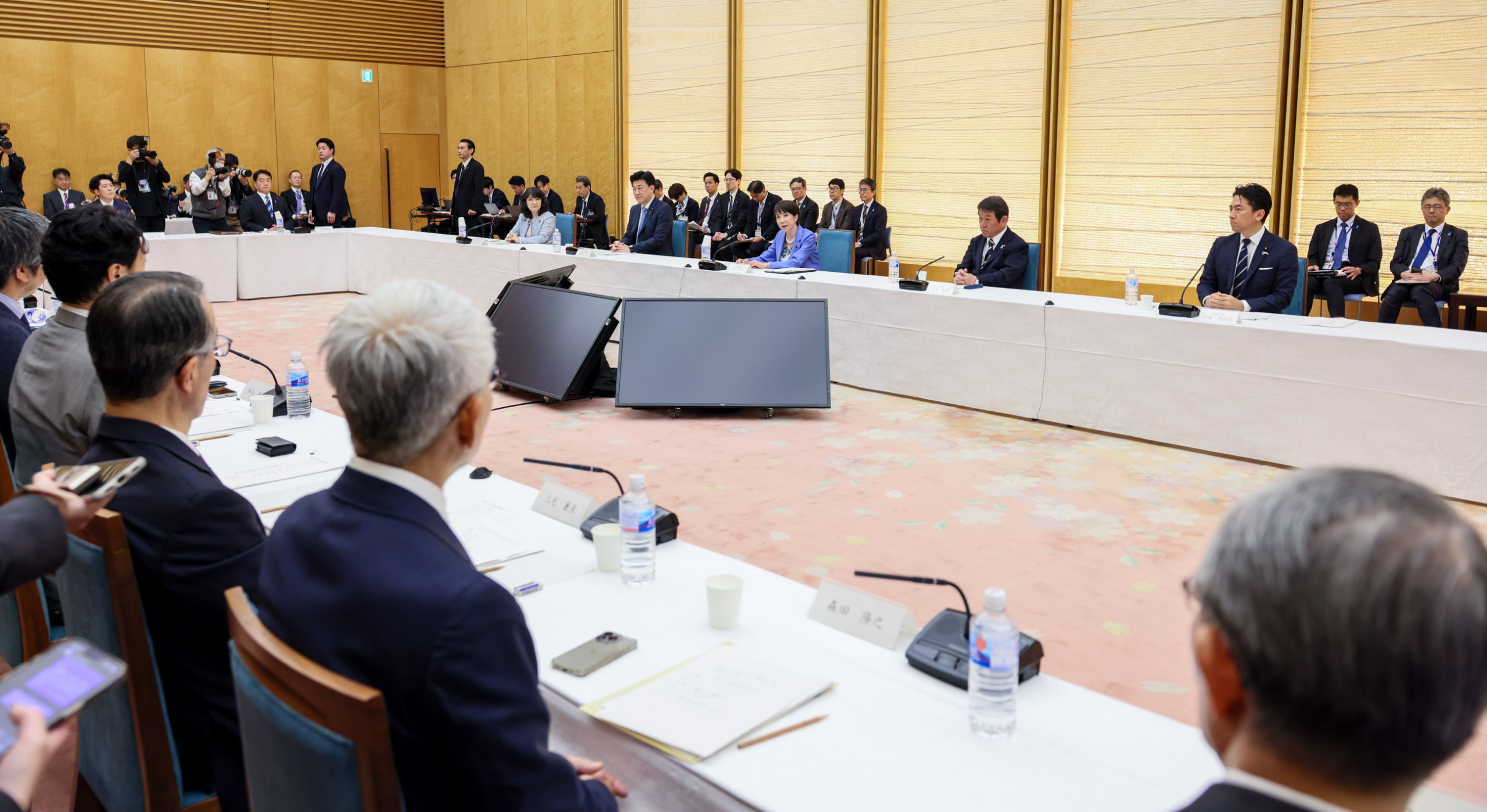
On April 27, 2026, Prime Minister Takaichi Sanae held the first meeting of the Expert Panel to Consider National Security. Following the discussion, the Prime Minister said, “In order to fully defend Japan’s peace and independence, we must proactively pursue the fundamental reinforcement of our defense capabilities. At the same time, it is essential to thoroughly strengthen Japan’s comprehensive national power by organically integrating our diplomatic and defense capabilities with economic, technological, informational, and human resource capabilities.”
Photo: Cabinet Public Affairs Office
In an era marked by a harsh geopolitical environment and the growing weaponization of the economy, how should Japan redesign its preparedness? Sagara Yoshiyuki presents a novel framework bridging national defense with fiscal, financial, and supply-capacity resilience, formulated by the Study Group on the Integrated Strategy for Defense, Economic and Fiscal Policy.
Amid Escalating Great-Power Competition
The security environment surrounding Japan has become exceptionally severe. Russia’s invasion of Ukraine has continued for over four years, with modern warfare being forged on the battlefield in cycles of mere weeks. China’s formidable military power has expanded from the periphery of Taiwan and the Senkaku Islands to the east of Iwo Jima, shifting the balance of power in the Pacific. North Korea is experiencing a surge in demand as it mass-produces and supplies artillery shells and missiles to Russia through its robust military production base. This deepening Russia-North Korea military cooperation has further allowed North Korean forces to gain firsthand experience in modern warfare on the front lines against Ukraine. Concurrently, the global weaponization of the economy has increasingly linked economic issues with national defense. Economic coercion is intensifying worldwide, and the free trade system has reached a major turning point.
The liberal international order (LIO) based on the rule of law and shared values, which was forged under US leadership after World War II, is transforming into a transactional world order (TWO) based on power. Amid the US-China rivalry and the rise of the Global South, great-power competition is intensifying, characterized by hard-nosed, pragmatic dealings driven purely by power and self-interest.
In response, the administration of Prime Minister Takaichi Sanae is moving forward with revisions to Japan’s three key national security documents. The central focus is on transforming and fundamentally strengthening defense capabilities and increasing the defense budget. A robust and sustainable defense capability can only be realized on the foundation of a strong and prosperous economy. On the other hand, if fiscal constraints take precedence, the very foundations of national defense and security may be undermined.
To ensure that defense spending does not merely expand government expenditures, but instead generates positive spillover effects that enhance the nation’s supply capacity, technological prowess, and fiscal and financial stability, how should Japan conceptualize defense expenditures?
With this awareness of the issues, the Study Group on the Integrated Strategy for Defense, Economic and Fiscal Policy (hereinafter “the Study Group”)—organized by the policy think tank PHP Institute, where the author serves as a committee member—has convened 15 times since October 2025 to comprehensively examine the multifaceted interactions between the defense/national security domain and the economic/fiscal/financial domain. This article introduces the strategic direction that emerged from the Study Group, as well as the ideal vision for a strategy integrating economic domains into the three key national security documents.
Challenges to Be Addressed in the Next Three National Security Documents
The various aspects of modern warfare unfolding in Ukraine, Gaza, Venezuela, and Iran represent a mixture of modern warfare—leveraging unmanned assets and the latest platforms—and wars of attrition requiring vast amounts of ammunition, both highly integrated with artificial intelligence (AI). Combat in non-kinetic domains, such as cyber, space, electromagnetic spectrum, and cognitive warfare, is also intensifying.
Japan is experiencing a situation that can be described as the “seamless integration of peacetime and contingency”, blurring the line between the two. The war in Ukraine has underscored that modern warfare is not merely a clash of military might, but a total war of national resilience that integrates diplomacy, economy, technology, human resources, and intelligence. For Japan, it has become crucial to respond not only based on formal situational determinations but also to establish administrative and operational frameworks on a routine, daily basis.
In the United States, mercantilist (economic nationalism) trends are on the rise, transforming the country into a predatory great power characterized by the use of military force against Venezuela and Iran, as well as the aggressive imposition of tariffs on allies and like-minded nations. The widening rift in transatlantic relations symbolizes a decline in US credibility regarding its commitments to allies and its predictability, leaving both the global order and the regional order in the Western Pacific increasingly fluid.
Japan must fundamentally strengthen its defense capabilities while securing a robust economic, fiscal, and financial foundation to support them, ensuring that the nation can defend itself through its own means even in the event of an armed attack situation. To enhance deterrence, it is indispensable to build a resilient “comprehensive national power of Japan” with a long-term war of attrition in mind.
Advanced Integration of Security Policy and Economic Policy
In the Japan Growth Strategy under the Takaichi administration, the defense industry has been positioned as one of the 17 strategic fields. The strategy identifies the importance of spin-offs, where the outcomes of defense research and development yield positive spillover effects for economic growth. Iconic examples of spin-offs derived from dual-use technologies, like GPS, materialized under specific Cold War conditions where massive US military R&D funding completely overwhelmed the private sector. This model is not easily applicable to the modern era, where advancements in commercial technologies have progressed at an exponential rate. In fact, the technologies prioritized by the US Department of Defense—such as AI, biotechnology, and quantum computing—are largely driven by the private sector rather than military funding. Furthermore, as exemplified by the rapid development of generative AI, the critical technology fields remain fluid, necessitating adaptable realignment. With China’s ongoing military-civil fusion, the current competition has shifted focus from spin-offs to the agility with which the military can spin-on commercial and civilian technologies.
It is worth noting that from the perspective of safeguarding sensitive technologies, transferring technologies and products developed for defense purposes into commercial applications (spin-offs) is structurally challenging. Instead, we should pay closer attention to the concept of “emergent” defense procurement (spin-on) that contributes to economic growth. One reason for Japan’s stagnant potential growth rate is the lack of domestic investment. Government demand, manifested through defense expenditures, plays a critical role in strengthening supply capacity, which currently serves as a bottleneck for the Japanese economy.
The pressing question for Japan is how to secure the necessary defense funding while maintaining fiscal discipline and minimizing adverse effects on interest rates and foreign exchange—essentially, finding the optimal mix of funding sources. Japan must reevaluate the relationship between security and the economy. Security policy and economic policy need to be strategically integrated within the Cabinet Secretariat, which holds comprehensive coordination authority under the Prime Minister’s leadership.
Two Strategic Concepts to Consider
The core of the next three national security documents revolves around advancing policies by integrating security with economic, fiscal, and financial dimensions. To provide a cohesive framework bridging a range of policies, the Study Group proposes two strategic concepts: “Integrated National Power Security” and “Strengthening National Resilience.”
(1) Integrated National Power Security
“Integrated National Power Security” refers to an approach that ensures international peace and stability, as well as national security, by integrating the full spectrum of national power—encompassing key elements such as diplomacy, defense, economy, intelligence, technology, and human resources across government, bureaucracy, business, academia, and individual citizens—and continuously generating mutually reinforcing capabilities through emergent processes. Should deterrence fail and an emergency arise involving the coercion, threat, or use of military force, this strategy aims to deter (deny) the aggression, endure through the shifting nature and intensity of the situation, prevent its escalation, and achieve an early conclusion and recovery by combination of nationally generated capabilities. This requires maintaining a resilient power base and consistent balancing efforts sufficient to counter pressures to change the status quo by force and to deter escalation into conflict.
(2) Strengthening National Resilience
“Strengthening National Resilience” aims to enhance the resilience of society as a whole and the nation across a broad spectrum, from peacetime to crisis situations, without being limited by formal classifications. This approach allows the country to effectively address a wide range of complex all-hazards, including large-scale natural disasters, earthquake, pandemics, catastrophic accidents, terrorism, organized crime, and armed conflicts. Regardless of the type of the emergency, the government must establish clear national directions and priorities while implementing strategies to strengthen, create redundancies in, and decentralize critical civilian infrastructure. This includes electricity, energy, information and communications, airports, seaports, transportation, and finance, ensuring they can maintain stable operations.
Elements to Incorporate into the Next Strategic Documents
Based on the two core concepts of “Integrated National Power Security” and “Strengthening National Resilience,” this article outlines elements that should be incorporated into Japan’s upcoming strategic documents.
(1) Economic Sustainability in a War of Attrition
Among the lessons of the war in Ukraine, one that has received remarkably little attention is that the strategic outcome is dictated not only by the requirements for military assets (hardware) and personnel (manpower) but also by “economic sustainability in a war of attrition” (financial capacity).
Following the 2014 invasion of Crimea, Russia systematically strengthened its economic, fiscal, and financial foundations in preparation for a full-scale invasion of Ukraine and the subsequent wartime economy. Moscow reduced the share of the US dollars in its foreign exchange reserves while steadily accumulating gold and Chinese yuan; at the same time, it maintained a trade surplus and decreased its reliance on the US dollar for trade settlements.
Because of these preemptive measures, the Central Bank of the Russian Federation was able to raise its policy interest rate dramatically from 9.5% to 20% shortly after the invasion, helping to control wartime inflation. Since then, Russia has been hit with severe economic sanctions, and the dual pressures of inflation and a wartime economy continue to strain its national finances. Nevertheless, the Russian economy has managed to maintain a current account surplus on the scale of tens of billions of dollars annually, supported by exports of oil, natural gas, and other energy resources to China and Global South nations, along with high energy prices.
In contrast, Ukraine’s trade and services balance had already been structurally in deficit prior to the war. Following the Russian invasion, Kiev has been forced into a grueling war of attrition, leaving it heavily reliant on financial assistance from Western nations, the World Bank, and the International Monetary Fund (IMF) to sustain its operations.
In the unlikely event that an armed attack situation or similar emergency occurs in Japan, the nation’s economic system—which has long reaped the benefits of globalization—would instantly paralyze, rendering its “wartime economy” exceptionally severe.
While Japan’s current account balance has historically registered a stable surplus, its trade balance has been structurally in deficit since the 2011 Great East Japan Earthquake, which prompted the shutdown of nuclear power plants and a subsequent surge in energy imports. Furthermore, the services balance has seen an expanding “digital deficit.” Among the components of the current account, the only sector generating a surplus is the primary income balance—specifically, interests and dividends derived from overseas investments. However, a significant portion of these earnings is reinvested abroad rather than being repatriated to the domestic economy.
Therefore, in addition to fundamentally strengthening its defense capabilities, Japan must secure an economic, financial, and fiscal foundation resilient enough to withstand emergencies—in other words, it must ensure its economic sustainability in a war of attrition.
(2) Estimation of the “Cost of Inaction”
When determining the appropriate level of defense expenditures, a critical factor to consider is the economic, fiscal, and financial “cost of inaction” that would incur if deterrence fails due to inadequate defense reinforcement and Japan plunges into an emergency.
In such situations, attacks on critical infrastructure in violation of international law are highly anticipated. For example, during its invasion of Ukraine, Russia has deliberately targeted power and energy facilities, causing Ukraine to lose not only the Zaporizhzhia Nuclear Power Plant but also 80% to 90% of its thermal power generation capacity. The costs associated with decentralization and evacuation facilities—so-called “passive defense”—become justifiable when viewed as an insurance premium to mitigate a far more devastating “cost of inaction.”
In France, for instance, as part of its economic security policy, the government has calculated the potential “cost of inaction” if the domestic automotive industry suffers losses due to overreliance on specific nations for rare-earth magnets. By comparing this figure with the actual costs required for supply chain resilience, they can evaluate and determine the necessary level of preparedness.
Even if the estimated “cost of inaction” proves to be catastrophic, political leaders must not cast it aside as an “unforeseen contingency.” We must never avert our eyes from the worst-case scenario; instead, we must actively prepare for it.
(3) Strengthening “Strategic Alignment”
In today’s security landscape, national defense can no longer be achieved by the government alone, nor by a single nation in isolation. Japan must strengthen its “strategic alignment”—the capacity to share missions and strategic objectives across the political, bureaucratic, business, and academic sectors, as well as with the general public, the United States, and like-minded countries, to foster effective and seamless collaboration.
Japan should enhance its interoperability with like-minded countries, including Australia, South Korea, and NATO members, to promote the joint development and mutual provision of defense equipment. By doing so, Japan can create a “two-way resilience” and effectively bolster its deterrence.
(4) Deepening and Expanding Dual-Use Technologies and Industries (Multi-Use)
Dual-use technologies and production capacities applicable to both the commercial and defense sectors directly affect a nation’s economic strength and national security. However, the private-sector participation in Japan’s defense industry remains sluggish compared to countries like the United States, China, and South Korea. As a result, Japan should further incentivize and accelerate the entry of commercial firms into the defense market by leveraging public procurement via defense expenditures.
Concurrently, reflecting the expanding boundaries of dual-use applications, Japan must develop “multi-use” (omni-use) technologies and production capacities that serve the public interest and are capable of addressing all-hazards, including large-scale natural disasters. Even as deep-rooted resistance to the concept of dual-use persists, the ultimate goal should be to maximize the broader technological base by reframing and promoting it as a “multi-use” endeavor.
(5) Globalization of the Defense Value Chain
Transferring of defense equipment not only enhances cooperation with the United States and like-minded countries to improve deterrence and response capabilities, but also serves as a critical industrial policy that increases the predictability of the business environment for defense enterprises over a five-to-ten-year horizon.
To achieve this, Japan must intensify its efforts to globalize the entire defense value chain. This strategy must encompass the complete lifecycle of defense equipment—from research and development to raw material procurement, manufacturing, sales (transfers), and maintenance and sustainment—while integrating the foundational pillars of intelligence, data, finance, and logistics. This approach is driven not merely by potential economic benefits, but rather by the strategic imperative to elevate Japan’s “strategic indispensability.”
Now that the restrictions of the “five categories”—rescue, transport, warning, surveillance, and minesweeping—have been lifted, it is paramount for the government to take the lead in pursuing export contracts for finished platforms, such as aircraft and naval vessels, as well as large-scale joint development projects. This governmental leadership enhances predictability for the defense industry, thereby stimulating investment and strengthening production capacities.
(6) Smarter Defense Capabilities
The US military is boldly implementing AI in areas such as intelligence, surveillance, and reconnaissance (ISR), command and control (C2), logistics, and maintenance, while China is rapidly advancing the “intelligentization of warfare.” In Japan, where a shrinking and aging population makes recruiting Self-Defense Forces personnel increasingly difficult, it is imperative to drive the smartification of defense capabilities by fully exploiting AI and unmanned assets across multiple domains.
It is vital that defense capability build-up and operational concepts, both of which are undergoing continuous updates, undergo mutually reinforcing development (“spiral up”). Although automation and unmanned systems are advancing rapidly on battlefields such as Ukraine and Gaza, human beings must ultimately retain the authority to make decisions. Executing effective and highly survivable operations requires a high-low mix of unmanned assets and the adept utilization of AI, alongside the agile evolution of operational doctrines to enable seamless integration between military units and machines as a cohesive team. Furthermore, direct feedback from operational units remains indispensable for the development of new defense equipment.
(7) Defense Innovation Driven by a Venture Capital Mindset
A defining characteristic of emerging defense companies like Palantir and Anduril is that they have been funded by venture capital (VC) since their inception, with backing from prominent Silicon Valley investors. In 1989, the year the Berlin Wall fell, seven of the world’s top ten companies by market capitalization were Japanese, including NTT and major city banks. Today, the top corporations by market cap—the seven tech giants collectively known as the “Magnificent Seven”—are all American companies that achieved their growth through the backing of venture capital.
The typical venture capital business model is predicated on building a portfolio with the explicit assumption that certain investments will inevitably fail. VC firms raise capital from investors to form a fund, provide hands-on, long-term support to their portfolio companies over a five-to-ten-year horizon, and aim to produce “home-run” exponential growth in just 10% to 20% of their startups. By doing so, the fund as a whole seeks to deliver a total return to its investors equivalent to approximately two to five times the original invested capital.
In essence, effectively supporting startups to yield results in cutting-edge research and development is a process of curation—building a high-quality portfolio based on sharp discernment, rather than attempting to “pick winners” from the outset, and instead systematically “letting the losers go.” This discipline requires continuous engagement over a five-to-ten-year horizon, featuring follow-on investments tailored to the startup’s growth phases—from seed and early to late stage—and its technological readiness levels (TRL). Crucially, this must be paired with decisive stop-loss measures (the termination of support) for companies that fail to meet their milestones at designated stage-gates.
While a series of support measures spanning from foundational research to development is currently being deployed for defense startups, these initiatives do not necessarily maintain or manage a portfolio that inherently accommodates the tolerance for failure. To construct a robust defense research and development ecosystem, Japan must continuously accumulate institutional improvements.
(8) Strengthening the Capabilities of the National Security Secretariat (NSS)
To effectively integrate security and economic policies at the highest level, Japan must significantly strengthen the National Security Secretariat (NSS), which holds comprehensive coordination authority. As the weaponization of economic interdependence intensifies, Japan must establish a robust institutional framework capable of fully operationalizing economic statecraft. This mandate encompasses not only countering economic coercion by countries of concern but also enhancing the effectiveness of economic security policies and economic sanctions executed in close coordination with the United States and like-minded nations.
To accurately assess the economic, fiscal, and financial spillover effects and risks associated with increased defense spending—as well as the “cost of inaction”—and to forge closer coordination with fiscal and monetary authorities to mitigate these risks, the NSS must employ a dedicated team of economists and staff members with deep expertise in fiscal and monetary policies.
Given that technological prowess now dictates diplomatic and defense capabilities, establishing a “Science and Technology Division” within the NSS would be a highly viable step. It is essential to continuously drive the integration of national security and science and technology policies at the Deputy Director-General level.
Just as the NSS has successfully integrated foreign policy and national security, Japan must now transcend interagency silos to foster a highly transparent, daily exchange of talent and data across security, economy, finance, and science and technology. By doing this, the nation can refine its policy integration into a more creative and collaborative paradigm.
An Essential Perspective
When the government discusses defense spending, it is crucial to adopt a perspective that considers the broader dynamics of the economy—such as industrial structures, production capacities, interest rates, and foreign exchange rates—rather than narrowly focusing on funding sources and fiscal balances alone.
Japan must no longer treat defense, economic growth, and fiscal sustainability as competing policy objectives. The next three national security documents should establish an integrated framework that converts defense expenditure into stronger deterrence, greater national resilience, and an expanded technological and industrial base, while carefully managing fiscal and financial risks. Only through such a “Creative Power” strategy can Japan secure the comprehensive national strength needed to navigate an increasingly transactional and uncertain world order.
Translated from “Tokushu 1 ‘Senso no Jidai’ no Boei Senryaku: Chugoku no ‘Anpo to Keizai wo Togosuru ‘Soryoku Anzenhosho’ Koso (Special Feature 1: Defense Strategies in the ‘Age of War’: The “Creative Power” National Security Initiative: Integrating Security and Economic Strategy),” Voice, July 2026, pp. 64–73. (Courtesy of PHP Institute) [August 2026]
SAGARA Yoshiyuki
Senior Research Fellow, Institute of Geoeconomics (IOG), The International House of Japan

Graduated from Keio University Faculty of Law and completed graduate studies at the University of Tokyo Graduate School of Public Policy. After working for private companies, the United Nations Secretariat, and the Ministry of Foreign Affairs of Japan, Mr. Sagara assumed his current position. His specialties are international political economy, foreign and security policy, economic security, and international conflict. At the United Nations, he worked at the New York headquarters and in Sudan, and also had a short assignment in Afghanistan. His publications include Kokusai Seiji Keizaigaku [Dai 2 han] (International political economy [2nd edition]) (co-authored, Nagoya University Press).
Keywords
- economic policy
- security policy
- defense capabilities
- modern warfare
- Integrated National Power Security
- Strengthening National Resilience
- three national security documents
Related posts:
 In Memoriam: Dr. Iriye Akira, Professor Emeritus at Harvard University—The Broad Perspective and Ideals That Championed “The Internationalization of History”
 The Reality Revealed by China’s “War Preparations”: How Far Can the Three Security Documents Go?
 Trials facing Japanese diplomacy beyond “Plan A′”: A new course demanded by multiple wars
 Recent Cyber Situations and the Bill Introducing Active Cyber Defense
 Seven Major Changes in the Security Environment