


Trials facing Japanese diplomacy beyond “Plan A′”: A new course demanded by multiple wars
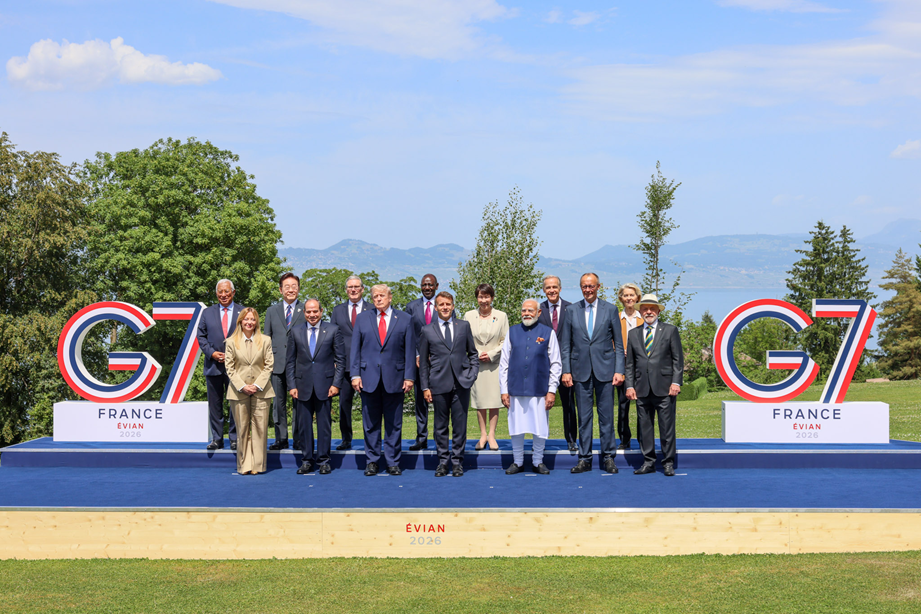
Prime Minister Takaichi Sanae (center back) participates in the Working Session on “Forging New Partnerships and Rebuilding International Solidarity” at the 2026 G7 Evian Summit. As Japan seeks a “multi-layered network of security cooperation” (Plan A′+) that does not rely solely on the United States, strengthening multilateral ties including Europe and the Global South becomes essential.
Photo: Cabinet Public Affairs Office
The world has entered a new “interwar period” laden with unprecedented risks. Japan is now called upon to pursue a more autonomous survival strategy.
- Multiple wars involving the United States and Russia are interconnected, and the crisis continues to expand
- In addition to stepping up self-reliance efforts, Japan should advance the diversification of its security cooperation
- Japan needs to shift its relations with China from a “strategic and mutually beneficial” relationship to one of “adversarial coexistence”
Due to the ongoing war involving the United States, Israel, and Iran, the Middle East has fallen into a state of turmoil. Even if a full-scale ceasefire is established in the future, things will likely never return to the state they were in before the attacks. Meanwhile, Russia continues its aggression against Ukraine and is intensifying its paramilitary attacks on Europe. Military cooperation among Russia, China, and North Korea is also accelerating, creating a structure in which Europe’s responses to these developments easily interconnect with Asian security.
Deductive and inductive approaches to statecraft
Broadly speaking, the world’s major countries fall into two types. One consists of countries that first establish a philosophy or strategy of “what ought to be” or “what direction to move in,” and then design policies based on that vision, attempting to align reality with their conception. These can be described as states that think and act deductively. The other consists of countries that carefully observe shifts in the international situation and signs of crisis, and then derive the most logical strategy from those observations. These are, so to speak, states that think and act inductively.
Looking across the world, extremely few countries belong to the former deductive group. Examples would be the United States and China. The US and China first establish their respective visions of the world they aim for, and then flesh out their national security strategies from there. This is because they possess the economic, military, and political power to allow for such an approach. Russia also once belonged to this group as a superpower, but it no longer has that level of national strength. Russian President Vladimir Putin did not fully understand this point. As a result, he invaded Ukraine in an attempt to restore a Russian imperial sphere, further accelerating the decline of his state.
On the other hand, for most middle powers, it is unfortunately difficult to bring reality closer to an ideal worldview of an international order. Even if they were to formulate such a grand strategy, they would quickly be forced to revise it should the global or regional situation change. Japan, which is scarce in energy and other resources and sits adjacent to China, Russia, and North Korea, is no exception. What is essential for Japan when formulating its diplomatic strategy is a highly inductive way of thinking—coolly evaluating the direction of global affairs and deriving the optimal course from those observations.
However, this by no means implies that Japan has no need for diplomatic philosophy or ideals. A strategy lacking them would be like building a house on sand. Nonetheless, when Japan designs its foreign strategy, what matters first is realism based on national power, rather than ideology. From this perspective, this article will first analyze the global situation surrounding Japan. Based on that analysis, it will examine the prerequisite conditions for the administration of Prime Minister Takaichi Sanae as it revises the three key security documents—including the National Security Strategy—this year in 2026.[1] Specifically, it will illuminate the wars in the Middle East and Ukraine, the diplomatic posture of the US administration, and the rift between the United States and Europe, analyzing the impact these developments bring to Japan. Based on those considerations, the latter half of the article will explore a desirable foreign strategy for Japan over the next five to ten years.
A world plunging into “simultaneous wars”
The current international situation is in the middle of a shift that it would be no exaggeration to call a once-in-a-decade occurrence. Russia’s aggression against Ukraine, which began in February 2022, severely fractured the post-war order, and the world effectively transitioned into a “pre-war” era. Furthermore, with the attacks on Iran launched by the United States and Israel on February 28, 2026, the international situation moved in an even more dangerous direction. The world today is in a condition better described as a new “interwar period”—in the sense that it evokes the next major war—rather than an era of overlapping crises preceding a possible major war. There are at least two reasons for this.
First, the situation has become one in which two wars involving major powers—the United States and Russia—are proceeding simultaneously, while both possess nuclear weapons, something that did not exist a century ago. Moreover, no exit is in sight for either war, and there is a danger that they will drag on for a long time. Ukraine is being forced into an existential war where defeat would mean losing its statehood. Although it may at some stage reach a compromise with Russia and temporarily agree to a ceasefire, it is difficult to imagine it concluding a peace treaty while its territory remains stolen.
Regarding the war in Iran, statements by US President Donald Trump have been fluctuating, making predictions difficult. With gasoline prices rising inside the United States and the casualties among US troops gradually increasing, Trump is eager for a ceasefire. However, if he remains unable to reopen the Strait of Hormuz and block Iran’s nuclear development, Trump will be questioned about what the war was fought for. There are no signs of the Iranian side halting its nuclear development, and the gulf between the two sides runs deep.
Under these circumstances, a scenario is also possible in which Trump unilaterally declares “victory” and halts military operations without achieving the reopening of the Strait of Hormuz. Even in this case, it is difficult to think that stability will come to the Middle East. Iran will retain its military structure centered on the Islamic Revolutionary Guard Corps (IRGC), likely coming to resemble a “giant North Korea.” There is a high risk that it will obsess over nuclear development, take the Strait of Hormuz hostage, and push forward with a hardline stance externally. Fighting between Israel and Iran is also expected to continue. The possibility cannot be ruled out that a makeshift compromise will trigger even larger problems.
Second, there is a danger that the situation in Asia will become interconnected with the wars in Ukraine and the Middle East, leading to a simultaneous rise in tensions. On the surface, the two wars and the Asian situation appear to be progressing separately. However, when turning one’s eyes behind the scenes, Russia, China, Iran, and North Korea are deepening their military cooperation, directly and indirectly supporting their respective wars.
One factor enabling Russia to continue its aggression against Ukraine is support from China and North Korea. North Korea is said to have deployed over 10,000 troops and supplied millions of artillery shells to assist Russia. Although China offers no overt military aid, according to US government estimates, much of the semiconductors and machine tools Russia needs to mass-produce weapons flow from China. Of course, this is not a one-way street of cooperation. In 2024, Russia concluded a treaty with North Korea that amounts to a quasi-military alliance, promising military support if North Korea comes under attack. Russia is believed to be providing North Korea with cutting-edge missile and satellite technology. As for “reciprocal support” to China, some analyses suggest Russia has begun providing state-of-the-art nuclear submarines and stealth technology.
In addition, Russia and Iran are also deepening their cooperation. According to reports, Russia provides Iran with satellite imagery and drone tactics necessary for warfare. Conversely, Iran continues to supply drones to Russia and is also supporting their production.
This situation evokes the international community of the 1930s. At that time as well, the wars and crises occurring in Europe and Asia were initially perceived as region-specific issues. Before long, nations such as Japan, Germany, and Italy loosely aligned with one another, heading toward a world-scale war. While history may rhyme, it does not simply repeat itself. Even if the world does not necessarily follow the exact same path as in the 1930s, should multiple crises deepen simultaneously, the risk of a Third World War can no longer be dismissed as mere fantasy.
Absence of the world’s “prosecutor”
What makes this situation even worse is the foreign policy of the Trump administration. After World War II, the United States, as the leader of the democratic camp, united its allies in Japan and Europe and protected the rules-based international order. If the US still possessed such will and capacity today, the world would not have tilted in so dangerous a direction. However, expecting such a role from the Trump administration is difficult. Even if a new US administration is inaugurated in 2029, the US will likely not regain strong leadership. The inward shift of the United States began before the rise of the Trump administration; President Trump is merely accelerating that trend.
The turning point came in 2013. In a speech, then-President Barack Obama declared that “America is not the world’s policeman.” Furthermore, the following year, the Obama administration began calling on North Atlantic Treaty Organization (NATO) member states to raise their defense budgets to 2 percent of Gross Domestic Product (GDP). More than two decades had already passed since the collapse of the Soviet Union, and from the perspective of the United States, the rationale for injecting massive defense budgets and serving as the world’s policeman had diminished. Bluntly venting frustration and hurling insulting remarks at allies may be behavior unique to Trump, but the policy of demanding self-help efforts from allies began during the Obama era. President Trump’s course is in line with this trend.
What has changed in the second Trump administration is that the United States has stopped acting not only as the world’s policeman, but even as the “world’s prosecutor.” Up through the Joe Biden era, the United States exerted heavy pressure on countries violating international law in order to uphold a rules-based order. To that end, it united allies and like-minded nations, strengthening diplomatic pressure and imposing sanctions. The response to Russia following its invasion of Ukraine is a typical example. It was, so to speak, equivalent to playing the role of a prosecutor who metes out punishment to violating nations. However, President Trump has no intention of fulfilling such a role. He believes that the order based on international law has already broken down, that the world is governed by the law of the jungle, and that major powers rule the world while other nations should obey their decisions. The only major powers he recognizes are likely China and Russia.
Japan’s need for an “Ultra-Plan A′” mindset
These international developments and changes within the United States signify that the premises underlying Japan’s foreign strategy have fundamentally shifted. As the rules-based order breaks down and multiple wars unfold, there are neither “policemen” nor “prosecutors” in the world. As the Takaichi administration formulates a new National Security Strategy and other related documents by the end of 2026 this year, it needs to devise prescriptions based on these harsh realities.
Then, what specific course should Japan pursue? During the Cold War between the United States and the Soviet Union, Japan’s Plan A (the best option) for security was “free riding” on the US military. In exchange for providing bases to the US military, Japan kept its defense budget as low as possible and relied heavily on the US military for national defense. As long as it depended on the United States for its security, Japan’s free hand in foreign policy was also significantly constrained.
However, as the Soviet Union collapsed and the Cold War ended, Plan A began to run out of steam. In 2013, with the Obama administration’s declaration that it would not serve as the world’s policeman, this became decisive. The administration of Prime Minister Abe Shinzo then changed course toward Japan playing a larger security role. By putting the security-related legislation into effect in 2016 and altering the interpretation of the Constitution, it made it possible to exercise the right of collective self-defense on a limited basis. In addition, the Abe administration proposed the “Free and Open Indo-Pacific” vision and came to play a greater role in the peace and stability of the Indo-Pacific. Furthermore, championing “diplomacy that takes a panoramic perspective of the world map,” it strengthened cooperation not only within the Indo-Pacific but also with European nations and the Global South. Under the administration of Prime Minister Kishida Fumio in 2022, Japan decided on a policy to double its defense budget and chose to introduce counterstrike capabilities for the Self-Defense Forces. Through these efforts, Japan graduated from Plan A (“free riding” on the US military) and transitioned, so to speak, to “cheap riding.” Nevertheless, because the basic structure of relying heavily on the United States for security remains unchanged, the current foreign policy course can be described not as Plan B, but as Plan A′.
The question is whether Japan will be able to navigate the international situation in the future through Plan A alone. Unless Japan further strengthens its self-help efforts in terms of security, maintaining stability will likely become difficult. This is because, as already seen, the international situation is deteriorating rapidly, and there is also a risk that the United States will tilt even further “inward.”
If so, whether Japan likes it or not, it will have no choice but to explore a “Plan A′+ (Plus)” that further reduces its reliance on the United States within the framework of the Japan-US alliance. While assuming dependence on the US military, Japan would substantially share greater burdens, responsibilities, and risks. This is, so to speak, a “shared riding” course. Realizing this will require Japan to enhance its security capabilities across all domains, including defense power, intelligence-gathering capabilities, and technology development capabilities.
To pursue Plan A′+, Japan must significantly expand its range of partner countries beyond the United States. Japan is already increasing defense and security cooperation with US allies such as Australia, South Korea, the Philippines, the United Kingdom, and France. Such cooperation includes joint exercises between the Self-Defense Forces and foreign militaries, information sharing, defense equipment cooperation, and support for building coast guard capabilities.
External cooperation is not limited to bilateral ties, but is also expanding to multilateral frameworks such as Japan-US-Australia-India and Japan-US-South Korea. While these do not serve as substitutes for the Japan-US alliance, they are useful in underpinning it. A linear alliance like Japan-US alone is not sufficient to maintain stability in Asia. Therefore, building upon the Japan-US alliance as a foundation, it is vital to establish a network of multi-layered security cooperation based on “Japan-US +α.”
Moving away from “strategic reciprocity” in diplomacy toward China
On top of this, how to face China, with which relations have cooled, is an unavoidable and difficult challenge. China constructs its policy toward Japan as part of its strategy toward the United States. As the US-China Cold War deepens, China’s view toward the Japan-US alliance and US forces in Japan will grow increasingly severe. Interconnected with this, tension between Japan and China will become semi-normalized. Up to now, Japan and China have defined their relationship as a “Mutually Beneficial Relationship Based on Common Strategic Interests.” However, the strategic goals pursued by Japan and China differ, and this definition no longer fits the reality. On the premise that relations with China will entail tension over the medium to long term, Japan needs to explore a “relationship of competitive coexistence.”
The first thing to aim for is establishing a system to prevent military tensions from escalating due to unintended clashes or other incidents. In addition to increasing communication between President Xi Jinping and Japan’s leaders, making the hotline between defense officials functional is an urgent priority. China effectively refuses dialogue with Japan, making implementation unlikely in the near term. Nevertheless, it is essential for the Japanese side to continue reaching out. Beyond that, expanding mutually beneficial economic cooperation will serve as a buffer to mitigate Japan-China confrontation. Even if a strategic, mutually beneficial relationship is difficult to achieve, many elements of mutually beneficial cooperative relations still remain.
Japan and China once experienced a ongoing state of “cold politics, hot economics,” where economic exchanges remained active despite political confrontation. However, as the economy and security have become deeply interconnected, relations are now shifting to “cold politics, cold economics.” Should this situation worsen further and head toward “zero politics, zero economics,” Japan-China crisis management would become extremely difficult. That should not serve China’s national interests either.
Amid the growing opacity of global affairs, Japan, like other major powers, needs to further increase its investment in defense. However, protecting national interests solely through power politics against opponents such as China will prove difficult. It is also vital to devote further diplomatic efforts to ensuring that the “rule of law” and free trade rules do not run out of steam any further.
Translated from “Nihon Gaiko ‘Puran A′’ goe no Shiren — Fukusu Senso ga Semaru Aratana Rosen (Trials facing Japanese diplomacy beyond ‘Plan A′’: A new course demanded by multiple wars),” Gaiko (Diplomacy), Vol. 97 May / Jun. 2026, pp. 32–37. (Courtesy of Jiji Press) [August 2026]
AKITA Hiroyuki
Commentator, The Nikkei

Born in Tokyo in 1965. He graduated from Jiyu Gakuen Senior College and completed his master’s degree at Boston University Graduate School. Joining Nikkei Inc. in 1987, he served in the Political News Department and as a correspondent in Beijing and Washington, D.C., before assuming his current position. His major publications include Ranryu Beichunichi Anzenshosho Sangokushi (Turbulent currents: The security three-kingdoms story of the US, China, and Japan) and Anryu Beichunichi Gaiko Sangokushi (Dark currents: The diplomatic three-kingdoms story of the US, China, and Japan).
[1] In her policy speech on October 24, 2025, Prime Minister Takaichi stated regarding the three security documents: “Since the formulation of the ‘three documents,’ including the National Security Strategy in December 2022, we have witnessed various changes in the security environment, such as the emergence of new ways of warfare. It is therefore essential that Japan take the initiative in fundamentally reinforcing its defense capabilities. […] Furthermore, we will begin discussions with the aim of revising the ‘three documents’ by the end of next year.”
Keywords
- self-reliance
- security cooperation
- simultaneous wars
- interwar period
- foreign strategy
- three security documents
- Plan A′+
Related posts:
 In Memoriam: Dr. Iriye Akira, Professor Emeritus at Harvard University—The Broad Perspective and Ideals That Championed “The Internationalization of History”
 The Reality Revealed by China’s “War Preparations”: How Far Can the Three Security Documents Go?
 “A World with America” and “A World without America”
 Defending Japan’s Sovereignty in the AI Era: Leveraging Linguistic Uniqueness to Build Sovereign AI
 From Support to Participation: The Future of ASEAN-Japan Relations