


Defense Spending Will Shape the Future of the Japanese Economy
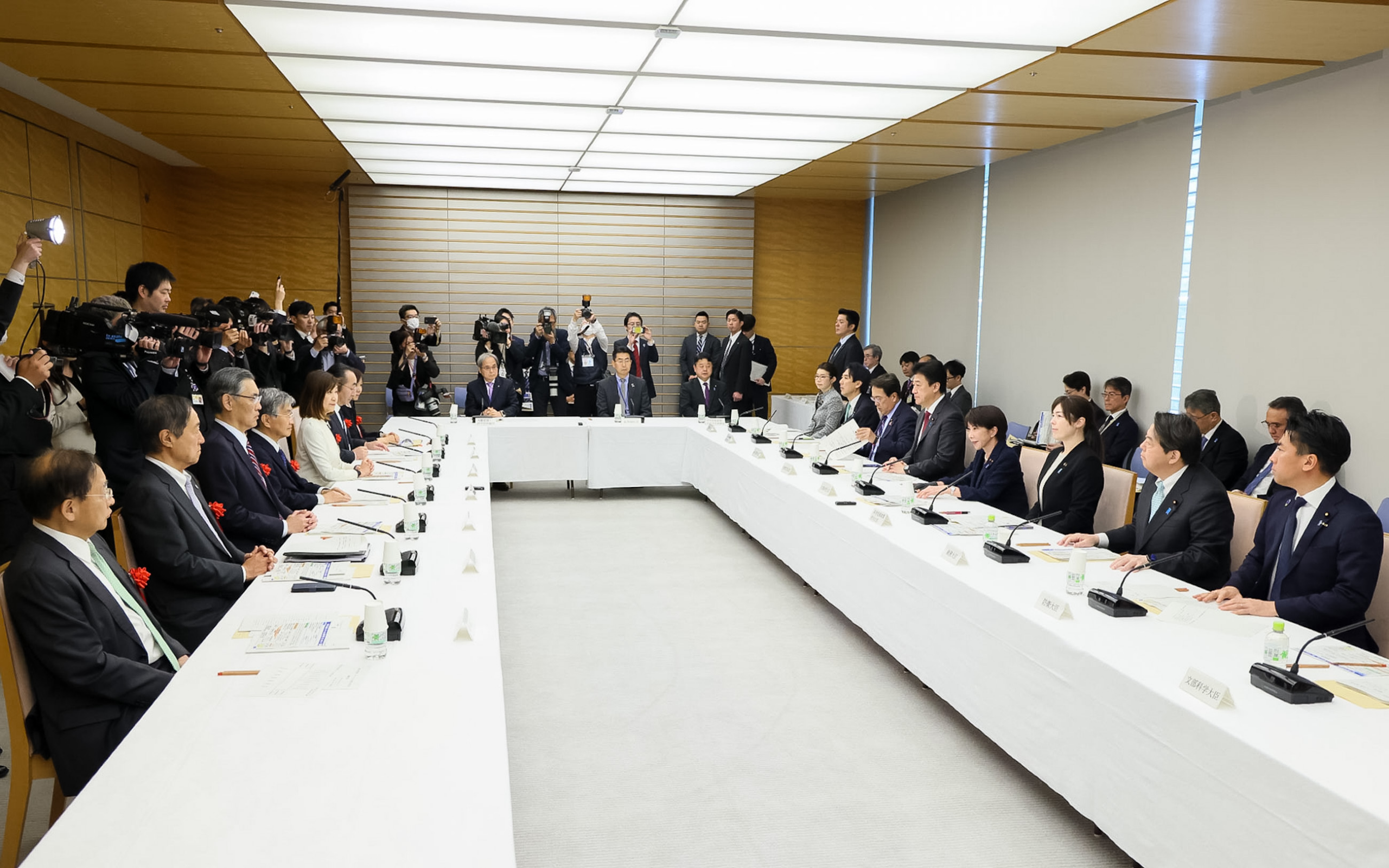
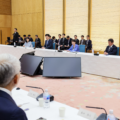
On March 27, 2026, the Council for Science, Technology and Innovation approved the 7th Science, Technology, and Innovation Basic Plan. Prime Minister Takaichi stated, “In a bid to restructure Japan’s entire social system to foster innovation with science and technology as the source of our national strength, we have set an ambitious goal of expanding total government R&D investments to 60 trillion yen and combined total public and private R&D investments to 180 trillion yen, with the aim of ranking third in the world within 10 years in terms of the number of top-level academic papers.”
Photo: Cabinet Public Affairs Office
At a time when defense spending is expanding worldwide, if properly designed, it can serve as a catalyst for transforming economic structures. This article provides a multifaceted analysis of its impact on the Japanese economy.
Vladimir Lenin, who established the Bolshevik administration during the Russian October Revolution (November 1917), sent a telegram to the Army Commander-in-Chief on November 29, 1918.
“As our troops push on westward and into the Ukraine, provisional regional Soviet governments are being formed to back up the Soviets in the localities. This has the advantage of depriving the Ukrainian, Lithuanian, Latvian and Estonian chauvinists of a chance to regard our troop movements as occupation and of creating a favourable situation for further advance” (Lenin’s Collected Works, Progress Publishers, Moscow, 1965, Volume 28, pg. 225).
Imperial Russia had fallen, but Ukraine and the Baltic states were not permitted their independence. A century later, Ukraine is once again enduring an invasion from Russia. This conflict is increasingly assuming the characteristics of a war economy, mobilizing even small and medium-sized enterprises that manufacture drones. Incidentally, it was Joseph Stalin who drafted this telegram.
Recent conflicts and global defense spending
Russia is not the only actor reshaping the global security landscape. China is asserting itself more forcefully in the East and South China Seas, and political instability persists in South Asia and the Middle East. As these developments intersect, global defense spending has expanded noticeably in recent times. Where is this momentum headed, and how long will it continue?
According to estimates by the Stockholm International Peace Research Institute (SIPRI), global defense spending reached approximately $2.7 trillion in 2024. In 2021, before Russia invaded Ukraine, the figure was $2.1 trillion. In other words, defense expenditures grew by roughly 30 percent in just three years.
By country, US defense spending is the largest, accounting for more than one-third of the global total (Table 1). China follows, with Russia, India, and advanced Western nations occupying the top ranks.
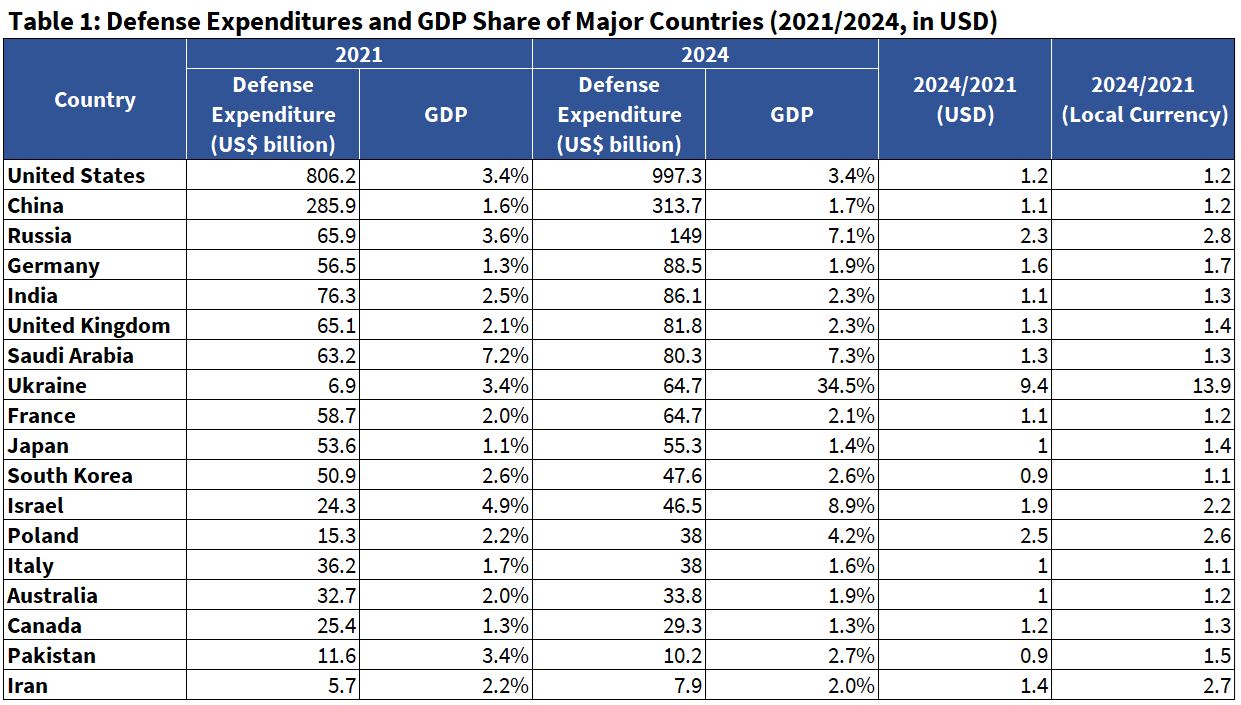
Note: The last column represents the 2024 defense expenditure compared to 2021, calculated in local currency.
Source: SIPRI Database
Recently, following Russia’s invasion of Ukraine, European countries have been rapidly increasing their defense spending. Calculated in local currencies, spending by the combatant nations increased by 2.8 times for Russia and 13.9 times for Ukraine. Germany has established a special fund to strengthen its defense capabilities, while Poland and the Nordic countries are also pursuing substantial increases in defense spending. In local currencies, Poland’s spending increased by 2.6 times and Germany’s by 1.7 times, reflecting in these figures the sense of tension felt by both countries due to their geographic proximity to Russia. Furthermore, although not listed in the table, the three Baltic states (Estonia, Latvia, and Lithuania)—which have historically faced pressure from Russia/the Soviet Union—have also increased their defense spending by 1.9 to 2.2 times over the same period.
In the Middle East, following the attack and hostage-taking by Hamas, Israel launched military operations in the Palestinian Gaza Strip in October 2023. As a result, Israel’s defense spending (in local currency) more than doubled compared to the period before. Much of this increase is considered to be the cost of military operations associated with the invasion of the Gaza Strip.
Defense spending is also on an upward trend among other US allies. Japan’s defense budget, while showing no major change in dollar terms due to the depreciation of the yen against the dollar, has increased by 40 percent in yen terms. Japan was originally scheduled to achieve a defense spending target of 2 percent of gross domestic product (GDP) in fiscal 2027, but the plan has been brought forward and is expected to be reached during fiscal 2025 (including the supplementary budget for that fiscal year).
Japan’s defense spending and economic effects: A microeconomic perspective
Defense spending is not merely a security expenditure; when properly designed, it can serve as a catalyst for broader economic transformation. Here, based on Japan’s current circumstances, I will outline its economic effects from the perspective of deploying uncrewed systems, utilizing startup companies, improving productivity among small and medium-sized enterprises (SME) and subcontractors, and moving away from a dual structure of industry.
First, the full-scale introduction of uncrewed systems (such as small drones) in the air, land, and sea domains is significantly altering the nature of defense equipment systems. Traditional high-tech crewed equipment has been characterized by high costs, long development periods, and small-scale production. In contrast, the uncrewed systems mentioned above feature software-driven recognition and control systems, short development timelines, and suitability for mass production. What made this possible is technological progress and falling costs in commercial technologies—such as electronic components, sensors, artificial intelligence (AI), communications, and nanosatellites (cubesats). As a result, this is opening up avenues for defense spending to spill over into a wide range of industries. Defense-related demand is expected to expand beyond the traditional heavy industry framework and stimulate decentralized, innovative companies, including startups.
Second, the utilization of such startup companies substantially increases the speed and diversity of technological innovation. Traditional defense industries centered on large corporations and presented high barriers to entry. On top of this, there were institutional obstacles such as rigid procurement systems, underdeveloped security clearance frameworks, and single-year contracting. However, in fields like uncrewed systems, AI, and nanosatellites, even small-scale enterprises with advanced technologies can possess a competitive edge. If government procurement is opened up to startups, it will encourage the inflow of risk capital and accelerate the development of dual-use technologies. This will open up a path toward introducing to Japan a structure similar to the Silicon Valley model of “civil-military innovation ecosystem.”
Third, there is the productivity improvement of small and medium-sized enterprises (SMEs) and subcontractors. While Japan’s manufacturing industry possesses advanced technological capabilities, the distribution of added value is distorted within multi-tiered subcontracting structures, which hinders productivity improvements among the SMEs supporting the industry. The new entry of SMEs into the defense sector is expected to improve this situation in two ways.
One is movement from within the supply chain. In the manufacturing process for modern high-tech equipment, suppliers of a wide variety of high-performance components (including commercial products) are involved in a multi-layered manner, so the material and component supply chain inevitably increases in complexity and importance. In other words, SMEs can correct the distortion in the distribution of added value by becoming an “indispensable piece” in a puzzle-like, complex supply chain. Another is investment in capital equipment—such as digitization and automation—and investment in the development of new technologies. When entry into the defense industry is linked to new investment, it provides an opportunity to improve the productivity of SMEs themselves. If the standardization of specifications and data connectivity between prime contractors and subcontractors are achieved in this process, productivity improvements within individual companies can translate into productivity gains for the manufacturing process as a whole.
Fourth, there is the course correction of the dual structure of industry. This also represents a further advancement of the third economic effect mentioned earlier. The Japanese economy has long been plagued by disparities between large corporations and SMEs, as well as between cutting-edge sectors and low-productivity sectors. If defense spending acts as a catalyst for the inflow of technology, capital, and human resources into SMEs, this divide could potentially be alleviated. In particular, if startups and SMEs collaborate to form agile supply chains, it will advance the transition away from traditional structures reliant on “keiretsu” and “subcontracting.”
However, such economic effects do not occur automatically. Institutional design—and above all, deregulation—such as introducing flexibility into procurement systems, reviewing the handling of intellectual property, and adopting multi-year contracting, is of decisive importance. Whether defense spending can be integrated with industrial policy, rather than ending up as a mere expansion of public expenditure, will be a critical turning point that shapes the future of the Japanese economy.
Japan’s defense spending and economic effects: A macroeconomic perspective
Defense spending is not merely a cost of security; when properly structured, it has the potential to contribute to the sophistication of the economic structure, particularly the improving total factor productivity (TFP). Below, I outline this mechanism from three perspectives.
First, defense spending can be expected to act as a catalyst for TFP improvement. In the defense sector, cutting-edge technologies—such as AI, sensors, communications, materials, and space—are utilized in an integrated manner, which serves to hone system integration capabilities rather than merely improving individual technologies. This “integrated knowledge” spills over into the commercial sector, driving up TFP through increased efficiency across the entire supply chain and the creation of new industries.
In Japan, a strong tendency toward “self-reliance” (doing everything in-house) makes it difficult to build cross-corporate integrated knowledge. However, the development of uncrewed systems and data integration platforms can be applied across a wide range of fields beyond manufacturing, including logistics, infrastructure management, and agriculture. If realized, this will contribute to raising the value-creation capacity of society as a whole, rather than relying merely on simple increases in capital and labor inputs.
Second, defense spending is characterized by a high proportion of equipment procurement and a relatively low need for land acquisition compared to other public investments. While much of public investment requires time and cost for land acquisition and local coordination, defense-related investment can easily utilize existing facilities and corporate equipment, allowing it to be executed relatively swiftly. Furthermore, the procurement of defense equipment generally does not require land acquisition. This property enhances the agility of capital formation.
However, in order to translate defense spending into economic growth, an increase in the labor share is essential. A structure is required that elevates the quality of human resources through wage increases and skills investment in defense-related industries, capturing expanded demand as domestic demand. If wages do not grow, defense spending will merely accumulate as retained earnings within individual companies, limiting the macroeconomic multiplier effect. Furthermore, over the medium to long term, the dual-use application of technologies to the commercial sector and the securing of a high domestic procurement ratio are also strongly desired.
Third, defense-funded R&D can serve as “semi-basic research” bridging basic and applied research to support TFP growth. Basic research conducted by universities and other institutions carries high uncertainty, while applied research undertaken independently by private companies requires short-term profitability, often leaving a blank space in the middle domain. In this domain, investment is required at a stage where the practical feasibility of technologies is verified but commercialization has not yet been reached, carrying a high probability of failure.
Defense-related scientific and technological research carries a relatively higher capacity for risk-taking, as the government provides funding even when projects are led by private companies. In terms of risk, it occupies a middle ground between basic and applied research. If the technologies and human resources nurtured here spill over into the commercial sector, a continuous chain of innovation should emerge. In this domain, a high degree of open-mindedness—sometimes characterized as “providing funds without meddling”—will also be required.
In summary, defense spending holds the promise of contributing to TFP improvement through such mechanisms as fostering system-integrated technologies, generating demand accompanied by an increased labor share, and making targeted investments in semi-basic research.
Development and Application of AI Staff Systems and Japanese Decision-Making
Meanwhile, the application of AI in the defense sector is rapidly expanding, shifting from implementation in individual equipment or standalone systems to supporting organizational decision-making (supplementing or substituting for staff functions). In Japan as well, the Acquisition, Technology & Logistics Agency (ATLA) is conducting research in FY2025 on “Research on Acquiring AI Staff Capabilities Using Multi-AI Agents for Defense Based on Prototype Research of Experimental Decision-Accelerating Equipment.” On its website, ATLA lists three objectives for this research: accelerating decision-making, securing superiority in information collection and analysis capabilities, and reducing the burden on personnel while achieving manpower savings. By utilizing AI agents that autonomously formulate and execute tasks required to meet given objectives, the system aims to cope with vast amounts of battlefield data and increasingly complex operational developments that exceed human cognitive capacity.
In March 2026, Fujitsu received a research contract from the Acquisition, Technology & Logistics Agency to develop AI agents that support decision-making by Self-Defense Forces commanders. The core development consists of two main pillars. The first is “technology for generating tactics using multi-AI agents,” in which multiple AI agents with diverse expertise are recreated in a digital environment to engage in multifaceted debate, proposing multiple operational plans to the commander. The second is the “development of simulation-language translation technology,” which enables operational plans generated by AI in natural language to be immediately verified within a computer simulation environment.
Notably, ATLA is encouraging its prime contractor to leverage open innovation with startups and other entities in developing AI agents. Accordingly, Fujitsu is soliciting technologies and proposals from startups in non-defense sectors that handle commercial products and services, aiming to adapt them to the defense domain. Selected companies are provided with development funding as well as the opportunity to establish a track record of implementation with the Ministry of Defense.
This roughly consists of three steps: heterogeneous data collection and analysis (integrating various sensors, imagery, communications, and geospatial information), situational awareness (cross-organizational and cross-functional analysis), and decision-making support (presenting and evaluating operational action choices). In essence, AI executes what Sun Tzu’s The Art of War describes: “If you know the enemy (data collection and analysis) and know yourself (situational awareness), you need not fear the result of a hundred battles.”
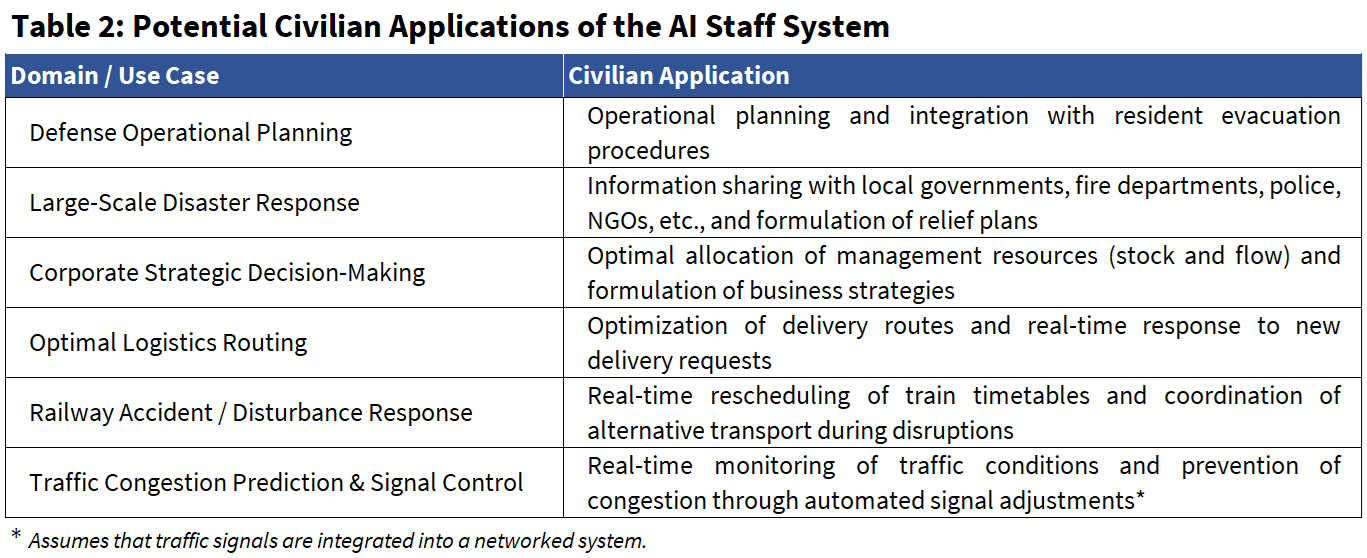
However, the system’s function of “understanding the overall situation and optimally allocating resources in complex environments” can be widely applied in the civilian sector (Table 2). Naturally, this is also expected to contribute to productivity gains in the civilian economy. As seen in the development of generative AI, Japan has lagged behind Western nations—particularly the United States in developing foundation models and platforms—in this type of system development. However, the defense sector embarking on system development with a view toward civilian applications, including the participation of startups, is considered to have the effect of boosting Japan’s overall AI development capabilities.
Furthermore, the sophistication of AI-driven decision-making support has the potential to fundamentally transform the roles traditionally played by staff departments that assist commanders and corporate executives. Traditionally, staff personnel have been responsible for a continuum of cognitive labor comprising information gathering and analysis, operational planning, and formulating recommendations for commanders. However, with the introduction of AI agents, the integration of vast amounts of data as well as the simultaneous generation and evaluation of multiple proposals will shift into the domain of the automated system.
As a result, staff departments will likely be restructured from being “the entities that create proposals” to “the entities that evaluate and select AI outputs while incorporating social and ethical perspectives.” Consequently, organizations are expected to transition away from large, hierarchical staff structures toward a framework centered on a lean, elite decision-making core powered by an AI platform.
This shift presents a vital opportunity to improve the Japanese decision-making structure, in both public and private sectors. Roughly 40 years ago, Nonaka Ikujiro (1935–2025) and his co-authors pointed out the systematic flaws of “Japanese-style decision-making” in both the military and private sectors in Shippai no Honshitsu (The essence of failure, Chuo Koron Shinsha). The fact that it remains a bestseller to this day implies that the challenges they identified remain unresolved even four decades later.
The development of AI staff systems and their adoption in the civilian sector could serve as a catalyst for reforming rigid, outdated decision-making frameworks.
Translated from “Tokushu 1 ‘Senso no Jidai’ no Boei Senryaku: Boei Shishutsu ga Nihon Keizai no Shorai wo Sayusuru (Special Feature 1: Defense Strategies in the ‘Age of War’: Defense Spending Will Shape the Future of the Japanese Economy),” Voice, July 2026, pp. 82–89. (Courtesy of PHP Institute) [August 2026]
ONO Keishi
Senior Fellow, The National Institute for Defense Studies

After graduating from the Faculty of Economics, Kyoto University in 1988, he worked at Sumitomo Bank (now Sumitomo Mitsui Banking Corporation) before joining the National Institute for Defense Studies of the Japan Defense Agency in 1997. After serving as head of the Security and Economy Division, he assumed his current position in 2024. During this time, he completed master’s programs at Aoyama Gakuin University Graduate School and the University of London Graduate School of Science and Engineering (SOAS). His publications include Nihon Senso Keizai-shi: Senpi, Tsukakiyu Seisaku, Kokusai Hikaku (The economic history of Japanese warfare: War costs, monetary policy, and international comparisons) (Nikkei Business Publications), Taiheiyo Senso to Ginko — Naze Nihon wa “Murina Senso” ga Dekitanoka (The pacific war and banks: Why was Japan able to wage an “unreasonable war”?) (Kodansha Gendai Shinsho), and translations such as Beikoku wo Meguru Chiseigaku to Senryaku — Supaikuman no Seiryoku Kinko Ron (Geopolitics and strategy surrounding the United States: Spykman’s theory of the balance of power) (original: Nicholas J. Spykman, America’s Strategy in World Politics: The United States and the Balance of Power, 1942) (Fuyo Shobo Publishing).
Keywords
- defense spending
- economic structure
- SMEs
- uncrewed systems
- innovation
- total factor productivity
- AI agents
Related posts:
 In Memoriam: Dr. Iriye Akira, Professor Emeritus at Harvard University—The Broad Perspective and Ideals That Championed “The Internationalization of History”
 The Reality Revealed by China’s “War Preparations”: How Far Can the Three Security Documents Go?
 Trials facing Japanese diplomacy beyond “Plan A′”: A new course demanded by multiple wars
 The “Creative Power” National Security Initiative: Integrating Security and Economic Strategy
 Parallels Between Takaichi Sanae and Konoe Fumimaro: Can Takaichi Diplomacy Learn from the Failures of a Popular Wartime Prime Minister?