


Parallels Between Takaichi Sanae and Konoe Fumimaro: Can Takaichi Diplomacy Learn from the Failures of a Popular Wartime Prime Minister?
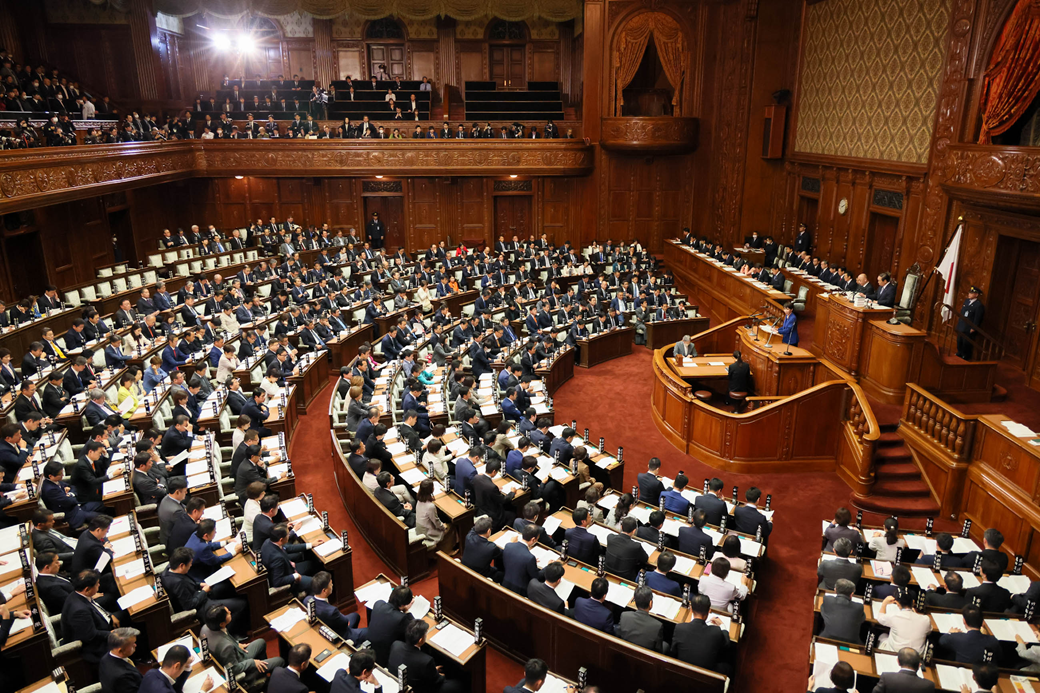
On October 24, 2025, Prime Minister Takaichi Sanae delivered a policy speech in the Diet, beginning with the statement, “I will strive to build a robust economy, turning people’s unease and apprehension over their current lives and the future into hope and foster a Japan that is stronger and more prosperous. I will deal with the challenges facing the international community as I embark on restoring Japanese diplomacy that flourishes on the world’s center stage.”
Photo: Cabinet Public Affairs Office
The international community is being tossed about by the actions of US President Donald Trump, including the attacks on Iran. Amidst this chaotic international situation, the Japan–US alliance, the axis of Japanese diplomacy, stands at a major crossroads. Six months after she took office, how should we evaluate the diplomacy of Prime Minister Takaichi Sanae? And where should Japanese diplomacy head from here? The Bungeishunju editorial department spoke with Nakanishi Hiroshi, a professor at the Graduate School of Kyoto University specializing in international politics, who served as an expert member of the Advisory Panel on Reconstruction of the Legal Basis for Security established under the Abe Shinzo administration.
The year 2026 opened with astonishing news as the United States launched a military operation in Venezuela, detaining President Maduro and his wife. At the end of February, a large-scale attack on Iran was carried out, resulting in the killing of Supreme Leader Ali Khamenei. What these two events that shocked the world demonstrate is that the post–World War II international order—built around the United States—can be seen as having entered an accelerated process of dissolution.
Before touching upon the foreign policy of the Takaichi Sanae administration, let us first sort out the current state of the international situation, which serves as the premise.
I believe that the major change currently taking place was triggered by the outbreak of the novel coronavirus that began in 2020. As we witnessed the threat of the virus spreading on a global scale, the divisions in the world widened, and cyberspace rapidly penetrated into daily life. As a result, value systems around the world shifted without people realizing it, crossing the boundary of violence that had previously been avoided.
Along with this, the international order also began to undergo major transformations. In 2022, Russia’s invasion of Ukraine broke out, and in 2023, terrorist attacks against Israel launched by Hamas, the armed group that exercises de facto control over the Gaza Strip in Palestine, instigated the widening use of force by Israel. A situation that could be called “becoming accustomed to war”—where tolerance for war rises worldwide—spread, and it can be considered that the globalization of conflict began to progress.
The problem is that there may be a possibility that the conflicts currently occurring sporadically in various regions will gradually link together one by one, eventually developing into a single “major war.”
Even in the Iran War, what should be closely watched is that Pakistan is playing the role of mediator in ceasefire negotiations. As a country with good relations with both the United States and Iran, it is considered well-suited to act as a mediator.
However, Pakistan has also concluded a mutual defense pact with Saudi Arabia, deepening its involvement in the Middle East. Middle Eastern countries are aiming to strike a balance by drawing in Pakistan, a nuclear-armed state, to counter Israel’s growing strength. On the other hand, while Pakistan has good relations with China, it is traditionally in conflict with India. That same India, meanwhile, has constructed a close relationship with Israel.
In other words, a situation is emerging in which the conflict structure in South Asia and the security environment in the Middle East are becoming linked and deepened, and the economic situation directly connects to the situation in East Asia as well. Should the Russia–Ukraine situation become intertwined with this, we are about to enter an era where a world war genuinely takes on a sense of reality.
Japanese sense of decline and Takaichi’s popularity
It is Prime Minister Takaichi Sanae who has come to take the helm of Japanese diplomacy in this era of crisis.
The Takaichi administration, which was formed last year in October 2025, recorded an astonishing cabinet approval rating of 82% in public opinion polls immediately after taking office, and even now, half a year later, it continues to maintain a high approval rating. As for this “Sanae boom,” I myself do not fully grasp it. Takaichi’s high approval rating in fact is less to do with Takaichi herself than with people’s mindset. However, I feel that Japanese people’s awareness is rapidly changing.
That change had been manifesting itself little by little. For example, since the war in Ukraine, Japanese people seemed to empathize with and smoothly accept the phrase repeatedly stated by then-Prime Minister Kishida Fumio, “Ukraine today may be East Asia tomorrow.” As a result, a strong diplomatic stance toward Russia and the strengthening of cooperation with NATO countries were decided upon without major opposition. Subsequently, the decision to increase defense spending to 2% of GDP—which previously would have faced fierce opposition from public opinion and the Diet—did not incur significant backlash either.
I believe that the sense of crisis among the public regarding the situation in which the country of Japan finds itself has heightened by that much. As Japanese people came to harbor a certain “sense of decline,” they have been harboring a vague fear of the future. Amid anxiety that Japan is in crisis and dissatisfaction that real life is becoming harder, it can be considered that they have come to long for the emergence of a politician who will be a miraculous savior.
It was there that Prime Minister Takaichi appeared. As the first female prime minister in constitutional history, the public placed its expectations on a fresh quality that seemed to break political common sense, and that situation continues even now; that is the state of affairs we are in.
Common traits of prime ministers who emerged during “times of emergency”
Looking at it this way, the mindset of Japanese society today seems to overlap with the 1930s, when the word “era of emergency” became a keyword. Following the Manchurian Incident in 1931, Japan became internationally isolated, and domestically, political upheavals involving the military occurred in rapid succession, such as the May 15 Incident and the February 26 Incident, plunging the nation into the Second Sino-Japanese War that began in 1937.
The person who assumed office as prime minister one month before that outbreak of the Second Sino-Japanese War was the 45-year-old Konoe Fumimaro (1891–1945),[1] born into the top family among the “Go-sekke (The Five Regent Houses)” closest to the Imperial Family. As a “young politician born into a nobility family close to the Imperial Family” emerged as prime minister during this emergency, he garnered overwhelming support and popularity from the public, and the era at the time took on the aspect of a “Konoe boom.”
I feel that the past prime minister who most resembles Prime Minister Takaichi at present may be this Konoe. She appeared at a juncture where people share a sense that it is a “time of emergency” (even if they do not use that exact phrase), and possesses the “uniqueness” of being the first female prime minister. In addition, several other common traits come to mind.
For example, there is the skillfulness in utilizing the media. Konoe was well-versed in the then emerging new media, having assumed office as president of the Japan Broadcasting Corporation (NHK) in 1936, the year before he formed his first administration. Immediately after the launch of his administration, he carried out the first-ever radio speech as prime minister, titled “Zenkoku-min ni Tsugu (Announcement to the Entire Nation).” His manner of speaking was clear and easy to understand, and even people with no interest in politics gathered in front of their radios to listen to his words. In the tense situation on the eve of the Second Sino-Japanese War, it was a media strategy that directly appealed for national unity and cooperation.
As for Prime Minister Takaichi today, amid growing distrust toward existing media, she adopts a method of transmitting messages herself on social media. Prime Minister Takaichi avoids difficult, concrete topics and speaks in words that easily elicit empathy. It seems that such an attitude, as with Konoe, is reflected in her high approval ratings.
Another common trait is that their conviction and political stance as politicians are difficult to understand.
Konoe was a person who was extremely adept at feigning to listen; he listened attentively to anyone’s opinion and even asked questions that made it seem as though he understood. Therefore, those who spoke with Konoe went home satisfied, but that did not mean Konoe understood and agreed with the true intentions of what the other person said. In the end, he remained a unique politician whose political stance was unclear to the very end.
Prime Minister Takaichi’s lack of “visionary capacity”
On the other hand, Prime Minister Takaichi advocates “conservatism,” and it is reported that she does not listen much to the opinions of those around her. At first glance, this is in contrast to Konoe, but whether her stance stems from a thoroughly thought-out conviction remains difficult to discern. She appeals to the public with the slogan “a strong and prosperous Japan” using conservative rhetoric, but that alone cannot be said to mean she possesses conservative convictions. Given her background of originating from the Matsushita Institute of Government and Management (MIGM) and having observed American politics before arriving at her present state through a career of changing political parties, she does not seem to be a person who entered political circles from a conservative standing from the outset.
For Prime Minister Takaichi, who has navigated political circles without an inherited electoral base, name recognition, or financial backing (jiban, kanban, kaban),[2] there is no doubt that support from voters was vital. The background to her approaching the conservative stance of former Prime Minister Abe Shinzo (1954–2022) was, I suspect, rooted in an insight into voter psychology rather than ideology. In fact, while the words spoken by Prime Minister Takaichi contain many slogans, one cannot feel a thoroughly thought-out “visionary capacity” regarding the details of her policies.
For example, although the Prime Minister sets forth grand goals such as “proactive fiscal policy with responsibility” and “17 strategic fields,” it can hardly be said that she has explained them to the public as achievable concepts and gained their understanding. Additionally, aiming to strengthen intelligence capabilities, she is striving to establish a new “National Intelligence Council (NIC)” with the Prime Minister as its head, but this too is difficult to understand. While there are no security experts who make light of intelligence, the current reality is that concrete details remain unseen regarding how the National Intelligence Council will transform the conventional framework and strengthen Japan’s intelligence capabilities. Merely saying “because it is the Prime Minister’s favorite policy” does not completely lack the ring of Imperial Rule Assistance politics.
In order to conduct diplomacy amid chaotic international circumstances, the prime minister’s own “visionary capacity” is indispensable. To avoid repeating Konoe’s mistakes, I feel that this is a point on which she should learn from history.
Japan-US relations at a crossroads
So, how should we evaluate Takaichi’s diplomacy so far, and how should diplomacy be conducted moving forward? What is reaching a crossroads in particular is the relationship with the alliance partner, the United States.
There is now a growing global recognition that diplomatic flattering of President Trump has its limits. Europe, in particular, has grown weary of diplomacy that caters to President Trump. As a result, it is broadening its perspective beyond the United States and moving toward improving relations with China. It is symbolic that Italian Prime Minister Giorgia Meloni and British Prime Minister Keir Starmer struck a stance distancing themselves from the Trump administration over the situation in Iran. They likely realized that being on good terms with President Trump does not necessarily bring good outcomes. Since the start of this year, British Prime Minister Starmer, Canadian Prime Minister Mark Carney, and French President Emmanuel Macron have visited Japan one after another to hold summit meetings with Prime Minister Takaichi, but this is less a “pilgrimage to Takaichi” and more part of hedging as a measure against President Trump.
Of course, circumstances differ between Europe and East Asia. An emerging major power like China exists here, and the United States also continues to place economic importance on this region. On the other hand, there is no strong regional framework like that of the European nations.
Therefore, under the current circumstances, there is no doubt that the relationship with the United States is of paramount importance for Japan. In that respect, Prime Minister Takaichi has held two summit meetings with President Trump since taking office, which can be evaluated as a success in terms of having established a starting point for a good relationship. In particular, despite the possibility that the dispatch of the Self-Defense Forces to the Strait of Hormuz might be requested during the March 2026 meeting, the fact that she navigated it without coming into conflict deserves positive evaluation.
However, in that meeting, President Trump’s true intention of viewing Japan purely as “a country that makes large-scale investments” was reconfirmed. The structure in which the United States protects Japan’s security with all its might is now fading away.
Throughout the postwar period, the Japan-US alliance was convenient for both countries. The framework of the Japan-US alliance since the Cold War era—in which the United States served as the “spear” and Japan as the “shield” to maintain deterrence in East Asia—was maintained in principle up until around the time of the second Abe administration, with Japan gradually incrementally expanding the scope of its support for the United States.
The US nuclear umbrella is no longer functioning
However, now that the tendency of major powers to seek rule by force has become clear, it is necessary to review, if not discard, conventional perceptions. In the 1960s, French President Charles de Gaulle famously asked the United States on its nuclear commitment, “Would the US trade New York for Paris?” but if replaced with today’s global situation, it would mean, “Would the US trade New York for Tokyo?” It is hardly conceivable that President Trump would expose his own country to the risk of nuclear weapons in order to protect Japan. In other words, shouldn’t we view the US nuclear umbrella as already essentially non-functional?
While Prime Minister Takaichi shows enthusiasm for reviewing the principle of “not allowing the introduction” of nuclear weapons within the Three Non-Nuclear Principles, even if the Three Non-Nuclear Principles are revised and US nuclear weapons are deployed to Japan, the entity holding the nuclear button is the United States. If that United States lacks the intention to protect Japan, it will be meaningless.
Regarding a Taiwan contingency, Prime Minister Takaichi expressed her view during a Diet session in November last year (2025) that if China exercises military force against Taiwan, it could constitute a “survival-threatening situation”[3] for Japan. This remark, which drew a strong backlash from China, may well be the biggest news in Takaichi’s diplomacy thus far.
Regarding this remark, the government states that it “completely maintains”[4] the conventional government view. The problem does not lie there. It is because the current international environment surrounding Taiwan has changed from the “conventional” one. Mainstream simulations of a Taiwan contingency on the US side show that “while they can win against China, both the United States and Japan will suffer major damage.” The United States has no intention of engaging in a major war over Taiwan, meaning that even if there is a certain degree of engagement with China, the possibility is growing that it will seek a political exit through an early settlement, just as with Iran.
Is there, then, any country other than the United States from which Japan can expect cooperation in the event of a Taiwan contingency? Good relations with South Korea are an achievement of Takaichi’s diplomacy, but given potential constraints regarding historical perception and domestic public opinion, it is difficult to hope for a future of building deep ties in terms of military and security affairs. Japan has also been advancing the strengthening of relationships, including security—such as information sharing, joint exercises, and cooperation on economic sanctions—with countries in Oceania and Europe. However, should a Taiwan contingency actually occur, even Australia is geographically quite distant, let alone Britain and France, for whom sending substantial military forces is geographically difficult.
Is there any country in Asia that Japan can rely on?
In short, if one considers Taiwan’s security to be of vital importance to Japan’s security, should the United States choose not to intervene or limit itself to partial intervention, Japan will have to bear a considerable portion of the burden on its own. If Japan is to engage in strengthening its defense capabilities with such a situation in mind, expanding only budgets and equipment without attending to personnel will fail to achieve a fundamental strengthening of defense capabilities. Revising Article 9 of the Constitution has been regarded as postwar Japan’s greatest political taboo, but that was premised on a robust Japan-US alliance. If we are to secure regional safety while taking into account the possibility that the Japan-US alliance may not function, we may have no choice but to step into discussions on conscription—even if in a form different from that of the prewar period.
However, it is extremely difficult to imagine any political force emerging in today’s Japan that would support such discussions. As a realistic and actionable measure, Japan should maintain its relationship with the United States as much as possible while strengthening cooperation with countries in South Asia, the Middle East, and Africa, with a focus on the Indo-Pacific region. On that basis, Japan would aim to construct a regional order through diplomacy while maintaining a strong position toward China. In a country where attempting dialogue with China itself is denounced as being “pro-China,” exploring such a path may not be easy, but if Japan continues to avoid negotiations with neighboring countries, it will only become increasingly isolated.
Even with friendly nations, robust and well-thought-out vision is essential. On April 15, 2026, Prime Minister Takaichi attended the online summit of the Asia Zero Emission Community (AZEC)[5] and offered support. The fact that action has been taken toward strengthening energy supply chains can itself be positively evaluated.
However, while considering the introduction of mechanisms for Japan and various countries to jointly stockpile petroleum and systems to mutually supply petroleum products over the long term, I felt that the immediate measure—in which Japan would provide $10 billion in loans to support Southeast Asian nations in purchasing petroleum from sources such as the United States—felt conspicuously lacking in substance. South East Asian countries are in need of petroleum right now, having decided on emergency procurements of petroleum from Russia, among other actions. Under such circumstances, Japan’s petroleum stockpile is large even by global standards. Although there are legal issues, enabling the provision of even a small amount of stockpiled petroleum, regardless of the quantity, would have a significant diplomatic effect. Furthermore, this 10-billion-dollar loan scale represents merely one-fifty-fifth of Japan’s investment in the United States. From the perspective of South East Asian nations, there is a possibility they might perceive it as, “Is this the extent to which Japan values us?” Considering it in this way, it appears as though a golden opportunity to expand the network in terms of security in the future is being missed.
Disconnect in sense of time shown by the inheritance of “Abe diplomacy”
One of the slogans championed by Prime Minister Takaichi is “A country that never takes on challenges has no future.” However, speaking as if taking on challenges will always lead to success sounds irresponsible.
If we draw an analogy to the prewar period once again, I am reminded of an episode in which Navy Minister Yonai Mitsumasa (1880–1948), prior to the outbreak of war between Japan and the United States, admonished the pro-war faction by warning [we must be careful] “not to rush into total ruin just to avoid a slow death.”[6] As the Second Sino-Japanese War bogged down into a stalemate, leaving Japan gradually cornered, the United States exerted pressure. Japan then went to war based on the naive calculation that if it formed an alliance with Germany and fought the United States as well, the United States would compromise at a suitable point. As a result, Japan followed the path to “total ruin” exactly as Yonai had feared.
For many Japanese citizens, there was a sense of a “slow death” under the Kishida administration and the succeeding Ishiba Shigeru administration. For this very reason, the birth of the Takaichi administration—which offers a dream of a “dramatic turnaround” amidst a harsh international situation—was welcomed. While the Takaichi administration appears to align with public sentiment thus far, it will be important to also hold the perspective that a challenge-oriented approach lacking meticulous calculations carries the risk of plunging into “total ruin.”
Prime Minister Takaichi, declaring that she will inherit Abe diplomacy—which advocated for a “Japan that shines at the center of the world”—set “Japanese diplomacy that flourishes on the world’s center stage” as her diplomatic policy during her policy speech in October last year (2025). What lies at the core of this is likely the memory of the late Showa period (1926–1989), when Japan was treated as a major power alongside the United States and European nations, and was rapidly overtaking the US as number one particularly in economic terms. However, the environment in which Japan finds itself has changed significantly compared not only to the Showa period, but even to the Abe administration era in the late Heisei period (1989–2019).
What is required of Japan today is to sense the major shifts of the times and to determine the precise use of power. It is my hope that Prime Minister Takaichi will listen to a broad range of opinions before making decisions, and deploy a diplomacy endowed with vision.
Translated from “Kinjisuru Takaichi Sanae to Konoe Fumimaro — Takaichi Gaiko wa Senchu no Ninki Saisho no Shippai ni Manaberuka (Parallels Between Takaichi Sanae and Konoe Fumimaro: Can Takaichi Diplomacy Learn from the Failures of a Popular Wartime Prime Minister?),” Bungeishunju, June 2026, pp. 118–125. (Courtesy of Bungeishunju, Ltd.) [August 2026].
NAKANISHI Hiroshi
Professor, Kyoto University

He specializes in Japanese foreign and security policy, diplomatic history, and international relations theory. Graduated from the Faculty of Law at Kyoto University, took the doctoral course of the Department of History at the University of Chicago and withdrew from the doctoral course at the Graduate School of Law, Kyoto University. His publications include Kokusai Seiji to wa Nani ka (What Is International Politics?). Co-authored works include Sengo Nihon gaikoshi (Diplomatic history of postwar Japan) Kosaka Masataka to Sengo Nihon (Kosaka Masataka and Postwar Japan) (co-edited and authored), and Nihon Seiji-shi no Naka no Rida-tachi (Leaders in Japanese political history) (co-edited and authored).
[1] Prime Minister of Japan (1937–1939, 1940–1941) who enjoyed immense public popularity. His administration concluded the Tripartite Pact and pushed the nation toward full-scale war, ultimately leading to total collapse.
[2] “Jiban (ground), kanban (signboard), and kaban (bag)” are slang terms referring to the three essential elements (three “bans”) of political activity: organizational strength such as a support base or support group, name recognition and public status, and financial resources to support election and political activities, respectively.
[3] A “survival-threatening situation” is defined in Article 2, Paragraph 4 of the Armed Attack Situation Response Law as follows: “a situation in which an armed attack against a foreign country that has a close relationship with Japan occurs, and as a result, threatens Japan’s survival and poses a clear danger of fundamentally overturning people’s right to life, liberty, and pursuit of happiness.” Related article: https://www.japanpolicyforum.jp/topics/diplomacy-jpf/pt2026020815545115416.html
[4] The government’s view is that whether a situation constitutes a “survival-threatening situation” is not determined mechanically in advance, but rather, it is determined objectively and rationally by comprehensively considering all available information in accordance with the specific circumstances of each situation.
[5] Asia Zero Emission Community (AZEC): A regional framework proposed by Japan to promote decarbonization and energy transition in Asia while ensuring energy security.
[6] “Jirihin wo sakeyotosite dokahin ni naranuyo”: Navy Minister Yonai defined “slow death” (jirihin) as a state of being gradually cornered by resource embargoes. He defined “total ruin” (dokahin) as total defeat and instant collapse in a war against America. He strongly warned against rushing into a short-sighted war just to escape immediate hardship.
Keywords
-
- international order
- foreign policy
- Japan-US alliance
- times of emergency
- Takaichi Sanae
- Konoe Fumimaro
- visionary capacity
Related posts:
 In Memoriam: Dr. Iriye Akira, Professor Emeritus at Harvard University—The Broad Perspective and Ideals That Championed “The Internationalization of History”
 The Reality Revealed by China’s “War Preparations”: How Far Can the Three Security Documents Go?
 Trials facing Japanese diplomacy beyond “Plan A′”: A new course demanded by multiple wars
 The “Creative Power” National Security Initiative: Integrating Security and Economic Strategy
 Defense Spending Will Shape the Future of the Japanese Economy