China’s Economic Sanctions Against Japan Become “Legalized”
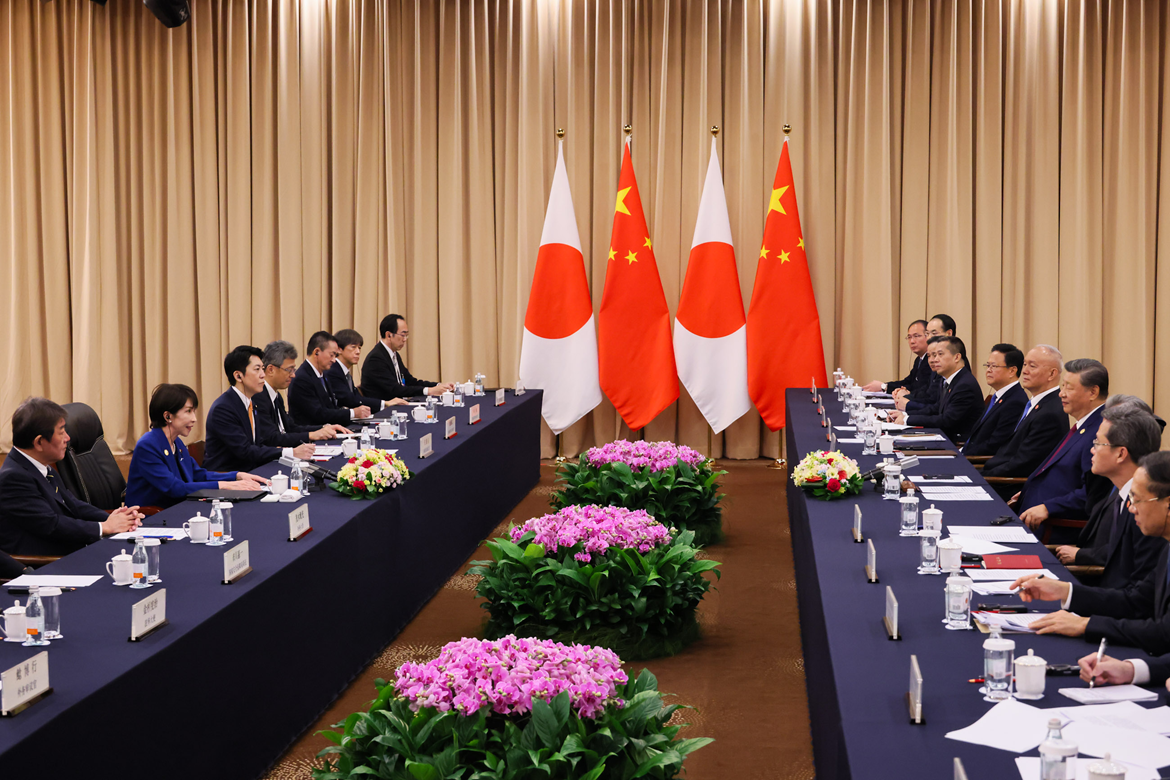
Japanese Prime Minister Takaichi Sanae and Chinese President Xi Jinping hold a bilateral summit on the sidelines of the APEC Economic Leaders’ Meeting in South Korea on October 31, 2025. As the environment surrounding national security and trade rules undergoes change, dialogue and engagement between nations through institutional frameworks are increasingly vital.
Photo: Cabinet Public Affairs Office
China has released a trade restriction list explicitly naming Japanese companies, schools, and other entities. How should we interpret the meaning of this rule “change” by China, and how should Japan respond? Professor Watanabe Mariko provides her analysis.
- Moving from economic coercion as a message toward legal regulation
- China has been establishing its system of security exceptions since 2020
- The playing field is shifting to legal systems, which conversely will weaken the basis for economic coercion
On February 24, 2026, China placed twenty Japanese companies, institutions, and organizations—including the National Defense Academy of Japan and several research institutes—on the Entity List (trade restriction list) established under its Export Control Law. In addition, China placed a further twenty Japanese companies and universities on a “watch list,” an instrument it applied for the first time.
It is dangerous to view this as “merely a measure targeting individual companies.” What this action signifies is that China has taken a step away from deliberately keeping Japan’s security status ambiguous, as it had done in the past, toward explicitly classifying Japan as “a country of security concern” and openly categorizing the group of entities over which it harbors concerns.
Conventionally, China had maintained an attitude of avoiding the institutional escalation of political and security tensions while keeping its economic relations with Japan intact. However, China’s latest measure indicates that it has moved one step beyond maintaining that ambiguity, entering a phase in which it explicitly treats a subset of Japanese companies as targets of security management.
On the other hand, viewed from the perspective of trade management, China’s placement of Japanese companies and organizations on the Entity List signifies that the Chinese side has positioned this measure within the framework of “security exceptions,” which are recognized to a certain extent under the free trade regime administered by the World Trade Organization (WTO). Until now, China has expressed its political and security intentions through forms of “economic coercion.” However, regarding measures that possess a legal basis—such as inclusion on the Entity List—and openly invoke security exceptions, asserting and proving their illegality becomes significantly more difficult. This measure therefore raises the difficulty of pursuing the issue as a trade dispute.
Looking back, China had not previously made a point of explicitly declaring security confrontation with Japan, tending instead to engage in acts that violated trade rules. In a manner that ran counter to the WTO’s most-favored-nation (MFN) principle, China practiced economic coercion—applying discrimination and pressure against specific countries for political and non-commercial reasons. The 2010 slowdown of rare earth exports was a quintessential example of this. By deliberately employing actions that hovered on the brink of violating trade rules—or constituted outright violations—China adopted an approach of communicating purely political messages.
Building security exceptions into law
The fundamental premise of the world of trade rules is to separate economics from national security. The WTO framework rests on the MFN principle of treating all member nations equally. On this basis, the framework is structured so that discriminatory measures against specific countries are permitted as exceptions only when there are grave concerns affecting national survival or national security. In other words, the sequence dictates non-discrimination as the rule, and discriminatory measures related to national security as the exception. This strict distinction between principle and exception has been the underlying philosophy supporting the post-war trade order.
However, these security exceptions are not unlimited. Within the WTO framework, member nations are not free to take whatever measures they choose simply by invoking national security. That said, the height of the threshold varies with the trade framework in question. For example, under the Regional Comprehensive Economic Partnership (RCEP) Agreement, to which China is also a party, the structure allows member nations broader leeway for self-interpretation regarding security exceptions. Conversely, under the Comprehensive and Progressive Agreement for Trans-Pacific Partnership (CPTPP), member nations bear an obligation to provide explanations when applying security exceptions.
Furthermore, in recent years, China has intensified its preparations to institutionally utilize these security exceptions. In 2021, the opening year of its 14th Five-Year Plan, China took actions that demonstrated the dual nature of its foreign policy. On one hand, it signaled an intention to advance external opening by applying for accession to the CPTPP. This was interpreted as an indication of China’s continued emphasis on participating in the international economic order and its intent to uphold the banner of free trade. At the same time, however, it rapidly proceeded with institutional development that prioritized national security. China chose a path of simultaneously pursuing two directions that appear at first glance to be in tension with each other: “openness” and “security.”
Insecurity drives extraterritorial application legislation
Extraterritorial application of law refers to a legal framework that regulates actions taking place outside a country’s borders in order to protect its own sovereignty, national security, and core interests, as well as to safeguard the legitimate interests of its domestic corporations and citizens. The extent to which such extraterritoriality is recognized in practice often appears to be determined by political power dynamics.
In paragraph 25 of the “Plan for Building the Rule of Law in China (2020–2025)” released in 2020, China declared among its principles “To meet the high-level needs of opening to the outside world, improve the system of laws and rules related to foreign interests, compensate for shortcomings, and raise the level of bringing efforts involving foreign interests under rule of law.” Under the plan, it commenced the development of legislation for extraterritorial application through provisions calling for (1) active participation in the formulation of international rules and the promotion of a fair and reasonable international rule system, (2) accelerated construction of a legal system applicable outside China’s own jurisdiction, and (3) the establishment and improvement of international commercial courts, centered on international cooperation in the joint construction of the “Belt and Road.”
As for the “active engagement” with international rules mentioned in (1), the underlying baseline is active participation in the system of the United Nations. Furthermore, regarding the WTO framework, China has also been actively engaged in efforts such as the establishment of and participation in Joint Statement Initiatives (JSIs), as well as the proposal and operation of the Multi-Party Interim Appeal Arbitration Arrangement (MPIA) as a workaround to avoid the paralysis of the Appellate Body caused by the United States blocking the appointment of its members. It is clear that deepening its involvement in trade rules as a stage for diplomatic and political activities is included within these efforts. In 2021, China expressed its intention to join the CPTPP and the Digital Economy Partnership Agreement (DEPA).
On the other hand, as China’s “insecurity” regarding the international environment has intensified, “defensive responses” have been put in place. The development of the extraterritorial application framework mentioned in (2) is part of this trend, aimed at securing national security even in areas that intersect with trade rules. At the core of these institutional developments is a series of legal frameworks enabling extraterritorial application. Specifically, these include the 2020 Provisions on the Unreliable Entity List, the Export Control Law that took effect in the same year, the 2021 Rules on Counteracting Unjustified Extra-territorial Application of Foreign Legislation and Other Measures, the Anti-Foreign Sanctions Law enacted in the same year, and the Regulations on Export Control of Dual-Use Items implemented in 2024. Rather than being disconnected measures, these have been developed as a “legal toolbox” that mutually combines export controls, countermeasures, blocking of extraterritorial application, and sanction retaliation for China to protect its own national security interests.
For example, Article 44 of the Export Control Law stipulates that “Any organization or individual outside of the territory of the People’s Republic of China that violates the provisions of this Law in relation to administration of export control, endangers the national security and national interests of the People’s Republic of China, [and] hinders the performance of non-proliferation and other international obligations, is to be subject to investigation and legal liability in accordance with the law,” explicitly establishing that this law applies extraterritorially. In addition, Article 45 touches upon “re-export,” raising the possibility that re-export controls similar to the US Export Administration Regulations will be introduced in subordinate regulations. If third-country companies that have imported or adopted Chinese products and technologies are prohibited from re-exporting them to other countries, this too would amount to extraterritorial application.
Furthermore, under the Rules on Counteracting Unjustified Extra-territorial Application of Foreign Legislation and Other Measures, as a retaliatory measure against foreign unjustified extraterritorial laws and measures (“unjustified extra-territorial application of foreign legislation and other measures”) or foreign sanctions (“discriminatory restrictive measures”), authority is granted to prohibit “any person” (including third-country “organizations and individuals”) from observing foreign unjustified extraterritorial laws and measures or executing or assisting in “discriminatory restrictive measures.” In the event that a violation of these provisions “infringes upon the legitimate rights and interests of a citizen, legal person or other organization of China,” it is stipulated that the affected party may “institute legal proceedings in a people’s court, and claim for compensation by the person who benefits from the said judgment or ruling” (Articles 7 and 9 of the Rules on Counteracting Unjustified Extra-territorial Application of Foreign Legislation and Other Measures, and Article 12, Paragraphs 1 and 2 of the Anti-Foreign Sanctions Law). These provisions are nothing less than the direct “extraterritorial application” of China’s own laws and regulations to third-country companies located outside Chinese territory.
Extraterritorial application itself is not a system unique to China; rather, it reflects a strong awareness of the systems and practices of the United States and Europe. For many years, the United States has conducted security management through export controls and the Entity List, and Europe has likewise been developing legal frameworks for extraterritorial application and sanctions. Emulating such international practices, China has established a system that enables it to institutionally secure security exceptions for itself and exercise them externally as needed. In short, an accurate understanding is not that China is trying to deviate completely from international rules, but rather that it has incorporated into its own repertoire the techniques that major powers have used within existing international rules, applying them in this instance to Japan.
What changes when extraterritorial application implemented?
Looking at the institutional design of the Entity List under the Export Control Law, which constitutes such extraterritorial application, China’s objective is clear. This legislation—which empowers authorities to order transaction bans, transaction restrictions, or export suspensions against importers and end-users that pose a risk of threatening national security or interests—is not mere political condemnation, but rather a control measure accompanied by legal force. First, in 2025, US and Taiwanese military-related companies were successively placed on China’s Entity List. Then, as mentioned at the beginning, in February 2026, twenty Japanese companies were added to this list, and another twenty became subject to the watch list. Considering these developments, Japan has come to be positioned—in a more explicit manner than ever before—within the security context of the US-China confrontation and the Taiwan Strait issue. Furthermore, other examples of extraterritorial application are increasing, such as the issuance of anti-suit injunctions regarding intellectual property rights (a dispute in which the EU prevailed against China at the WTO) and the application of the Anti-Foreign Sanctions Law to a Swiss company for complying with US economic sanctions.
Viewing this shift from the perspective of trade rules reveals that the focus of China’s external measures has moved from “economic coercion,” where illegality is relatively clear, toward “extraterritorial application,” which makes it easier to invoke security exceptions. Economic coercion refers to actions that take the form of trade measures or administrative enforcement while substantially exerting political pressure on a target country. In such cases, policy objectives related to national security are not necessarily brought to the fore, and the ambiguity itself serves as an effective tool. On the other hand, extraterritorial application-type measures widen the scope for legal justification by explicitly citing statutory national security objectives or counter-sanctions as their formal rationale. As noted earlier, China has used these two approaches selectively depending on the situation.
Specific examples of economic coercion include the slowdown of rare earth exports to Japan in 2010, restrictions on Australian barley and wine in 2020, trade limitations targeting Lithuania in 2021, and the reduction of passenger flights and restrictions on tourism, study abroad, and entertainment following Prime Minister Takaichi Sanae’s remarks in the Diet on a “Taiwan contingency” in November 2025. These are measures highly suspected of violating the WTO’s MFN principle, and countries such as Australia and members of the EU have engaged in political negotiations with China after bringing complaints to the WTO.
However, the recent measures are different. China is no longer merely exercising ambiguous pressure; instead, it has shifted to institutional means that afford relatively greater scope for argument within the framework of international rules. Schematically, China is attempting to demonstrate a firm stance by redefining Japan-China relations—moving from a stage of “exercising economic coercion while maintaining ambiguity” to a “security stage where military tension and economic competition are interconnected.”
In this sense, it is suggestive that prior to the recent inclusion on the Entity List, China had begun using the expression “new militarism” toward Japan following the “Takaichi statements.” China has partially removed the ambiguity it had maintained in order to clash politically while sustaining economic relations, explicitly designating certain Japanese companies as targets of security controls. The possibility remains that China will further reinforce this stance in response to the Takaichi administration’s elimination of the “Five Categories” for defense equipment exports.
Legal positioning as countermeasures
However, this new phase is not entirely without constraints for China either. By listing companies that it considers to pose a “military threat,” China can also be said to have removed its justification for claiming security concerns regarding other companies. Now that China itself has, to a certain extent, visualized which companies are subject to military concerns and which are not through designations on the Entity List, if it were to subject other companies to conventional economic coercion, the political, arbitrary, and non-commercial nature of such actions would become even more explicit.
In other words, it may have become easier for Japan to raise economic coercion as an independent issue before international dispute settlement bodies. Regarding the Entity List measures themselves, since security exceptions are brought to the fore, challenging them based on WTO rules is not easy. On the other hand, however, with respect to discriminatory, political, and non-commercial measures against companies or sectors not included on the Entity List, greater scope has emerged to frame them as “economic coercion” even more clearly than before and bring the issue into sharp focus. Therefore, for Japan, it is conceivable to bring complaints under WTO rules regarding economic coercion and make its illegality visible internationally. In this sense, a new option has been created for Japan.
Under these circumstances, since the difficulty of utilizing conventional economic coercion increases for China, there is a high probability that it will focus on maintaining its Entity List operations and making additions as necessary. In other words, as a result of taking institutionalized measures grounded in national security, it may become more difficult for China to resort to economic coercion, which is more easily called into question under trade rules.
However, if Japan does not explicitly turn China’s economic coercion into a distinct issue, China will retain broad discretionary power in practice. Both economic coercion and Entity List operations could be continued, expanded, or reduced entirely at China’s own convenience. As a result, Japanese companies will be exposed to greater uncertainty regarding which actions are deemed national security issues and which are targeted for political coercion. This is a problem that could also have a serious impact on future corporate investment decisions and supply chain construction.
Responding to this new phase requires an overarching examination that goes beyond reacting to individual cases. While clarifying the issue of economic coercion, now is precisely the time to consider how to navigate the trade order in an era of expanding security exceptions.
Translated from “FOCUS: Higashi-Ajia Josei no Henka to Nihon — ‘Hoka’ suru Chugoku no Tainichi Keizai Seisai (FOCUS: Changes in East Asian Affairs and Japan – China’s Economic Sanctions Against Japan Become ‘Legalized’),” Gaiko (Diplomacy), Vol. 97 Mar. / Apr. 2026, pp. 102–107. (Courtesy of Jiji Press) [August 2026]

WATANABE Mariko, Ph.D.
Professor, Gakushuin University
Born in 1968. Her areas of expertise are the Chinese economy and applied microeconomics. After graduating from the University of Tokyo, she joined the Institute of Developing Economies, Japan External Trade Organization (JETRO). After serving as a visiting researcher at the Hong Kong School of Business (M. Phil) and Peking University’s Guanghua School of Management, she became head of the East Asia Group at the Institute of Developing Economies’ Center for Regional Studies. She earned her Ph.D. (Economics) from the University of Tokyo and has held her current position since 2013. Her edited works include Chugoku no Sangyo wa Donoyoni Hatten Shitekitaka (How Has China’s Industry Developed?) and Sangyo Seisaku to Tsusho ru-ru (Industrial Policy and Trade Rules).
Keywords
- economic coercion
- security exceptions
- Entity List
- extraterritorial application
- Export Control Law
- Anti-Foreign Sanctions Law
- WTO rules