The Strategic Logic of “Autonomy” in Asian Decarbonization: What Should Japan Connect?
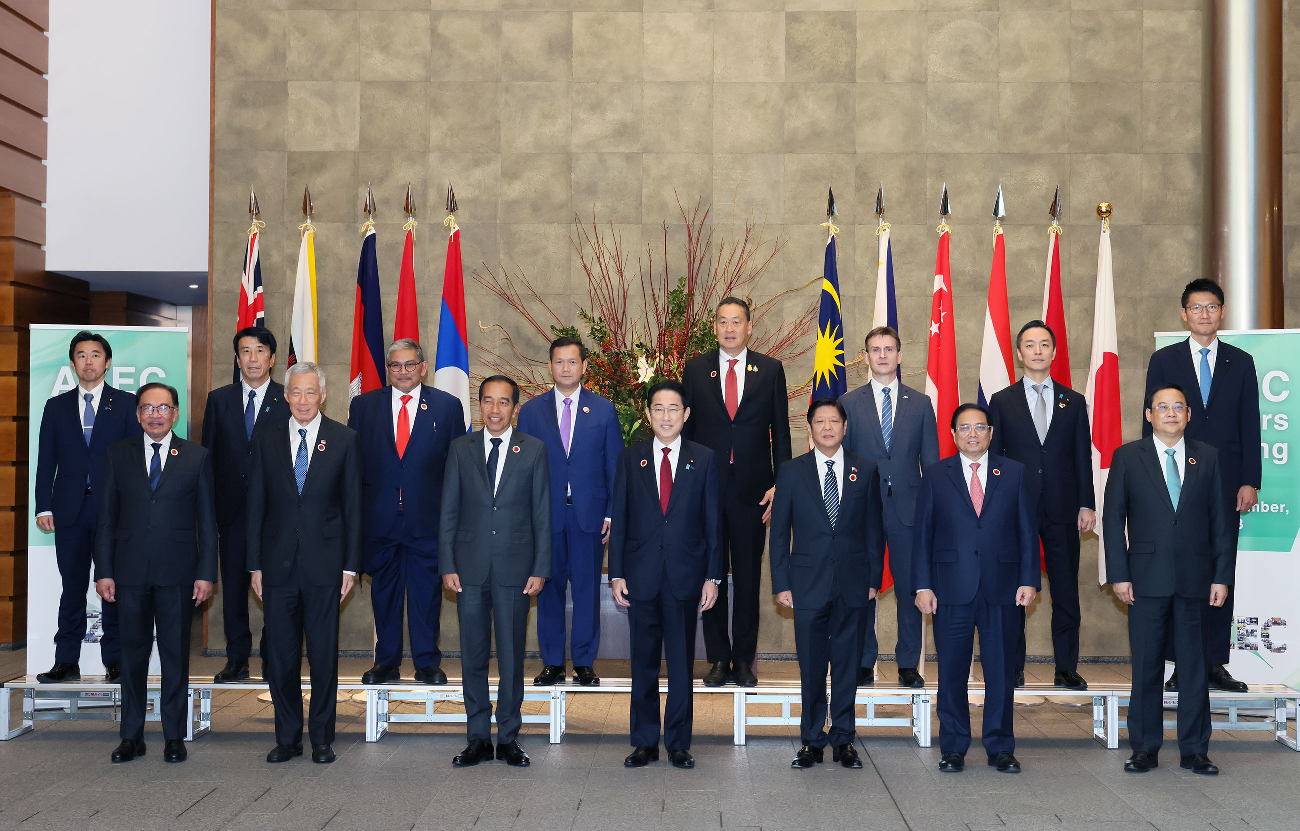
On December 18, 2023, the First Asia Zero Emission Community (AZEC) Leaders’ Meeting was held in Tokyo. Then-Prime Minister Kishida Fumio affirmed the importance of achieving a common goal of “net-zero emissions through various pathways” and a triple breakthrough of simultaneously achieving “decarbonization, economic growth, and energy security.” He emphasized that together with AZEC partner countries, Japan will continue to contribute to achieving decarbonization in Asia and global sustainable growth through activities under the AZEC platform.
Photo: Cabinet Public Affairs Office
The Asia Zero Emission Community (AZEC) serves as a framework for cooperation among environmentally like-minded Asian nations. The key to the success of this framework lies in designing highly transparent institutional systems and fostering the trust required to mobilize private investment.
- AZEC should simultaneously pursue decarbonization, economic growth, and energy security.
- The ties that bind AZEC stem from a bundle of policy implementations, including infrastructure, institutional frameworks, finance, and human resource development.
- What is required of Japan is to engage with Asian AZEC members through “non-forcing” collaboration—offering inclusive partnerships without demanding binary choices.
The global order is moving around two distinct forms of “autonomy.” The first is the effort by advanced democracies—such as European nations and Canada—to reinforce their own foundations in security, industry, technology, and finance, even while still requiring US power. The second is the movement among Global South countries to avoid aligning exclusively with either the United States or China, and to broaden the scope of negotiations within a multipolar world. Although different in nature, both share a common thread: rather than simply submitting to an externally imposed order, they seek to expand their own options.
What is required of Japan is not to discuss these two kinds of autonomy from the outside, but to build cooperation with countries that seek autonomy. Moreover, this cooperation must not be one that forces a choice between “this side or that side.” Many Asian countries must continue economic growth, secure energy, and address climate change. Decarbonization will not become a reality unless power plants, transmission networks, factories, ports, finance, and human resources are put into action, even if ideals are proclaimed.
AZEC—the Asia Zero Emission Community—represents Japan’s pragmatic “answer” to this formidable challenge. AZEC does not treat decarbonization merely as a diplomatic slogan; it addresses decarbonization, economic growth, and energy security simultaneously. Herein lies the strategic rationale of AZEC.
From this perspective, climate change countermeasures must be understood not only as benevolent international cooperation, but as a “redesign of the international order.” Decarbonization is not simply a matter of switching fuels at power plants. Climate policy alters the flows of resources, technical standards, financial conditions, industrial locations, and employment patterns. Consequently, who establishes the rules, who provides the capital, and who bears the risk have become central issues of diplomacy.
Partnerships in an “Era of autonomy”
The term “like-minded country partnership” often evokes images of an exclusive club restricted to nations sharing identical values. However, the reality in Asia is far more complex. Southeast Asian nations maintain multi-layered connections with the United States, China, Japan, Europe, India, the Middle East, and Australia. While valuing security ties with the United States, many have no choice but to maintain strong trade and infrastructure relationships with China. Furthermore, decarbonization priorities vary significantly between resource-rich nations and manufacturing hubs, or between urban states and island nations.
Therefore, Japan’s approach to like-minded partnerships must not focus on creating exclusive camps. Instead, it must offer institutional frameworks that allow each country to advance toward a common objective while preserving its own development pathway. In this sense, AZEC’s flexible core concept—“one goal, various pathways”—is highly pragmatic. The goal of net-zero emissions is shared. Yet the specific sequence and combination of technologies—whether renewable energy, power grid expansion, hydrogen, ammonia, carbon capture and storage (CCS), electrification, energy efficiency, or carbon markets—will differ for every country. Treating this diversity not as a weakness, but as the starting point for AZEC collaboration, is essential.
European autonomy moves in the direction of enhancing self-sustained capacities in regulation, industrial policy, currency, and defense support. Meanwhile, autonomy in the Global South shifts toward keeping a distance from existing rules set by major powers and leveraging multiple strategic options. Japan’s role is not to observe these two trends as opposing concepts, but to provide practical, mutually beneficial cooperation so that Asian countries can expand their choices while remaining anchored within an open international order.
Where does AZEC stand today?
AZEC was first proposed by Japan in 2022 and entered its institutionalization phase following the Ministerial and Leaders’ Meetings in 2023. It comprises 11 partner countries: Japan, Australia, Brunei, Cambodia, Indonesia, Laos, Malaysia, the Philippines, Singapore, Thailand, and Vietnam. In 2024, the Action Plan for the Next Decade was presented, establishing a direction to advance decarbonization and emissions reductions through concrete investments and projects in high-emitting sectors such as power generation, transport, and industry. Discussions expanded further toward cooperation including energy resilience at the Leaders’ Meeting in 2025 and at AZEC Plus in 2026—which welcomed India, South Korea, Bangladesh, Sri Lanka, and Timor-Leste.
This progress is far from trivial. Asian decarbonization cannot advance through repeated pledges in international negotiations alone; it requires connecting each country’s specific power development plans, industrial policies, public finances, financial systems, regulations, and skilled workforce. AZEC is not a framework designed to decide everything through a single treaty. It serves as an “arena for policy implementation,” connecting host governments, businesses, financial institutions, and research entities to uncover projects, formulate institutional frameworks, and mobilize capital.
In the book Decarbonization Policy Toward Asia Zero Emission Community, for which the author served as editor, individual analyses were conducted on power generation, steel manufacturing, technology transfer, carbon markets, and financial support. What emerges from these analyses is that the success or failure of decarbonization is not determined by a single technology. How to reduce coal-fired power, at what rate to increase renewable energy, to what extent to stabilize electricity prices, and how to change corporate investment decisions—only when these factors work together does emission reduction become a viable economic policy.
Participating countries in AZEC vary widely in income levels and industrial structures. The required cooperation differs for nations with growing manufacturing sectors and rising power demand like Indonesia and Vietnam, a country strong in finance and institutional design like Singapore, and a country with vast resources and renewable energy potential like Australia. If Japan attempts to force all these nations into a single template, the framework will quickly ossify. Instead, taking diversity as a given while building shared foundations—in measurement, finance, and technical standards—is essential.
In evaluating AZEC today, one should look beyond the sheer number of agreements and assess how deeply decarbonization policy is integrated into partner nations’ policy formulation. Incorporating renewable energy into national power development plans, shifting power grid investment priorities, standardizing industrial emissions data, and enabling financial institutions to evaluate low-carbon projects—only through the accumulation of such steady, localized changes will regional cooperation take root as a lasting institution.
Ties that bind stem from policy implementation
The ties connecting Southeast Asia and Australia within AZEC remain weak if based solely on shared ideals. Stronger ties emerge from joint projects.
First, national power sectors are of primary importance. Power demand in Asia will continue to grow. If power generation fails to decarbonize, electric vehicles, data centers, and low-carbon factories will ultimately remain dependent on fossil fuels. Expanding renewables, upgrading power grids, building energy storage, managing supply-demand adjustments, and reforming electricity markets represent the core agenda of AZEC.
Second, national industrial sectors matter deeply. Steel, cement, and chemical industries sustain employment and export competitiveness, yet remain hard-to-abate sectors. Here, Japan’s energy-saving technologies, operational management, material innovations, and financing schemes are highly effective. However, simply selling technology does not constitute true partnership; it must be integrated with the host country’s industrial policy, human resource development, standards, and infrastructure development.
Third, institutional frameworks are essential. The Joint Crediting Mechanism (JCM), emissions trading, carbon pricing, disclosure, and Measurement, Reporting, and Verification (MRV) transform decarbonization from a “pledge” into a “tradable value.” If emissions reductions are measurable, comparable, and trusted, private capital will flow in more readily. Conversely, if institutional reliability is low, markets will not value the same reduction efforts.
Fourth, human resources are critical. Those executing decarbonization on the ground extend far beyond diplomats at international conferences. Plant operators, grid engineers, local government officials, bankers, accountants, regulators, and regional enterprises are all key actors. For AZEC to function over the long term, it must deepen the layer of human resources capable of policy implementation across partner countries through training and joint research. Though unglamorous, capacity building steadily accumulates diplomatic trust.
Cooperation with Australia is equally crucial. Australia is both a resource-rich nation and a powerhouse in renewables, hydrogen, critical minerals, and grid infrastructure. By connecting demand centers in Southeast Asia, technology and finance from Japan, and resources and renewables from Australia, AZEC transcends standard Japan-ASEAN cooperation, gaining strategic depth as an Indo-Pacific energy framework.
Strategic rationale lies in market design
The strategic rationale of AZEC lies in its non-ideological nature. It is neither anti-US nor anti-China. Its significance rests in expanding the maneuverability of Asian nations to balance their own development with decarbonization without being dragged into US-China confrontation. For Japan, this is not merely climate diplomacy, but an economic security policy that re-links supply chains, resources, energy, finance, and standard-setting.
Carbon market integration, for example, is not simply a system for trading emissions allowances or credits. It is an institutional arrangement that determines which reductions are recognized as genuine, how double-counting is prevented, how much revenue remains in developing countries, and what investment signals are sent to corporations. Japan’s involvement here means actively participating in shaping Asia’s decarbonization rules. If a system characterized by high transparency and fair allocation is established, AZEC can become a foundation of trust for the region.
Finance operates under a similar logic. For developing nations, decarbonization investments carry heavy upfront costs: retiring fossil fuel plants early, reinforcing power grids, retrofitting factories, and cultivating talent. All require long-term capital. Because public funds alone are insufficient, projects must be restructured into bankable formats that attract private finance. When public institutions, donor nations, and host governments share risks, establish regulatory frameworks, and demonstrate predictable returns, a viable intersection between public finance and private investment is created.
However, market design is not a panacea. Introducing a carbon price does not automatically advance decarbonization; in lower-income nations, the impact on electricity tariffs and employment can easily spark political friction. This is why carbon pricing, subsidies, regulations, technical assistance, and social protection policies must be combined. The value of AZEC lies not in exporting a single policy, but in co-designing policy packages tailored to each nation’s circumstances.
In this sense, AZEC also serves as an arena for “standard-setting.” How environmental value is measured, how low-carbon products are certified, how renewable energy certificates are handled, how corporate emissions are disclosed, and how cross-border credits are treated will shape future trade and investment conditions. If Japan can propose highly credible rules that remain compatible with Western standards, it will help reduce uncertainties for Asian enterprises engaging with global markets.
The challenge lies in the “Exit Strategy” from fossil fuel dependence
However, AZEC is not without its challenges. The primary challenge is ensuring that its emphasis on flexibility does not become an excuse to prolong dependence on fossil fuels. In Asia, natural gas and coal remain critical sources of power, and an abrupt shutdown would severely impact both industry and livelihoods. This is precisely why transitional technologies are necessary.
Yet transition technologies must come with a defined exit strategy and timeline. While hydrogen, ammonia, CCS, and Carbon Capture, Utilization, and Storage (CCUS) are promising options, they face hurdles regarding cost, supply volume, and the verification of their actual emission reduction effects. The deployment of these technologies must not serve as a justification for delaying the expansion of renewables or energy efficiency measures. Although pathways may be diverse, the ultimate objective must remain firm. The target is strictly net-zero emissions, and each technology must be evaluated by how reliably it contributes to that goal.
A second challenge is inclusivity. Decarbonization impacts employment and local communities. A policy will not be sustainable over the long term if it leaves behind workers in coal-related industries, households sensitive to electricity rates, small and medium-sized enterprises, or local governments. Beyond technical cooperation, AZEC must integrate a just transition into its framework—one that encompasses vocational training, regional development, and consideration for citizens’ daily lives.
A third challenge is making results “visible.” While leaders’ meetings and joint statements are necessary, they alone will not deepen regional trust. Demonstrating which projects reduced emissions by how much, contributed to a stable power supply, or generated jobs must be presented in a way that the general public can easily understand. If results remain vague, AZEC risks being perceived as a mere slogan.
Toward Japan as a mediator expanding the options
Japan’s role in AZEC should not be to impose a single solution on Asia. Rather, it should be to expand high-quality options from which each country can choose. If countries have access to more choices—such as scaling up renewables, strengthening power grids, decarbonizing industries, utilizing transparent markets, or securing long-term finance—their autonomy will grow, as will their trust in Japan.
In this regard, AZEC offers valuable insights into Japan’s relationship with the Global South. Many nations do not wish to remain passive recipients of aid. They seek to foster their own industries, create employment, and secure their energy supplies while participating in climate action. What Japan should present to these nations is not a unilateral proclamation of ideals, but a commitment to co-creating institutional systems and concrete projects.
In an era of shifting international order, simply championing grand visions is not enough. Ultimately, it is daily policy implementation that generates true diplomatic power. AZEC is not yet a complete community. Rather, it is in the process of building trust from here on out. That is precisely why it is important to steadily increase the number of transparent institutions, measurable results, and projects that contribute to the development of partner countries.
Japan, too, must transform. If domestic progress in renewable adoption, power grid reinforcement, industrial decarbonization, or carbon pricing stalls, the persuasiveness of Japan’s message to Asia will diminish. Domestic reform and international cooperation are not separate endeavors. Sharing its own experiences and missteps in decarbonization will prove to be Japan’s most trusted diplomatic asset.
The focus going forward is whether AZEC can evolve from a conference-centered framework into one where investment and institutions operate in practice. Japan needs to foster not only dialogue with national governments, but also multi-layered networks that connect local businesses, electric utilities, financial institutions, universities, and local governments. Whether Asian decarbonization can move forward not as a distribution of burdens, but as a redesign for growth—herein lies the future of Japan’s like-minded country partnerships.
Translated from “‘Jisso’ wo Tomoni surukoto de Chutai ga Umareru: AZEC, Ajia Datsu-tanso ‘Jiritsu’ no Senryakusei — Nihon wa Nani wo Tsunagubekika (Co-Creating Policy Implementation to Build Ties Among AZEC Partner Countries: The Strategic Logic of “Autonomy” in Asian Decarbonization—What Should Japan Connect?),” Gaiko (Diplomacy), Vol. 98 Jul. / Aug. 2026, pp. 76–81. (Courtesy of Jiji Press) [October 2026]

KATO Shinya, Ph.D.
Professor, Faculty of Economics, Meijo University
Graduated from Kobe University. Completed the doctoral program in Economics at the Graduate School of Economics, Kobe University, in 2014. Holds a Ph.D. in Economics. After serving at Okayama Shoka University and Yamaguchi University, assumed his current position in 2025. Visiting Senior Research Fellow at the Economic and Social Research Institute, Cabinet Office. Specializes in environmental economics, computable general equilibrium analysis, and input-output analysis. His publications include Kono Issatsu de Mikuro to Makuro ga Dojini wakaru Keizaigaku (Economics: Understanding micro and macroeconomics simultaneously in one book) and (edited) Decarbonization Policy Toward Asia Zero Emission Community.
Keywords
- AZEC
- Asia Zero Emission Community
- decarbonization
- energy security
- autonomy
- collaboration
- partnerships