


Japan’s International Cooperation Seen from Palau: Rising Geopolitical Interests, Principles and Strategies under Scrutiny
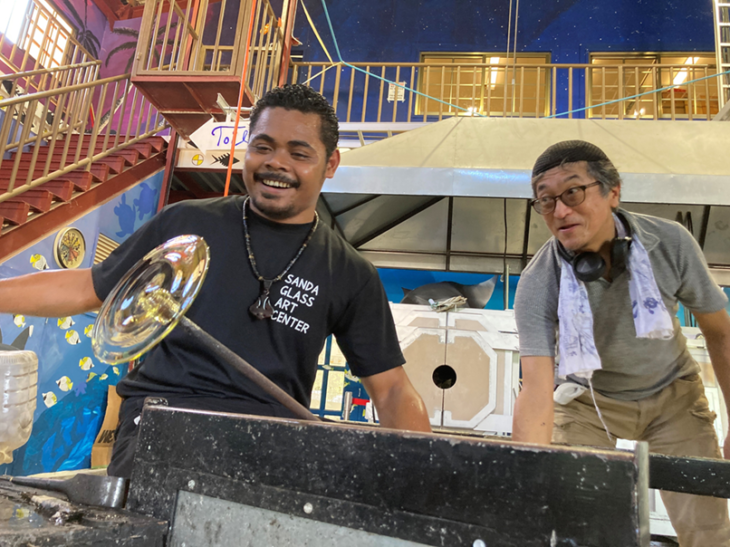
Belau Eco Glass Studio. The project commenced in 2022 as an initiative aimed at reducing waste glass and forming a circular society. (Photo: JICA)
The Pacific Island region is seeing rising geopolitical interest from around the world. Located in the western part of this region, Palau has deep ties with Japan in terms of both historical and personal exchanges. Through JICA’s support, we examine the challenges unique to island nations and the ideal form of aid that contributes to realizing “Human Potential.”
- Infrastructure investment to stimulate economic growth in island regions
- Resolving multiple vulnerabilities through innovative aid
- Growing importance of fostering regionalism amid rising geopolitical risks
Mine Yoichi: In mid-September 2025, I traveled to Palau with Nakanishi-san to inspect the sites of Japan’s international cooperation. Palau is located at the western edge of Micronesia, east of Mindanao Island in the Philippines.
Nakanishi Hiroshi: At the time of our visit, it was a day-long journey via Guam, but with the establishment of a new direct flight from Narita on October 29, the travel time has been significantly shortened to four and a half hours, making it much closer. It is also convenient that Palau is located directly south of Japan with no time difference. The incumbent President Surangel Whipps Jr. visited Japan to coincide with the inauguration of the direct flight service.
Mine: The ocean in Palau is crystal clear and truly beautiful; it is understandable why so many tourists visit the country. Tourism accounts for about 40% of the Gross Domestic Product (GDP), and I strongly felt its further potential.
Palau Basic Information
◇Area: 488 square kilometers (approximately the same size as Yakushima)
◇Population: 17,695 (2024, World Bank)
◇Capital: Melekeok (relocated from Koror in October 2006)
◇Ethnicity: Micronesian
◇Languages: Palauan, English
◇Independence: 1994 (also joined the UN the same year)
◇Government: Presidential (4-year term, no third term allowed)
◇Legislation: Bicameral (15-member Senate, 16-member House of Representatives), 4-year term
◇GDP: US$281 million (2023, World Bank)
◇GNI per capita: US$14,070 (2023, World Bank)
◇Major Industry: Tourism
War Scars Seen in a Pro-Japanese Nation
Nakanishi: In addition to its geographical proximity, it is a country with deep historical ties to Japan. Following World War I, Japan was designated as a Mandate state by the League of Nations (LON) to administer Micronesia. The Territorial Government of the South Seas (South Seas Bureau) was established in the then-capital, Koror, to govern the South Sea Islands. Due to this history, it is said that people of Japanese descent account for 25% of the population, and some Japanese words still live on in the Palauan language today. For example, “delicious” is sometimes expressed as aji daijobu (meaning there is no problem with the taste).
During my actual visit to Palau, I felt that the influence of the Japanese colonial period remains deeply ingrained culturally and socially. It appears that many of the immigrants from Japan were from Okinawa.
Mine: Palau saw some very fierce fighting during World War II. In 1944, intense ground battles took place on Peleliu Island and Angaur Island to the south, resulting in more than 16,000 casualties from the Japanese military.
Nakanishi: Because the Japanese military evacuated the local residents from the battlefields in advance, few people were caught up in the fighting, and as a result, sentiment toward Japan remains favorable today. Even after it came under US administration as a United Nations Trust Territory in 1947, people of Japanese descent have continued to play important roles in Palauan society. Independence came in 1994, which was relatively late among the Pacific Islands, and the president at that time was Mr. Kuniwo Nakamura, a second-generation Japanese-Palauan. Among these nations, Palau is the country with the deepest relationship with Japan.
Mine: On this occasion, we also toured the war sites on Peleliu Island, which made us reflect on how the “memory of war” should be passed down to future generations.
Nakanishi: Even now, projects to collect the remains of the war dead are continuing, and we saw caves where Japanese soldiers barricaded themselves, large artillery batteries, the wreckage of tanks, and the ruined building of the Navy headquarters. In 2015, Their Majesties the Emperor and Empress (now the Emperor Emeritus and Empress Emerita[1]) visited for a memorial service. It is an important place for facing the memory of the war, and efforts such as the preservation of war sites will be necessary in the future.
Vulnerability Hidden Behind “Elevated” Affluence
Mine: On the other hand, Palau faces several vulnerabilities regarding climate change, economic independence, and its geopolitical location.
Nakanishi: Regarding the impact of climate change, while there are countries among the Pacific Islands like Tuvalu where sea-level rise is a severe issue, in Palau’s case, it appears that the most significant impact of climate change is changes in the ecosystem affecting the growth of natural fruits. Key vulnerability lies in economic and fiscal issues. When Palau became independent in 1994, it concluded the Compact of Free Association with the United States (COFA).[2] The financial assistance from the US based on this agreement was renewed last year, but that aid accounts for approximately 15% of the national budget, making fiscal independence an unlikely prospect.
Mine: Thanks to COFA, Palauans can travel to the United States without a visa, so it is said that not a few Palauans migrate to Guam, Hawaii, or the US mainland.
Nakanishi: Palau has only one community college (equivalent to a junior college), so talented young people go to universities in the United States and often do not return after graduation. The issue of human resource development is serious, and it seems that Japan is coordinating with the local situation to see if it can support the introduction of a technical college (KOSEN[3])-type education system. Furthermore, there is the issue of the industrial structure.
One-third of the population in Palau is comprised of immigrants—Filipinos engaged in the service and medical industries, and Bangladeshis engaged in labor such as construction. Many Palauans are in occupations that deal with nature, such as tourism and fishing, creating a situation where it is difficult for core industries that link increased productivity to economic growth to flourish.
Mine: Diversification of Palau’s industrial base is necessary. In addition, partly due to the outflow of young people abroad, the population is aging, following in Japan’s footsteps. Palau is classified as a high-income country with a Gross National Income (GNI) per capita of $14,000, and based on economic indicators alone, it is certainly a wealthy country. However, the cumulative amount of Official Development Assistance (ODA) received per 10,000 people has exceeded 20 billion yen, so it can be said that the affluence of this country has been considerably “elevated.”
Nakanishi: Japan’s aid policy has been based on the principle of supporting the self-reliance of developing countries as a whole and eventually pushing them to graduate from aid and join the ranks of developed nations. In that respect, Palau can be considered a special case where it is difficult for the country to possess self-reliance as a state in and of itself.
On the Front Lines of ODA Observed in Palau
Nakanishi: We inspected the sites of support provided by the Japan International Cooperation Agency (JICA) on the ground, and a truly wide variety of projects are being implemented. One of the projects that deserves special mention would be the “Japan-Palau Friendship Bridge.” This bridge, which connects the two main islands of Koror and Babeldaob, where the international airport is located, was completed in 2002 through Japanese Official Development Assistance (ODA).
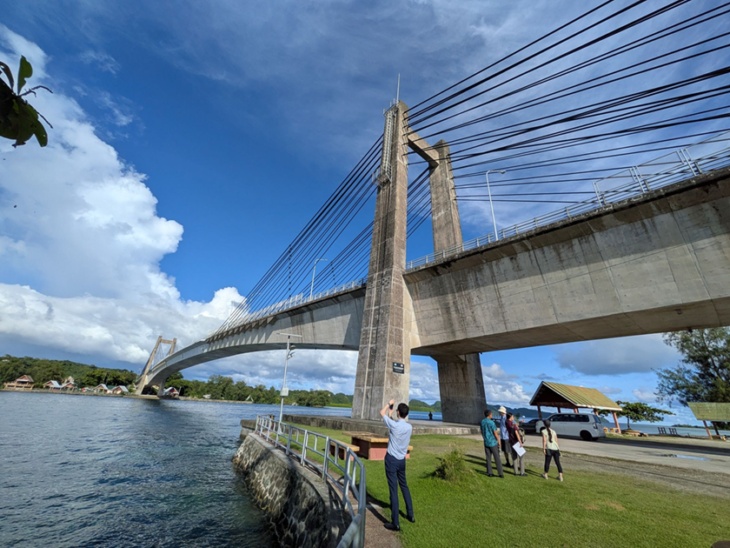
Japan-Palau Friendship Bridge, completed in 2002 as a symbolic project of Japan’s development cooperation. (Photo: JICA)
Mine: It was quite impressive to see a concrete bridge spanning over 400 meters in length built on such small islands. In island nations, transportation infrastructure that connects island to island—and further links them to global economic hubs—becomes an indispensable element in promoting development. In addition, Japan has contributed to substantial infrastructure development by utilizing grant aid and overseas investment and lending. Examples include the reconstruction of the Minato Bridge, which connects Koror Island to Malakal Island (where the commercial port and power plant are located), as well as the expansion work on the international airport terminal building and its subsequent operation after completion.
Nakanishi: On the other hand, in the socio-economic sector, the construction of waste disposal sites and recycling-related facilities is also progressing. Waste management is a serious issue for island nations. Reclaiming land along the coast has a negative impact on the environment, and incineration is inefficient given the scale of the islands. Therefore, a recycling-type disposal site was constructed on Koror Island. Attached to it is a glass studio called “Belau Eco Glass,” which utilizes waste glass to produce simple but beautiful ornaments and jewelry. The cover photo of the 2023 “White Paper on Development Cooperation (Japan’s ODA White Paper)” captures a scene of this production process.
Efforts to create innovation are also being undertaken. Trials are underway for the hydroponic cultivation of vegetables and the farming of marine products by pumping up deep ocean water. Furthermore, surveys are progressing for the demonstration of ocean thermal energy conversion, which utilizes the temperature difference between deep ocean water and surface water. I also visited a pilot farm and sampled some small leafy vegetables.
Mine: These are attempts not only to foster new industries—such as water resource utilization, power development, commercial agriculture, aquaculture, and recycling—but also to cross-cuttingly address and overcome multiple vulnerabilities. It was good to be able to observe this up close.
Of course, it seems that not all initiatives go smoothly. I heard that there were some opposing opinions from the local community regarding the attempts at ocean thermal energy conversion, but the Japanese staff appear to be providing thorough explanations. It is important to take into account the local politics and culture, engage sincerely with local people, and build mutual understanding through conversation. I felt it is crucial to make them feel that “Japanese people are trying to walk alongside us” by not imposing our own knowledge.
Nakanishi: In the field of education, JICA’s Japan Overseas Cooperation Volunteers (JOCV)[4] teach subjects such as arithmetic and physical education at elementary schools, and they also provide advice to the Palauan Ministry of Education. In the medium- to long-term future, the issue of human resources will be crucial.
Mine: While aid for education and healthcare is symbolic, it would be ideal if the concept of “Human Security,” which addresses vulnerabilities on the ground, is applied based on the philosophy of “Human Development” that draws out human potential. I received the impression that support from Japan, including the JOCV, is being carried out thoroughly in that regard.
Nakanishi: To add to that, separate from JICA, in terms of strengthening maritime security capabilities, the Nippon Foundation has shown a unique presence by cooperating with the Japan Coast Guard (JCG) to contribute to the provision of vessels such as patrol boats and other vessels, as well as the training of personnel. This can be cited as a good example of the diversification of actors involved in development cooperation.
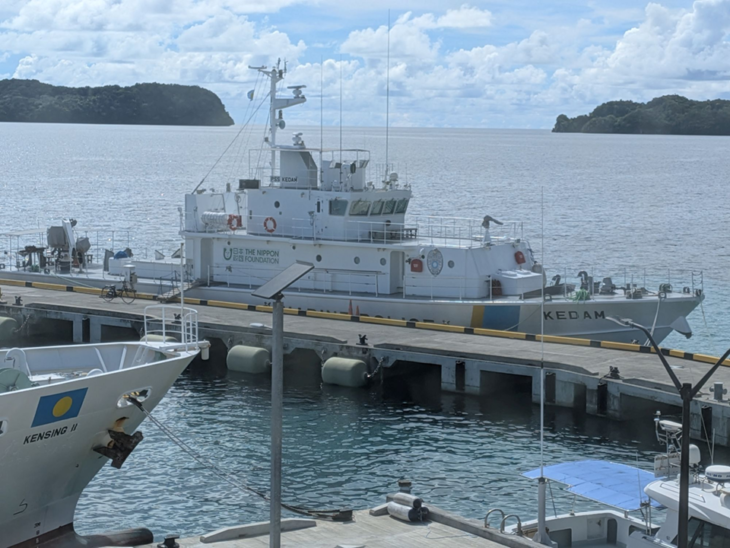
A patrol boat of the Division of Marine Law Enforcement (DMLE) donated by the Nippon Foundation. It supports maritime sustainability from a security perspective. (Photo: JICA)
Mine: “Co-Creation,” where diverse actors cooperate to jointly create new solutions and social value, is also a principle of new international cooperation. JICA has many overseas offices in the Pacific region. It would be beneficial to strengthen efforts that generate even greater development effects by expanding networks while exchanging views among the offices across the islands—for example, by scaling up projects in Palau to other island nations and regions.
Building Relationships Based on the Geopolitics of the Pacific
Mine: In considering cooperation with Pacific Island countries, the factor of rising geopolitical interest cannot be ignored.
Nakanishi: As a general trend in this region, we can observe the expansion of China’s maritime influence and the diminishing presence of the United States. However, Palau is one of the few Pacific Island countries that maintains diplomatic relations with Taiwan. While the relationships from the eras of administration by the United States and Japan form the backbone of Palauan diplomacy, the relationship between Palau and Taiwan is also deep.
Mine: It is rare to find a country where a Taiwanese embassy is located.
Nakanishi: It was located on the upper floor of a building in central Koror that houses a large supermarket funded by Taiwanese capital. Many public buildings in the capital, Melekeok, were also constructed with aid from Taiwan, giving a strong sense of the economic ties. Furthermore, President Whipps, who was re-elected in January this year, is a shrewd politician nicknamed the “Trump of Palau”; he is conscious of making Palau strong and does not hide his vigilance toward China. Therefore, China appears to recognize that it would be difficult to get Palau to switch sides immediately to its side. But they are undoubtedly considering increasing influence through tourism and economic sectors.
Mine: Among the Pacific Island countries, the Marshall Islands and Tuvalu also recognize Taiwan.
Nakanishi: In Palau, the approach has varied depending on the administration. The previous President Tommy Remengesau Jr. tended to try to maintain a balance among countries, including with China. As long as tourism remains the pillar of the industry, the economic power of China cannot be ignored.
Mine: There are also ties in food and agriculture, such as Chinese water spinach being sold in the markets, and the number of tourists from China appears to be increasing. It remains unpredictable whether Palau will lean toward rapprochement with China in the future or continue to stand by Taiwan as before. Much depends on the US strategy in the Pacific, but it remains to be seen how the policies of the Trump administration will be solidified in the region.
Nakanishi: The impact of the dissolution of the US Agency for International Development (USAID) felt relatively small in Palau, but there is no doubt that the future course of US diplomatic and military engagement will significantly affect the future of Palau and the Pacific region. The United States, Japan, Australia, and Taiwan each maintain a certain level of involvement in Palau. It is important for these partners to walk alongside Palau and maintain cooperative relationships in the western Pacific area, especially in responding to changes in the geopolitical environment. In the process of advancing security cooperation, Palau may function as a hub for policy formation across this region in the future.
Mine: We should also pay attention to the strengthening of solidarity among island nations and the movements toward Pacific regionalism. Cooperation among Small Island Developing States (SIDS) is progressing, as seen in the adoption of the Multidimensional Vulnerability Index (MVI) at the United Nations. There even seem to be voices suggesting that seats for small island states should be secured on the Security Council in the future.
From that perspective, the Pacific Islands Leaders Meeting (PALM),[5] held under Japan’s initiative, is crucial. While the 9th Tokyo International Conference on African Development (TICAD 9) held in August 2025 was a success, PALM—which seeks to foster political leadership and regionalism in this area by including Australia and New Zealand alongside the Pacific nations—is a framework as significant as TICAD. We should strive to make such initiatives more active. Furthermore, Palau is increasing its presence as it serves as the 2026 Chair of the Pacific Islands Forum (PIF), the framework for regional cooperation.
Nakanishi: It has only been in the last 10 to 15 years that awareness of the importance of the Pacific Islands has grown in Japan, partly aided by geopolitical interests. During this period, Japan’s diplomacy toward Pacific countries has shown certain progress, and the importance of international cooperation in the region has increased. However, as a whole, it is still in a transition period, and it cannot be said that a comprehensive strategy for the Pacific region has been fully established. This is also true for the United States and Australia; while they say “the Pacific Islands are important,” they have yet to translate that into concrete policies. Moving forward, it will be necessary to review regional policies and the positioning of each country after aligning the overall situation of the Pacific region with the circumstances of individual nations. This will further enhance the significance of international cooperation.
Nakanishi Hiroshi:
By aligning regional policies with the
situations of individual countries and
positioning development cooperation
within that framework, the significance of
ODA will be further enhanced.
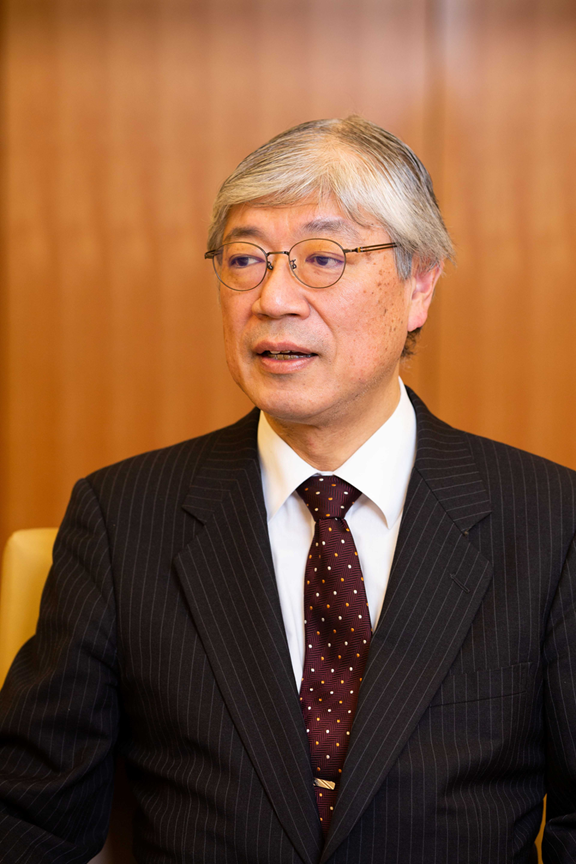
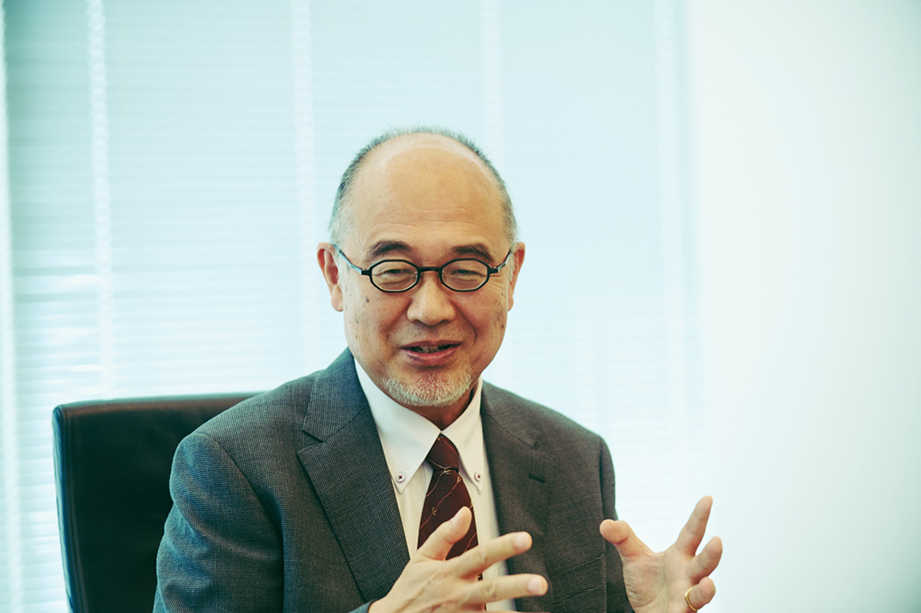
Mine Yoichi:
It is essential to grasp needs that cannot
be fully captured by economic
indicators from the perspective of
“expanding choices in one’s way of life”
and to maintain an attitude of working
together to solve problems.
Mine: Before the war, Japan referred to the Micronesia region, including Palau, as the South Seas (Nan’yo). More precisely, Micronesia was classified as the Inner South Seas (Uchi-Nan’yo), while present-day Southeast Asia was classified as the Outer South Seas (Soto-Nan’yo). Setting aside the appropriateness of such a classification, it would be worthwhile to have a vision for future regional cooperation in which Japan acts as a peaceful catalyst connecting the Association of Southeast Asian Nations (ASEAN) with the Pacific countries, especially Micronesia.
In that regard, Okinawa will serve as one of the core elements. Based on the “ASEAN Human Resources Development Initiative” proposed by Prime Minister Zenko Suzuki in 1981, the JICA Okinawa Center was established in 1985. The reason for its establishment was that Okinawa is geographically, climatically, and culturally close to Southeast Asia. Regarding Palau, as Nakanishi-san pointed out, there is also the fact that many of the Japanese who immigrated to Palau under Japanese administration were originally from Okinawa. Over the years, a variety of expertise in inter-island cooperation has been accumulated at the JICA Okinawa Center, making it an entity capable of playing the role of a hub connecting ASEAN and the Pacific.
Recognizing “Reciprocal Cooperation” as the Most Important Factor
Mine: I would like to return to the topic of international cooperation with Palau. Why do we provide international cooperation to a middle-to-high-income country like Palau? In addition to the geopolitical context we just discussed, it is important to respond to the needs of people that cannot be fully captured by economic indicators alone. Palau is a country that depends on the United States for its finances and faces structural constraints in fostering industries. That said, there are people on the ground who are rooted in the islands and leading their lives while dealing with complex threats, including natural disasters. From the perspective of “expanding choices in one’s way of life” for the island residents, rather than limiting ourselves to their income levels, is it not the case that an attitude of jointly seeking solutions to the challenges faced by Pacific islands—such as education, medical care, and addressing climate change—is fundamentally required?
In Palau, I once again realized the importance of the concept of “Human Security,” which addresses risks with a focus on people. Japan, like Palau, is also an island nation. While incorporating geopolitical interests, I believe we have reached a stage where we must envision development cooperation comprehensively for the future, asking ourselves, “What can we learn from each other through heart-to-heart, person-to-person cooperation?” and then, “What kind of value can we create together?”
Nakanishi: That means deepening cooperation “reciprocally.” Rather than one-sided aid, it is necessary to integrate development cooperation into overall diplomatic relations while sharing common challenges.
Mine: The Development Cooperation Charter also explicitly states that for countries facing special vulnerabilities, such as Small Island Developing States (SIDS), necessary cooperation will be utilized strategically.
Nakanishi: I believe balance is important. For Japan, I think Palau is a country with which we have an exceptionally good relationship, but if we perceive Palau only from a Japanese perspective, it could lead to friction with the local people. Furthermore, it is important to build relationships based on a view of the Pacific Islands as a whole. Efforts to develop the relationship with Japan while recognizing the traditions and history of the partner are crucial.
Translated from “Parao kara Mita Nihon no Kokusaikyoryoku: Takamaru Chiseigaku-teki Kanshin, Towareru Rinen to Senryaku (Japan’s International Cooperation Seen from Palau: Rising Geopolitical Interests, Principles and Strategies under Scrutiny),” Gaiko (Diplomacy), Vol. 94 Nov. / Dec. 2025, pp. 104–112. (Courtesy of Jiji Press) [March 2026]
[1] Their Majesties the Emperor Emeritus Akihito and Empress Emerita Michiko. They transitioned to these titles following the Emperor’s abdication on April 30, 2019, the first such event in Japanese imperial history in approximately 200 years.
[2] The Compact of Free Association (COFA) is an international agreement establishing the relationship of free association between the United States and Palau. Under this agreement, the United States provides financial assistance and maintains exclusive military authority and responsibility for Palau’s defense, while Palauan citizens are granted the right to reside and work in the US.
[3] KOSEN is a unique educational institution in Japan. It is a five-year higher education institution where students can enroll from the age of 15. https://www.kosen-k.go.jp/en/
[4] JOCV is a Japanese government-funded program under JICA that dispatches skilled Japanese citizens to developing countries to contribute to social and economic development at the grassroots level.
[5] PALM is a summit-level meeting held every three years since 1997, hosted by Japan to strengthen relations with Pacific Island countries and discuss regional challenges.
Keywords
- international cooperation
- Palau
- JICA
- infrastructure investment
- regionalism
- geopolitical risks
Related posts:
 Will “Chinese-style” Development Permeate Hong Kong?
 China’s Expanding Presence in Central Asia: Its Global Strategy and Public Responses
 Afghanistan Earthquake: Relief Activities by Peace Japan Medical Services and Peshawar-kai
 Recent Cyber Situations and the Bill Introducing Active Cyber Defense
 Reading China’s Tactics Aiming to Change the Status Quo