


Washoku and Folklore
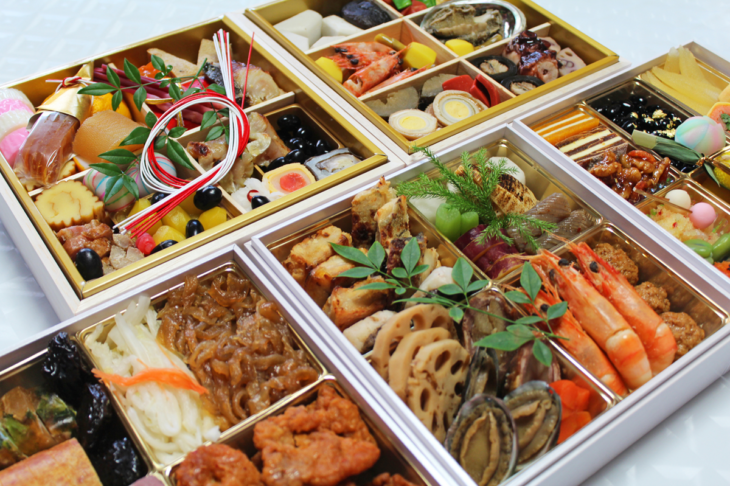
The essence of “Washoku” (Japanese cuisine), as inscribed on UNESCO’s list of Intangible Cultural Heritage, is epitomized by the festive foods of the New Year. Osechi, an assortment of local seasonal ingredients, embodies the spirit of shinjin-kyoshoku—the ritual of sharing a communal meal with deities, Buddhas, and ancestral spirits. As a gochiso (feast) prepared with significant time and labor, it stands in stark contrast to the meals of ordinary daily life (Ke), serving as a vital bridge that connects Japan’s traditional food culture to the next generation.
Photo: carrie / photolibrary
Amidst a Diverse Food Culture
It is difficult to categorize Washoku (Japanese cuisine) into a single type because it has developed uniquely across different eras and regions.
One reason for this diversity is the geography of the Japanese archipelago. It stretches approximately 3,200 kilometers from north to south, spanning latitudes from 20 to 45 degrees north. Consequently, the arrival of the “cherry blossom front” (sakura zensen) or the rainy season differs by a month or more between Okinawa and Hokkaido. The presence or absence of heavy snowfall also creates significant regional contrasts. These factors lead to variations in the resources gathered from mountains, rivers, seas, and fields, which in turn shape distinct regional dietary habits.
Furthermore, Japan remains an archipelago of mountainous islands, with mountains occupying over 60 percent of the land today. Human dwellings and settlements are scattered up to elevations of several hundred meters. Notably, the development of settlements at high altitudes in the Japanese archipelago is remarkable; this is likely because high rainfall and a lack of rocky mountains made it easy for vegetation to flourish. These differences in altitude also cause variations in lifestyle and dietary habits.
A further reason is the long period of life under the Baku-han system of the early modern era [the Edo period (1603–1867)]. For 265 years, over two hundred domains / clans (han) coexisted. Just as each domain referred to itself as a “country,” each had its own distinct lifestyle. While a new, common style known as the “Edo specification” emerged, each domain (country) prioritized and maintained its traditional way of life. As a result, various food products developed in different regions, which later came to be known as “local specialty dishes” (meibutsu-ryori).
However, the daily dietary life of the common people was not so diversified. While rice could not be called the sole staple, a “grain-based diet” (ryushoku)—where other grains (millets) were added to rice—was the staple. This was common almost nationwide. It will be necessary to categorize the food of daily life including side dishes.
In addition to examining the common food of Ke, a term meaning daily life, another perspective is to search for national commonalities in the meals of Hare, meaning festive or special occasions.
Incidentally, “Washoku,”[1] which is inscribed on UNESCO’s Representative List of Intangible Cultural Heritage, is appended with the subtitle “traditional dietary cultures of the Japanese, notably for the celebration of New Year.” First of all, would it not be best for us to focus on the meals served during the annual events that have been passed down through generations?
Taking the New Year as an example, zoni (New Year’s mochi soup)[2] is a widely shared commonality. Regarding zoni, there is a tendency to discuss regional differences based on the method of preparing the broth or the variety of toppings. However, the most important element is the existence of the mochi (rice cake) itself.
Furthermore, there is a tendency to view the distinction between the maru-mochi (spherical or disc-shaped rice cakes) of Western Japan and the kiri-mochi / kaku-mochi (flat, rectangularly cut rice cakes) of Eastern Japan as a problem. This is solely due to the climate; in cold regions, simply rolling the dough into rounds would cause them to crack. Therefore, the dough must be rolled out to push out internal water droplets and air bubbles, and to eat it, it must be cut into pieces. Even in regions that use kiri-mochi, the kagami-mochi (a New Year’s decoration featuring mochi)[3] should be circular (round). Originally, that large cake would be cut and eaten, but since it also cracks and becomes difficult to eat, people in Western Japan also prepare separate small mochi cakes.
In both the East and West, the New Year’s kagami-mochi is roasted as part of the Tondo (or Dondo-yaki [New Year’s bonfire ritual]) during Koshogatsu (Little New Year),[4] divided into small pieces, and eaten. As a festive food (gyoji-shoku), it is the kagami-mochi that we must pay attention to.
Also, during that season of winter desolation, osechi (Osechi-ryori [Traditional Japanese New Year food]) is prepared using ingredients that can be secured in each respective land. Along with the zoni soup, these first become offerings to deities, Buddhas, and ancestral spirits. By taking those offerings down from the kamidana (home altar) and people sharing the meal together (ainame), it has been treated as a celebration. This is not limited to the New Year. Most of the many ritual events throughout the year place great importance on shinjin-kyoshoku (sharing a meal with the gods). This could be described as a transmission of food culture that is unique even on a global scale.
Once again, we must go back in time to trace the ancestral forms. Yes, we must attempt a “return to our roots” (senzo-gaeri).
The changes in our lives over the past half-century or so have been immense. The period of high economic growth starting around 1965 was perhaps the most rapid and diverse change and transformation in history, and it would be appropriate to call it a “lifestyle revolution.” Regarding changes in dietary life, daily meals, in particular, became abundant. It was around that time that the term “The age of dietary abundance” began to be used. This was something that encouraged the nationwide homogenization of food through the development of commercial distribution.
On the other hand, urbanization and rural depopulation, a declining birthrate, and an aging population are progressing, making it difficult to stem the retreat of the grain-based diet or the simplification of ritual offerings.
Here, I would like to attempt a consideration of “Washoku” and the “traditional dietary cultures of the Japanese” by once again tracing back through time.
Hare-no-gohan (pure white rice)[5] and Ke-no-meshi (Katemeshi, daily loaded rice)[6]
If asked, “What is the staple food of the Japanese?” how would one answer? Most people would likely still answer, “Cooked rice (rice meals).”
Of course, that is one side of the truth. However, as mentioned earlier, throughout history, not all Japanese people in every era have used rice meals as their staple food. Broadly speaking across eras, it was primarily in urban areas where rice circulated as a staple ingredient. Therefore, those who relied on rice as their staple were mainly city dwellers—that is, the non-producers of food.
Even so, city dwellers did not necessarily have enough rice to eat. Synthesizing various historical documents, it can be inferred that during the mid-to-late Edo period, people typically ate only two meals a day. Notably, around 1721 (Kyoho 6), when the population was surging, the Shogunate even issued sumptuary edicts (kenyaku-rei) to strictly enforce a two-meal-a-day limit within the city of Edo. Meanwhile, around that time, “eating devices” such as baked sweet potato stalls, soba noodle shops, and sushi shops emerged to curb the hunger of townspeople. In the cities, although rice meals were established as the staple, it was a form of staple diet that tended to be so insufficient that supplementary snacks had to be added separately.
Japan has long been dedicated to rice cultivation. Traces of paddy-field rice cultivation dating back to the late Jomon period have already been identified. Since then, in every era, rice cultivation has been the nation’s key industry. One need not even bring up the kokudaka system (land productivity rating) or the fuchimai system (stipend rice) of the Edo Shogunate. However, no matter how much production was increased, Japan’s land area did not possess enough rice production—that is, paddy field acreage—to provide for the entire diet of the total population.
During the Edo period, which imposed the nengu (land tax in rice) system, terms such as “roku-ko yon-min” (60% to the government, 40% to the people) or “shichi-ko san-min” (70% to the government, 30% to the people) existed. In particular, farmers, who accounted for 70 to 80 percent of the Japanese population, were obligated to surrender more than half of their harvested rice. As a result, it was difficult to provide for their daily staple food with the rice remaining in their hands.
Farmers in every era were almost entirely removed from a diet of rice. While omitting detailed numerical evidence, it can be estimated that in many farming and mountain villages, if rice were to be the staple, they could only secure enough for about one-half or one-third of a year’s sustenance. Furthermore, if they tried to secure rice for festive Hare days, the amount for daily consumption became even more limited. Naturally, they had to supplement rice with something else to sustain themselves.
Fortunately, however, they were able to produce a fair amount of barley, Japanese millet (hie), foxtail millet (awa), potatoes, and daikon radishes on their upland fields, which could serve as staples in place of rice. That upland farming also has a long history, though there are differences between Western and Eastern Japan. In not a few places, yakihata (slash-and-burn agriculture) had been developed long before johata (permanent fields). This was, of course, before the advent of rice cultivation. And even under the tax system of the Edo period, these were mostly not subject to taxation. This is a point that must be given renewed attention.
Thus, ingenuity was applied to supplement the lack of rice with such upland crops. The representative of this was katemeshi (rice bulked out with other ingredients), and zosui (rice soup),[7] which was katemeshi diluted with broth.
The “kate” (糅) in katemeshi is a character created in Japan. In China, it is represented as “Liang” (糧), meaning to soften rice. It can be interpreted as increasing the volume of rice. While mugimeshi (barley rice) was sometimes treated as an exception, the staples of the common people consisted of hiemeshi (millet rice), imomeshi (potato rice), daikon (leaf) meshi, kurimeshi (chestnut or acorn rice), and so forth. These were the staples of the common people. This was “kate.”
From a historical perspective, Ke (daily) meals consisted of katemeshi (loaded rice) and zosui. In contrast, pure white rice was strictly reserved as a Hare (festive) feast. This is why it was honored with the term “gohan”—literally meaning “The Honorable Meal”—to distinguish it from ordinary sustenance.
If we look closely, this tendency can be said to persist even to the present day. Certainly, the amount of consumption has decreased. However, in terms of proportion, approximately half must still depend on rice-based meals. Yet, katemeshi is no longer a staple in modern times. In its place, foods such as udon, ramen, bread, and spaghetti have become staples. One might say that indigenous upland crops (ingredients for katemeshi) have been replaced by imported upland crops (wheat and related grains). In any case, it can be said that rice-based meals in Japan have sufficed by securing about half of the total diet throughout history.
These dietary habits could be traced in various regions until the 1950s and 60s (Showa 30s). Therefore, if asked what the traditional staple of the Japanese is, one must answer: “Hare-no-gohan (pure white rice) and Ke-no-meshi (katemeshi).”
Having confirmed the distinction between Ke (daily) and Hare (festive) food, let us re-examine the major differences in terms of preparation. Here, we can rephrase Hare meals as gochiso (feasts). The conditions for such a feast (chiso) should be common even today.
First, using an abundance of precious ingredients that cannot be used in daily life. Here, the meal consists of rice using only white rice. Next, applying labor that cannot be afforded in daily life. Besides white rice meals, steaming mochi-gome (glutinous rice).[8] That is, making okowa (sturdy steamed rice). In doing so, it becomes a feast that adds the labor of steaming in a seiro (steaming basket), rather than simple boiling.
Furthermore, mochi (rice cakes), which require the additional labor of pounding with a mortar and pestle, become an even greater feast.
Feasts of Mochi and Sake over Rice
Let us take a look at the front of a Shinto shrine. There, an an (offering table) is placed, upon which several sanpo (ritual stands) laden with shinsen (offerings) are lined up. On the upper tier are mike (offering rice), miki (sacred sake), and mikagami (mirror-shaped mochi); on the middle and lower tiers are uncooked rice, fish, vegetables, fruits, and so on. The former are called jukusen (cooked offerings), and the latter are called seisen (raw offerings).
In this setting, “rice” is valued above all else. Whether in jukusen or seisen, prepared rice products (mike, miki, and mikagami) and rice grains (brown rice and white rice) occupy the highest positions. While praying for a “bountiful harvest of the five grains,” particular importance is placed on rice cultivation and rice consumption.
Here, let us focus once more on the mike, miki, and mikagami at the center of the upper tier. These are representative of jukusen cooked offerings. All of them are made using an abundance of white rice. The miki (sacred sake) and mikagami (mirror-shaped mochi) are of particular importance. They serve as the highest gochiso (feasts) to entertain the deities. If we were to define a feast (gochiso), it would be precious ingredients prepared with a great deal of time and labor. Among them, sake is what takes the most labor to produce, and in that regard, sake becomes the ultimate feast.
As expressed in the poem, “This sacred sake is not my own; it is the sake brewed by Omononushi, the deity who fashioned Yamato,” chanted by Takahashi-no-Ikuhi[9] in Volume Five of the Nihon Shoki (The Chronicles of Japan), in ancient times, the brewing of sake was regarded as a divine act performed by the gods themselves.
Immediately following a ritual, the naorai is held. This is a ceremony in which people partake together in the jukusen (mike, miki, and mikagami) that the deities have tasted. In other words, gods and humans dine together. Through this, people believe they have received “blessings” (okage). Japanese festivals pass this down as their great purpose. Events within the household were originally of the same nature.
There, sake is indispensable above all else. There are many instances where the naorai (post-ritual feast) consists of nothing but sake. If we were to narrow down the shinsen (offering to the gods) essential for shinjin-kyoshoku (communal dining with the gods) to just one, it would be miki. As the saying goes, “Omiki agaranu Kami wa nashi (No deity refuses sacred sake).” Also, as the phrase “Sake ga saki-saki”[10] goes (saki here is a play on an ancient word from the court ladies’ language).
The sacred sake offered to the deity is solemnly drained in three sips. As this is a type of covenant ritual between gods and humans, it is done with careful prayer and confirmation. Furthermore, the next cup is again taken in three sips. Since there are three sips for three cups, multiplying them results in san-san-kudo (3-3-9) (a sacred numerology signifying the completion of a solemn covenant). However, in a general naorai, it is often concluded with ikkon-ichijun (a single round of sake).
Incidentally, even today, if one visits a shrine with the proper decorum, there are many instances where one receives a heishi (ceremonial jar) containing omiki and a sakazuki (sake cup; interpreted broadly as a ke, or vessel). There are also many instances where sake is used as a gift for celebratory occasions. To say it once more, it is sake that is the “divine blessing” (omegumi), a specialized concentration of the spiritual power of rice.
Furthermore, this sake-making was also inscribed (registered) on UNESCO’s Intangible Cultural Heritage list in 2024 under the title “Traditional knowledge and skills of sake-making with koji mold in Japan.”[11]
Mirin and Sugar
The “Traditional knowledge and skills of sake-making with koji mold in Japan” are not limited to Japanese sake (seishu). The UNESCO inscription also includes mirin (sweet rice wine), amazake (sweet rice drink), doburoku (unfiltered sake), and rice shochu (distilled spirits).
Let us focus here on mirin. It is one of Japan’s representative seasonings, and it serves to create sweetness.
Incidentally, regarding sugar: in Japan, where production was scarce, sugar entering through Dejima in Nagasaki remained an expensive, controlled commodity throughout the Edo period. In the city, it was handled by medicinal wholesalers and apothecary shops.
In the late Edo period, the retailing of sugar began in some areas, but it remained an expensive item beyond the reach of commoners. Details on this can be found in Kitagawa Morisada’s Morisada Manko (Sketches by Morisada)[12] (1837/Tenpo 8).
Take, for example, confections (kashi). Broadly speaking, in the early Edo period, baked sweets represented by senbei (rice crackers) were common. In the later period, rice cakes using an (sweet bean paste) appeared. This was because sugar had become available, but its use was almost entirely limited to Kyoto, Edo, Osaka, castle towns, or post towns. For the general commoners, it was considered a luxurious pleasure to taste these when visiting towns or going on a journey.
The scarcity of sugar lasted for a long time. People were forced to use it sparingly. Placing the sugar jar out of children’s reach while saying, “Licking sugar will make your teeth fall out,” was one example of sugar conservation.
It was only from the modern era onward that sugar gradually became available for free use. However, it was not until the latter half of the Showa period (1926–89) that it could be used freely as a seasoning in common society.
As a result, people began to add large amounts of sugar to simmered dishes (nimono). Influenced by women’s magazines and cooking classes, sugar became indispensable to cooking. The luxury of Hare (festive) became part of Ke (daily). While one cannot necessarily say that mirin provided the foundation for this, we must pay attention to the fact that sake (seishu) is added along with sugar. So-called “cooking sake” has also become widespread.
While sushi and soba are introduced overseas as representatives of modern Japanese cuisine, one wonders how foreign visitors to Japan evaluate the sweet side dishes made with sugar and sake. Though I cannot find appropriate statistical data, it is a point of great interest.
Dashi and Hishio (fermented sauces)
Another cooking method that developed in Japan is the extraction of dashi (soup stock).
Most of that dashi is derived from marine products. Examples such as kombu (kelp), iriko (dried baby sardines), and katsuobushi (dried bonito flakes) are too numerous to mention. While this is unique to the Japanese archipelago surrounded by the sea, we cannot simply leave it at that. There exists a stage prior to solid dashi materials. That is hishio.
Hishio (fermented sauces) consists of gyosho (fish sauce) and mamesho (soy-based sauce). Today, what has become commonly generalized in daily life is mamesho, which is none other than miso (fermented soybean paste) and shoyu (soy sauce).
The most important component of the umami (savory taste) in miso and shoyu is amino acids, produced when the proteins in the raw materials are broken down by the action of koji mold and other microbes; among these, glutamic acid plays a major role. It can be said that Japanese people have favored and remained fixated on the taste of glutamic acid. Consequently, foreigners (especially Westerners) sometimes say that “Japanese people smell like miso.”
It is said that miso was already being made as far back as the Heian period (794–1185). However, the specific characters for “miso” came to be used exclusively from the Muromachi period (1336–1573) onward. The Muromachi period was a time when dining styles using zen (trays) and wan (bowls) were established following the spread of Buddhism, and the daily dietary pattern of ichiju-issai (one soup, one side dish)[13] spread within warrior society; therefore, it is thought that miso also became commonly used around that time.
On the other hand, the widespread use of shoyu (soy sauce) did not occur until the Edo period. Furthermore, for a while, it was limited to urban areas. Even in the cities, shoyu remained precious for some time.
In Edo, it is said that shoyu began to circulate around the Kan’ei era (early 17th century). This followed the arrival of merchants from Banshu (Hyogo Prefecture), Kishu (Wakayama Prefecture), and Omi (Shiga Prefecture) who moved to Noda and Choshi (Chiba Prefecture) to begin full-scale shoyu production. At that time, shoyu was called “murasaki” (purple). While this was partly because the color of shoyu is close to purple, it was likely also a way to indicate the high value of shoyu by associating it with purple, which held the most noble position among colors.
Producing shoyu is relatively simple in regions that produce soybean miso (mame-miso). This is because one can place a bamboo basket (zaru) inside the miso vat and utilize the liquid that seeps into it as homemade tamari shoyu. However, in regions producing rice miso or barley miso, one must prepare a separate batch of soybean miso, which is troublesome. Therefore, in rice and barley miso regions, homemade shoyu remained undeveloped for a long time. Consequently, daily cooking in those areas relied heavily on the flavor of miso.
However, today, the center of our seasonings as Japanese people is undoubtedly shoyu. It can be said that the change in the flavor of Japanese cuisine, which progressed over a long period from the Edo period to the present century, was, in short, a transition from miso flavor to shoyu flavor.
Long ago, shoyu was also a type of hishio. Consulting the Kojien (edited by Izuru Shinmura, 6th edition), it states that it was “used as name-miso (licking miso),” but it is a further maturation of soybean miso, which is what we call tamari (liquid extracted from miso) today. Therefore, if we place it in the middle, as mentioned earlier, miso is misho (not yet fully matured into hishio),[14] and shoyu is what is pressed from hishio; in that sense, it can literally be described as something like an oil.
The shoyu we are familiar with today is, in other words, mamesho (soy-based sauce). In contrast, there exists gyosho (fish sauce). It may also be called uo-shoyu (Japanese fish sauce). This is made by fermenting the meat and entrails of seafood. When seafood is salted and left for a long period, the enzymes contained in the fish meat and entrails act to decompose the meat, turning it into amino acids. This state is shiokara (salted fermented seafood). If left for more than a year, the fish meat dissolves into a thick liquid. Collecting and straining only that liquid part results in uo-shoyu. There is no specific set time for the preparation, but the important thing is to include the summer season, during which fermentation progresses.
Currently, uo-shoyu is widely recognized in Southeast Asia; for example, Vietnam’s nuoc mam, Thailand’s nam pla, and the Philippines’ bagoong are famous. Surviving examples of uo-shoyu in Japan are limited to Akita’s shottsuru (from sandfish), Noto’s ishiru (ishiri) (from squid or sardine), and the Seto Inland Sea’s ikanago-shoyu (from sand lance).
However, the history of uo-shoyu in Japan can be traced back quite far. For example, it is said that during the reign of Emperor Keiko (71–130 CE), there was an instance of ikanago no hishio (ikanago-shoyu) being offered. So, in Japan, which came first: miso/mame-shoyu (soy-based soy sauce) or uo-shoyu?
One might say that uo-shoyu is a more spontaneously created and older product. Since miso and shoyu use soybeans and grains as their main ingredients, they must have come to be made after farming techniques were developed. Even that is ancient, but at the earliest, would it be from the Yayoi period (300 BCE–300 CE) to the late Jomon period (around 14,000 to 300 BCE)? On the other hand, uo-shoyu can be made at any time as long as fishing techniques are somewhat established. Or rather, in order to preserve fish caught in excess, pickling/salting them is the reasonable course of action. In that respect, it can be called a spontaneous technique. Thus, if we imagine boldly, we can assume the possibility of its existence dating back even to the Jomon period.
Come to think of it, fish sauce can be called a truly rational seasoning. It possesses all the elements: the flavor of fish (the aroma of the sea), the umami of glutamic acid, and an appropriate saltiness. When used for simmering vegetables and such, it produces a deep body (koku) and a strong flavor. Of course, dashi (stock) is entirely unnecessary. It can truly be called a comprehensive seasoning. However, if one were to point out a flaw, the aroma of the sea is too strong. Depending on how one perceives it, it could even be called a malodor. Perhaps it was avoided for this reason, and as mame-shoyu (soy-based soy sauce) began to be mass-produced, its presence gradually faded.
However, mame-shoyu desperately lacks the aroma of the sea. In other words, when used as a seasoning for simmered dishes, it lacks the flavor of fish; perhaps the custom of extracting dashi from katsuobushi, dried sardines (niboshi), or kombu seaweed spread as a way to combine and compensate for this. If that is the case, the habit of extracting dashi, which is commonplace today, is not so old. It is quite permissible to imagine that its full-scale spread occurred from the Muromachi period to the Edo period—originating from Shojin-ryori (Zen vegetarian cuisine) and leading to the development of the honzen and kaiseki cuisine of the present day.
The origin of dashi lies in gyosho (fish sauce).
Festive Meal Settings and the Tradition of Communal Dining
While the traditions of Ke (daily) meals have become difficult to discern, the traditions of Hare (festive) meals—especially feasts (gochiso) related to annual events—are still being passed down in various places. Representative examples include New Year’s feasts and the meal settings (zengumi) at celebratory banquets.
The traditional honzen style (formal tray service) used there follows the pattern of ichiju-sansai (not counting the rice, it consists of five vessels on one tray). Incidentally, the format for Ke meals is ichiju-issai (one soup, one side dish; not counting the rice and pickles). This distinction was common almost nationwide. This style of meal setting was made possible by the wide-scale distribution of lacquerware during the Edo period.
The Hare meal setting (Hare-no-zengumi [festive meal set]) is represented by gohan (rice), sumashi-jiru (clear dashi soup), namasu (vinegared salad), nimono (simmered dish), and yakimono (grilled dish) (which later occasionally changed to sashimi). Along with the lacquerware meal settings, these have been widely popular feasts for banquet (en-kai) seating since the early modern era. To this, a second tray (ni-no-zen) or a third tray (san-no-zen) may sometimes be added. Furthermore, this meal setting should be viewed as the sakana (accompaniment/appetizer) for the sake at that gathering. Even if white rice is present, it is only about three mouthfuls. This serves to prevent drinking sake on an empty stomach. The soup is a salty o-sumashi (clear broth), and the ingredients are not the main focus; its purpose is to rinse the mouth. Even with the namasu placed at the far side, it serves to refresh a palate made slippery by sake. In this way, each sip of sake is refreshed by a bite of sakana appetizer. Whether starting solemnly and ending boisterously, the form is arranged so that the drinking party (Shinjin-ainaname) proceeds without hindrance.
For this reason, just before the drinking session ends, a final “closing” dish is served once again. Even today, the custom remains in appropriate dining establishments where, after drinking sake with sakana, one fulfills the stomach by saying it is time for chazuke (rice with tea) or similar fare.
The manners for eating also differ between Hare meals and Ke meals. In a word, at Hare gatherings, one should act “with decorum” and “slowly.” To put it simply, the rice is taken one mouthful at a time in a way that rests upon the chopsticks. This is possible because the rice grains alone have stickiness (ordinary katemeshi lacks stickiness, so it must be shoveled into the mouth). Particularly at Hare gatherings, there were manners regarding how to use chopsticks so as not to leave an impression of having ransacked the food. The development of cooking methods that create “scenery” by standing or laying out the side dishes was intended to maintain the scenery not only before the meal but also during and after it.
It is not just about eating manners. As mentioned earlier, Hare gatherings begin with the “shikikon” (formal ritual toasts),[15] passing around the hirasakazuki (flat sake cup). For a while thereafter, things proceed solemnly. There were also rules for the exchange of greetings and the procedure for pouring sake. For example, an elder in the seat of honor leaves early after placing a celebratory gift. This serves as a signal, after which the gathering becomes a raku-za (relaxed seating) where formalities are dropped (bureiko).
Such manners of communal dining as a form of Japanese culture, beginning with the communal dining of gods and humans (shinjin-kyoshoku), cannot be treated lightly or neglected. Nevertheless, experiencing banquets in a zashiki (traditional tatami room) has generally become difficult. For that very reason, the ritual events in each land, passed down through generations every year, are necessary. We now live in an age of gluttony where Ke and Hare are confused. In such daily eating, cultural transmission is difficult to achieve. It may be inevitable that each person acts individually. Therefore, traditional events and communal dining held several times a year become even more important.
Regarding “Washoku” as well, it is fine for each region and each person to have their own theories. However, “Washoku: Traditional Dietary Cultures of the Japanese” along with “Traditional Sake-making” have been inscribed on UNESCO’s Intangible Cultural Heritage list. Centering on these two themes, I hope to more authentically connect the transmission of food culture and communal dining culture in Japan to the next generation and to the people of the world.
Translated from “Tokushu ‘Hassin suru Nihon Bunka — Dento to Kanosei: Washoku to Minzoku (Special feature ‘Disseminating Japanese Culture’ — Tradition and Possibilities: Washoku and Folklore),” Asteion, Vol. 103 2025, pp. 70-81. (Courtesy of CE Media House Inc.) [March 2026]
 KANZAKI Noritake
Folklorist
Born in Okayama Prefecture in 1944, he has served as a member of the Council for Cultural Affairs, a director of the National Association for the Revitalization of Traditional Culture (a public foundation), and director of the Travel Culture Research Institute. He currently serves as a visiting professor at Tokyo University of Agriculture, president of the Isuzu School of the Ise Cultural Chamber (a public foundation), and a member of the Okayama Prefectural Council for Cultural Promotion. He is also the chief priest of Usa Hachiman Shrine in Okayama Prefecture. His publications include “Matsuri” no Shoku-bunka (The food culture of festivals), Yashiro wo Motanai Kamigami (Gods without shrines) (both published by Kadokawa Sensho), Sake no Nihon Bunka (Sake in Japanese culture) (Kadokawa Sophia Bunko), and Nihonjin no Genfukei (The Original Landscape of the Japanese People) (Kodansha Academic Library).
[1] Washoku is a social practice based on a set of skills, knowledge, practice and traditions related to the production, processing, preparation and consumption of food. It is associated with an essential spirit of respect for nature that is closely related to the sustainable use of natural resources. https://ich.unesco.org/en/RL/washoku-traditional-dietary-cultures-of-the-japanese-notably-for-the-celebration-of-new-year-00869 https://www.japanpolicyforum.jp/culture/pt201401301406073568.html
[2] Zoni is a traditional Japanese soup containing mochi (rice cakes) and various ingredients like vegetables and chicken, typically eaten on New Year’s Day.”
[3] Kagami-mochi is a traditional Japanese New Year decoration consisting of two round mochi, which represent the sun and the moon, or the human heart. The name comes from its resemblance to ancient bronze mirrors (kagami), which were considered sacred objects where gods dwell.
[4] Traditionally celebrated around January 15th to conclude the New Year festivities. It is believed that Toshigami-sama (the New Year deity), who was welcomed into homes during the main New Year period, returns to heaven on the smoke from the burning decorations during the Tondo-yaki bonfire.
[5] Sacred, unmixed rice offered to deities and eaten on special occasions.
[6] Daily “loaded” rice: Rice that has been bulked out with other grains and vegetables.
[7] Zosui is a savory rice soup made by simmering pre-cooked rice with broth, vegetables, and other ingredients. Historically, it was a practical way to increase the volume of a small amount of rice to feed a whole family.
[8] Glutinous rice is the essential ingredient for “Hare” (festive) occasions. Unlike ordinary rice, it is pounded into mochi or steamed as sekihan (red rice) to symbolize concentrated life force and divine energy.
[9] Takahashi-no-Ikuhi, who composed this poem, was ordered by the 10th Emperor Sujin to brew sacred sake to be offered to Omononushi-no-Okami. He is enshrined at Omiwa Jinja as the oldest god of sake brewing in Japan.
[10] “Sake ga saki-saki” (Sake comes first / Sake brings happiness): A play on words where Saki means both “first” (prioritized) and an ancient court lady’s term for sake, derived from Saki-wai (happiness/prosperity). It signifies that sake is the most sacred drink, prioritized in rituals to bring divine blessings and joy to the participants.
[11] Sake is an alcoholic beverage made from grains and water that is deeply rooted in Japanese culture. Craftspeople use koji mold to convert the starch in the ingredients into sugar. They oversee the process to make sure the mold grows in optimal conditions, adjusting the temperature and humidity as needed. Their work determines the quality of the sake. Viewed as a sacred gift from deities, sake is indispensable in festivals, weddings, rites of passage and other socio-cultural occasions. https://ich.unesco.org/en/RL/traditional-knowledge-and-skills-of-sake-making-with-koji-mold-in-japan-01977
[12] An encyclopedic record of Japanese folkways and customs in the late Edo period, authored by Kitagawa Morisada (1810–unknown). It is an invaluable source for understanding the daily lives (“Ke”) of townspeople, providing detailed illustrations and descriptions of street foods, clothing, and housing in Edo, Kyoto, and Osaka.
[13] Ichiju-issai (one soup, one side dish): The standard meal pattern for daily life (Ke), established by the warrior class during the Kamakura and Muromachi periods. Inspired by the simple Shojin-ryori (Zen vegetarian cuisine) of temples, it consists of a staple grain, a soup (usually miso), and one side dish. This minimalist structure remains the foundation of Japanese dietary habits. [Source: MAFF]
[14] Misho is an ancient name for miso, referring to food that has not yet fully matured into hishio (soy sauce).
[15] Shikikon (formal ritual toasts): The opening ritual of a Hare (festive) banquet. It begins with shikikon, where a hirasakazuki (flat sake cup) is passed among guests to share sacred sake. This procedure marks the transition from ordinary life to a sacred communal space. Following a strict pattern—often sankon (three rounds)—it reinforces the bond between the participants and the deities.
Keywords
- Washoku
- Japanese cuisine
- dietary cultures
- dining traditions
- food rituals
- Hare
- Ke
Related posts:
 Japanese Culture at World Expositions: Beyond 1970 and 2025
 Japanese Pop Culture and Cultural Diplomacy: Overseas Expansion, Reception, and the Role of Fan Communities
 Defending Japan’s Sovereignty in the AI Era: Leveraging Linguistic Uniqueness to Build Sovereign AI
 A Policy Vision Beyond Abenomics
 From Tomiichi Murayama to Sanae Takaichi: Thirty Years After the Cold War—The Present Location of Japanese Politics