


Reading “Intergenerational Conflict”

The generational divide is a structural factor that has existed since the second Abe administration, and it threatens the LDP’s dominance and influences the cooperation of opposition parties. The author points out that Japanese politics going forward should be premised on the multi-layered conflicts among voters, and that attention should be paid to the possibility that a single policy can have complex political consequences.
Photo: Kei / photolibrary
Since the revelation of the political fundraising scandal involving factions of the Liberal Democratic Party (LDP), the landscape of Japanese party politics has been transformed through two national elections: the Lower House election in October 2024 and the Upper House election in July 2025.[1] The situation has changed at a dizzying pace, characterized by the defeat of the LDP-Komeito coalition in the Lower House election, the birth of a minority government, Komeito’s departure from the coalition, the rapid surge of the Democratic Party for the People (DPP), the sharp expansion of support for Sanseito, and the Japan Innovation Party (JIP) joining the “coalition government” in a confidence and supply agreement (non-cabinet cooperation).
The LDP’s response to the political fund scandal was insufficient to convince voters, and combined with the burden of rising prices, the party was abandoned by the electorate. Having lost their majority in the Upper House as well as the Lower House, the LDP and Komeito faced further turmoil as (former) Prime Minister Ishiba Shigeru initially signaled his intent to remain in office. After intense internal strife, the LDP finally elected Takaichi Sanae as its new president on October 4, 2025. Following Komeito’s exit from the ruling coalition, the LDP secured JIP as a new “coalition” partner and managed to inaugurate a new administration on October 21.
Looking at the opposition side, despite the LDP’s defeat in the 2025 Upper House election, the Constitutional Democratic Party of Japan (CDPJ) failed to significantly increase its vote share, producing a result that felt underwhelming for the leading opposition party in an election where the ruling party lost. On the other hand, the DPP and Sanseito made major gains. Due to the reshuffling of the coalition and the shifting power balance among opposition parties, the future outlook for party competition remains difficult to predict. There is no doubt that the catalyst for this political upheaval was the LDP’s “politics and money” scandal, and it is certain that dissatisfaction with the government’s measures against rising prices further accelerated this volatility. That being the case, if the LDP achieves a certain degree of trust recovery, will its grip on power become solid again (or at least appear that way to outside observers)?
If electoral cooperation with the new partner JIP succeeds, will the LDP’s grip on power become solid again? Not necessarily. This is because behind this political turmoil lies a new axis of conflict, different from the traditional ideological divide between conservatives and liberals, that is becoming increasingly evident.[2] In particular, as seen in the differences in voting behavior across age groups, varying perceptions of party competition among generations are becoming intricately intertwined with the growing awareness of intergenerational conflict among the youth. Using data from exit polls and public opinion surveys, this article delineates how party competition among voters is linked to the issue of generations.
The Structure of Party Competition Seen from Exit Poll Results
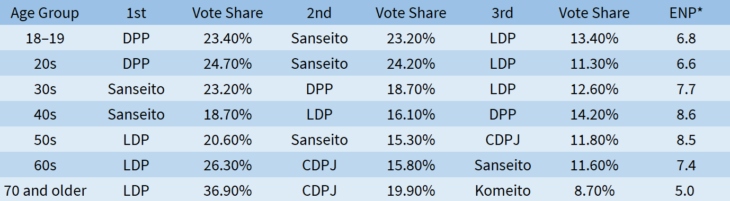
According to the results of the July 2025 Upper House election exit poll, conducted jointly by NHK, Nippon TV, and the Yomiuri Shimbun, the differences in voting behavior by age group are striking (Table 1). While the LDP received the highest vote share among those aged 50 and over, Sanseito ranked first among those in their 30s and 40s, and the DPP (closely followed by Sanseito) took the top spot among those aged 18 to 29. It is clear that the preferred political party varies significantly by age.
Furthermore, looking at the combination of the first and second-place parties in terms of vote share reveals yet another pattern. For those aged 60 and over, the combination of the LDP and the CDPJ remains the primary set of options. However, for those in their 40s and 50s, the landscape shifts to the LDP and Sanseito, and for those in their 30s and younger, it changes further to the DPP and Sanseito. Among the younger generation (aged 30 and below), the LDP’s vote share has already fallen to a mere third place.
Table 1: Vote Share by Age Group (Top Three Parties) based on Exit Polls
*ENP:Effective Number of Parties
Source: Nippon TV News “Zero” National Exit Poll.
Available at: https://www.ntv.co.jp/election2025/exitpoll/all.html (Last accessed: Dec 4, 2025)
Although five parties—the LDP, CDPJ, Komeito, DPP, and Sanseito—appear in Table 1, the LDP is the only party that appears across all age groups. While this is to be expected of the primary ruling party, and although the LDP remains a major actor in party competition for all generations, its presence is minimal among those in their 30s and younger.
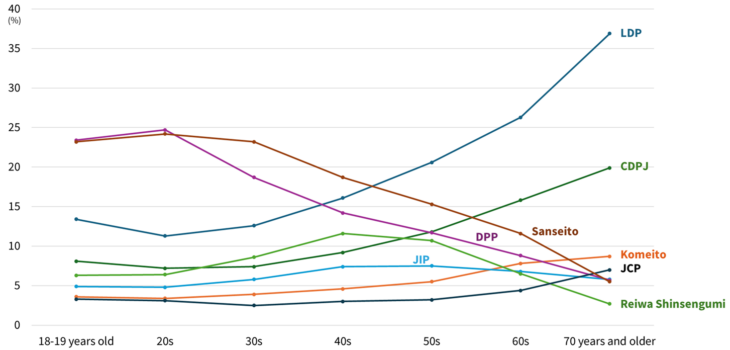
Figure 1 illustrates the relationship between age and the vote share for each party, including those ranked below third place. The voting patterns can be broadly categorized into three types. The first is the elderly-centered voting pattern, where the vote share is high among older age groups but decreases as the age of the voters declines. This is prominently seen with the LDP and CDPJ, and to a lesser extent, Komeito and the Japanese Communist Party (JCP) also align with this pattern. The second is the opposite: the youth-centered voting pattern, where the vote share is high among younger generations and declines among older ones. This applies to the DPP and Sanseito. The third pattern is the middle-aged-centered voting pattern, where vote shares are low among both the young and the elderly but slightly higher among those in their 40s and 50s. This is most noticeable with Reiwa Shinsengumi but also applies to the JIP.
The results of this exit poll suggest that among the elderly, a party competition between the LDP and CDPJ—which overlaps with the traditional ideological divide between conservatives and liberals—firmly persists. On the other hand, among the youth, the main current is a competition for votes between the DPP and Sanseito, parties that seek to distance themselves from the political establishment, with the LDP struggling to maintain a foothold. It is clear that the traditional conservative-liberal divide is not linked to voting patterns here. These respective structures of party competition among the elderly and the young weaken as age increases or decreases, respectively, merging in the middle-aged groups (40s and 50s) into a pattern where the LDP, DPP, Sanseito, and CDPJ all compete in a jumbled fashion.
This point can also be confirmed by the Effective Number of Parties (ENP) by age group. The ENP is an index used to identify whether a country has a two-party or multi-party system and, in the case of the latter, exactly how many parties should be counted as existing (by excluding the influence of minor parties). Although it can be measured based on vote shares or seat shares, here the ENP was calculated for each age group using proportional representation vote shares from the exit polls.[3] The results show that the ENP is smaller among the young and the elderly, while it reaches higher values in the 40s and 50s (Table 1). In the 40s and 50s, the ENP values are 8.6 and 8.5, respectively, meaning that approximately 8.5 parties served as substantial options for voters in these age groups during the election. Conversely, for those aged 18–19 (6.8) and in their 20s (6.6), the number of substantial options falls below 7, and for those aged 70 and over, the ENP is 5.0, indicating only about five parties serve as substantial options. While the conventional party competition composed of the LDP, CDPJ, Komeito, and JCP remains robust among the elderly, a trend toward multi-party fragmentation emerges as age decreases by allowing various parties to enter the fray. Among the youth, a different structure of party competition appears as the presence of left-wing liberal parties diminishes.
It should be noted that exit polls are intended for election day forecasting rather than serving as highly representative samples that act as a microcosm of the electorate; thus, the analysis results do not necessarily align perfectly with the actual electorate and should be treated as a reference. Nonetheless, it is worth adding that the Yomiuri Shimbun-Waseda University Joint Public Opinion Survey (conducted Sept.–Oct. 2025)—a mail-in survey using a more representative probability sample in which the author participated—exhibits similar patterns, despite some differences (for instance, the top party for the 40s was the LDP at 20.1%, followed by the DPP at 16.1%).
The “Rightward Shift of Youth” Thesis: A Retrospective
This discussion brings to mind the “rightward shift of youth” thesis from the early 2010s. This thesis was based on the fact that during the second Abe Shinzo administration (December 2012 – September 2020), the LDP’s vote share among younger generations was higher than in other generations. In its emphasis on how the “youth” are voting “differently from other generations,” the current phenomenon of young people voting for the DPP or Sanseito can be discussed in parallel. What should be confirmed first is that among those currently in their 30s (who were in their 20s ten years ago), the support rate for the LDP is not particularly high; in fact, it is considerably lower compared to the elderly. In other words, the younger generation is not the stable support base for the LDP that the “rightward shift of youth” thesis assumed. Furthermore, young people are generally undergoing a process of “de-ideologization” and, similar to other countries, are increasingly adopting liberal values (Jou, Endo, and Takenaka 2018).
The “rightward shift of youth” thesis has also been questioned academically (Endo and Jou 2019; Oguma and Higuchi eds. 2020). In my own research, I emphasized that while the LDP’s vote share among the youth might indeed be high, their actual support rate for the LDP is lower than in other generations; thus, the argument for a “rightward shift of youth” is weak. On the other hand, youth support for the Democratic Party of Japan (DPJ) and its successor parties has been significantly lower than in other generations. Consequently, for young people, the choice of party support was not a three-way choice between the LDP, the opposition, or being independent, but rather a two-way choice between the LDP or being independent. However, when they went to the voting booths, they felt there were no viable opposition options and ended up voting for the LDP as a result. This was the mechanism by which young people voted for the LDP without a corresponding sense of party support—a phenomenon occurring under conditions where the presence of the left-wing liberals was rapidly fading. Sociologist Oguma Eiji concluded this to be a “polarization lacking a left” (Oguma and Higuchi eds. 2020).
From this context, the structure of party competition among the younger generation continues to “lack a left” (Figure 1). On the other hand, while the Abe-led LDP was previously the only major option for the youth, it has now fallen behind parties like the DPP and Sanseito. While the overall structure itself likely has not changed much, there is a possibility that the key actors within that structure have changed.
Against this backdrop, what factors caused the LDP to recede into the background and allowed the DPP and Sanseito to become viable options? One factor that can be pointed out is that the three subsequent administrations (Suga, Kishida, and Ishiba) failed to inherit the “reformist image” that the Abe Cabinet had projected. In the author’s research, it has been suggested that younger generations evaluate differences between political parties not based on an ideological axis of conservative versus liberal, but rather by the degree of their “reform orientation” (Endo and Jou 2019). The second Abe administration gained support through the impression that the economy had improved under Abenomics and used this evaluation of economic performance as leverage to push forward various policy changes. In this sense, the LDP factional political fund scandal was a significant blow. It exposed an adherence to old-fashioned factional politics, which likely became a major factor in the decline of LDP support.
Figure 1: Vote Share by Age Group based on Exit Polls
Source: Nippon TV News “Zero” National Exit Poll.
Available at: https://www.ntv.co.jp/election2025/exitpoll/all.html (Last accessed: Dec 4, 2025)
The DPP and Sanseito exploited this gap, successfully positioning themselves as “reform-oriented” parties through specific policy appeals. While exclusionist trends have long existed in Japan, there was no political party to represent them in national politics until Sanseito emerged as a vessel for such sentiments in the 2025 Upper House election. However, this is likely only one side of the story; expectations for a shift in economic policy toward tax cuts and proactive fiscal spending may also be a reason for their breakthrough.
On the other hand, the current Takaichi administration’s high approval rating—especially its overwhelming support among the youth—should be seen as stemming from expectations that she will push forward “reforms” as a successor to the Abe line. As with the second Abe administration, the key to maintaining these approval ratings in the future will likely depend on economic policy and its results.
Intergenerational Differences in Perceived Social Conflicts
The DPP and Sanseito, having successfully appealed to voters, developed electoral campaigns targeting the “working-age generation.” In particular, the DPP advocates for a revision of the tax burden and a reduction in social insurance premiums for the working generation, with the goal of “increasing take-home pay.” Their argument prioritizes the tax-paying working generation over the elderly, whose lives are supported by the social security system, and calls for lightening the burden on the former.
Behind this lies a sense of crisis regarding the urgent social challenges posed by rapid population aging and the declining birthrate. Deeply related to this is the concern among the “working generation” about the imbalance in the financial burden and the sustainability of the current social security system. Moreover, while this sense of crisis and concern tends to be framed as an intergenerational conflict, there are actually generational differences in attitudes toward this framework.
Here, I would like to introduce a public opinion survey conducted before the Upper House election that includes questions on various social conflicts. In the SmartNews, Media, Politics, and Public Opinion Survey (SMPP Survey) conducted from January to March 2025, respondents were asked whether they believe “strong conflict exists” regarding six types of social conflicts. Looking at the respondents as a whole, among the six conflicts, the perception of conflict is most widespread regarding labor-management conflict (“conflict between management and laborers/workers”), followed by economic conflict (“conflict between the wealthy and the poor”). The high ranking of labor-management and economic conflicts is a consistent pattern also confirmed in other surveys conducted in the 1990s. The third most common is ideological conflict (“conflict between politically conservative and liberal people”), with intergenerational conflict (“conflict between the working generation and the elderly”) and gender conflict (“conflict between men and women”) tied for fourth. Among the six, the perception of urban-rural conflict (“conflict between urban and rural residents”) is the least widespread.
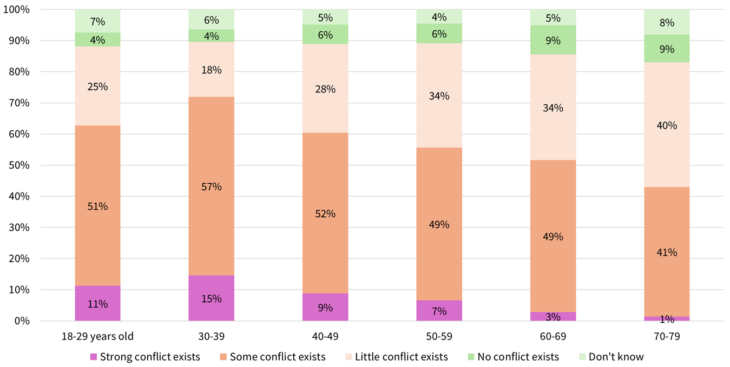
However, when isolating the perception of intergenerational conflict and examining the distribution of responses by age, it becomes clear that intergenerational conflict has a significant presence for the younger generation. Figure 2 summarizes the responses regarding “conflict between the working generation and the elderly” by age group. For both “strong conflict exists” and “some conflict exists,” the proportion of such responses is higher among younger groups (though higher in the 30s than the 20s) and lower among the elderly. Looking at the combined figures for “strong” and “some” conflict, the highest percentage of people perceiving intergenerational conflict is in their 30s at 72.0%, followed by those aged 18–29 at 62.7%. For those in their 30s in particular, this is the issue where the perception of conflict is the third most widespread, following labor-management and economic conflicts. On the other hand, for those in their 70s, it remains at only 42.9%. Perceptions of conflict such as these tend to be more sensitively recognized by those in a weaker position; thus, the difference in perception between the young and the elderly regarding intergenerational conflict can be interpreted as the dissatisfaction of the youth versus the indifference of the elderly.
As a supplementary note, gender conflict (“conflict between men and women”) is another social conflict where generational differences are prominent; similar to intergenerational conflict, younger generations are more likely to perceive the conflict. This may reflect the current life experiences of the younger generation, such as unstable employment and changing gender norms. For the other four conflicts, there are no significant differences in distribution by age.
Figure 2: Perceptions of Intergenerational Conflict, by Age Group
Source: SMPP Survey, 2025
Identification with Social Conflicts and Generations
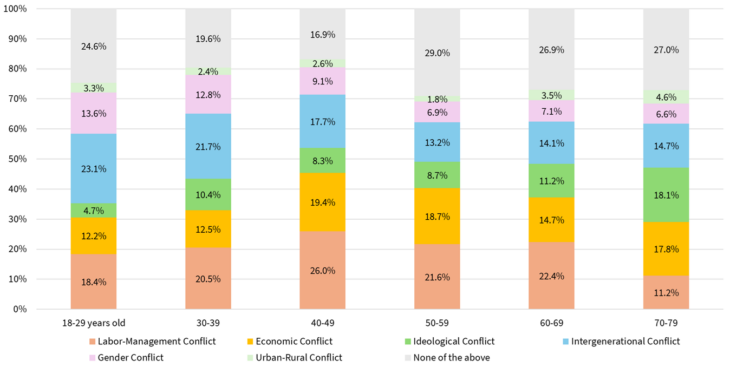
The SMPP Survey further asks, “Among these, which conflict are you particularly conscious of as a party (stakeholder)?” providing the six aforementioned conflicts and the option “None of the above,” from which respondents choose one. Among all respondents, “None of the above” was the most common answer, accounting for 24.2%. The fact that one-quarter of voters do not consider themselves a party to any social conflict conversely means that three-quarters do consider themselves a party to some form of conflict. Among the six conflicts, labor-management conflict again received the most responses (19.9%), followed by intergenerational conflict (17.3%). While the perception of the conflict itself was not necessarily the most widespread compared to others, it became clear that a significant number of voters possess a sense of being a party to intergenerational conflict.
Figure 3 shows the results of this “identification as a party” categorized by age. It is evident that responses vary greatly depending on age. Labor-management conflict and economic conflict are closely related; the combined figure for these two is highest among those in their 40s and 50s, indicating that economic-related conflicts are most consciously felt among the middle-aged.
On the other hand, for younger generations up to their 30s, intergenerational conflict is the issue where the sense of being a party is most strongly held. At 23.1% for those aged 18–29 and 21.7% for those in their 30s, it is the conflict with the highest identification in both age groups. In contrast, among those aged 50 and over, only about 13–14% identified as a party. Here again, we see the generational difference in the recognition of intergenerational conflict.
Notably, among those in their 70s, ideological conflict is the issue with which the most people identify as a party, accounting for 18.1%. As confirmed by the exit poll results, it is clear from this as well that the traditional conservative-liberal divide remains firm and deeply rooted among the elderly. Identification with ideological conflict decreases as age declines, showing that this perception of political conflict has not spread among the younger generation.
Figure 3: Subjective Identification with Social Conflicts, by Age Group
Source: SMPP Survey, 2025
Does the Perception of Social Conflict Shape Party Competition?
Does the sense of being a party to a social conflict link to party competition? Here, I will introduce the results of a cross-tabulation between identification with social conflicts and party support. Since the survey did not include questions asking which side of a given conflict respondents position themselves on (for example, whether they identify as the “working generation” or the “elderly” in an intergenerational conflict), those who identify as a “party” cannot be captured as a monolithic group. However, if there is a correlation with party support, “parties” from different positions would support different political parties, resulting in a distribution distinct from the overall party support figures.
Table 2 is a cross-tabulation showing the distribution of party support for each conflict identification category. The figures represent the percentage of “parties” to each respective conflict who support each political party. Note that as this survey was conducted from January to March 2025, it is necessary to account for the fact that the support rate for Sanseito is lower than its eventual breakthrough in the July Upper House election of the same year.
Table 2: Identification with Social Conflicts and Party Support (%)
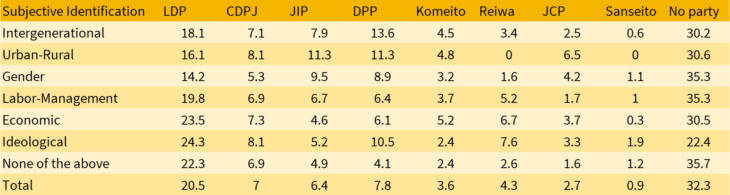
Note: Political parties other than the eight listed, as well as “Don’t know” and non-responses, are omitted. The horizontal total equals 100% when including these omitted categories.
Source: SMPP Survey, 2025.
Let us examine the support for each political party. By comparing the figures vertically for each party, we can identify where their support is highest. Support for the LDP is high among “parties” to ideological and economic conflicts, while support for the CDPJ is high among “parties” to ideological and urban-rural conflicts. As expected, JIP support is high among “parties” to urban-rural conflict. Additionally, the DPP enjoys a high support rate among “parties” to intergenerational conflict. Support for Komeito is high among those in economic conflict, Reiwa Shinsengumi among those in ideological conflict, and the JCP among those in urban-rural conflict. Among the independent voters (no party support), support is higher among “parties” to labor-management and gender conflicts.
While I will omit a summary for each conflict identification due to space constraints, looking at those who identify as a party to intergenerational conflict—the focus here—the high level of support for the DPP is indeed striking. While the DPP has an overall support rate of 7.8%, it secures as much as 13.6% support among those who identify as “parties” to intergenerational conflict.
While it is a well-known fact that support for the DPP is high among the younger generation, it is also true—as confirmed in Figure 3—that those who identify as a party to intergenerational conflict are also concentrated among the young. Given this, rather than a direct link between intergenerational conflict identification and the DPP, it is possible that this is a spurious correlation mediated by age. Therefore, I would like to examine whether intergenerational conflict identification is linked to DPP support even after controlling for the influence of age, and whether this effect increases depending on age, using a regression analysis. The dependent variable here is the favorability rating for the DPP (evaluated on an 11-point scale from 0 to 10), and the independent variables are whether or not one identifies as a party to intergenerational conflict, age, and an interaction term between the two. Furthermore, gender, education level, and conservative-liberal ideology were included to control for the influence of these factors.[4]
Table 3 shows the results of the regression analysis. When a coefficient is marked with asterisks (**), it indicates statistical significance, leading to the conclusion that there is an association between that variable and DPP favorability. A positive coefficient value means that belonging to that category (or an increase in that numerical value) raises favorability, while a negative coefficient means it lowers it.
First, regarding age, a statistically significant negative relationship is observed. In other words, younger people tend to have a higher favorability rating for the DPP. Additionally, among the control variables, those with a conservative ideology have higher favorability for the DPP compared to those who answered “Don’t know.”
The crucial point here is that even after controlling for age and ideology (eliminating their influence), the identification as a party to intergenerational conflict still maintains a relationship that boosts favorability toward the DPP. Furthermore, a statistically significant relationship was confirmed for the interaction term between intergenerational conflict identification and age. To explain simply: among younger age groups, those who identify as a party to intergenerational conflict have higher favorability toward the DPP. However, the magnitude of this effect gradually diminishes as age increases (disappearing by the early 50s). Among the elderly, the relationship reverses, where identifying as a party to intergenerational conflict leads to lower favorability toward the DPP. This strongly suggests a link between the perception of intergenerational conflict and support for the DPP, providing a glimpse into one of the mechanisms forming DPP support among the youth.
Additionally, similar analyses were conducted for the favorability of other political parties, and an opposite relationship was confirmed for left-wing liberal parties such as the CDPJ, Reiwa Shinsengumi, and the JCP (regression tables omitted). That is, among the younger generation, identifying as a party to intergenerational conflict lowers favorability toward left-wing liberal parties, whereas among the elderly, such identification boosts their favorability. The favorability of other political parties showed no relationship with intergenerational conflict identification.
Table 3: Regression Analysis of Favorability Ratings for the Democratic Party for the People (DPP)
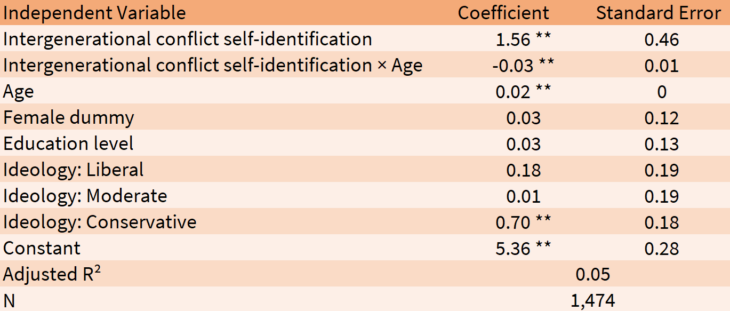
**: p< .05
Source: SMPP Survey, 2025
The Entanglement of Party Competition and Japanese Politics
In this article, I have explored the current state of Japanese party politics through the lens of generations (or simply age groups). What we have seen, relying on exit poll results in the first half and public opinion survey data in the second half, is a landscape where the young, middle-aged, and elderly each perceive different structures of party competition and observe different social conflicts. Party competition based on the traditional ideological divide between conservatives and liberals defines the conceptual framework for politicians and the media; consequently, messages, analyses, and discourses aligned with this framework are familiar and easily accepted by the older generation. However, because this differs from the younger generation’s perception of party competition, such messages often fail to reach them or may miss the mark entirely. Furthermore, there is even a possibility that young people feel frustrated by having a political interpretation imposed upon them that differs from their own.
These intergenerational differences in party competition are intricately intertwined with the intergenerational conflicts that have become emphasized in recent electoral campaigns. The perception of intergenerational conflict is spreading among the youth and is beginning to define party competition as well. Support from young people dissatisfied with intergenerational inequalities finds its way to the DPP, while distancing itself from left-wing liberal parties such as the CDPJ, Reiwa Shinsengumi, and the JCP. Intergenerational conflict acts as a wedge that, rather than defining a conflict between the LDP and the opposition, clarifies the divisions within the opposition parties themselves.
It should be emphasized here that this article has only dealt with the “perception” of whether voters believe intergenerational conflict (or other conflicts) exists in society. Whether a profound conflict in policy preferences or values between the elderly and the young actually exists—as posited by the “Silver Democracy” thesis—is a matter that must be verified empirically. The reality is that, at present, no established consensus has been provided on this issue.
Regardless of whether such a conflict actually exists, however, it is possible for people to come to believe in the existence of intergenerational conflict through various discourses. While there is certainly an imbalance in the financial burden across generations regarding the social security system, whether one finds the current situation desirable is a matter of individual psychology, and it is naturally possible for individuals to hold preferences that do not align with their attributes as “elderly” or “youth.” Sharpening a conflict structure for the purpose of mobilization is not necessarily synonymous with exploring and addressing the policy challenges of each generation. Above all, we should not forget that intergenerational solidarity is one of the fundamental principles that allow a society to function.
Furthermore, a unique characteristic of intergenerational conflict that distinguishes it from other social conflicts is that a reversal of positions inevitably occurs. In labor-management or economic conflicts, it is not particularly common for one to switch from one side to the opposite. However, in the case of intergenerational conflict, today’s elderly were once the youth, and today’s youth will eventually become the elderly. Even if the two are viewed in a confrontational relationship, the current interests of the younger generation may involve a trade-off with their own future interests. The time span through which one views their own interests should be a key factor in gauging and reconciling the frustrations of the current “working generation.”
The “entanglement of party competition” across generations examined here is by no means a temporary phenomenon. Rather, it is a development continuous with the second Abe administration and even earlier, holding the potential to become a structural factor that threatens the LDP’s long-term dominance and foretells the future of cooperation among opposition parties. To foresee the future of Japanese politics, it is necessary to understand that there are multiple axes of party competition among Japanese voters; even a single policy change may be interpreted within multiple axes of conflict, potentially producing political consequences through complex pathways.
References:
Endo Masahisa, Willy Jou, 2019. Ideorogi to Nihon Seiji (Ideology and Japanese politics) (Shinsensha)
Oguma Eiji and Higuchi Naoto (eds.), 2020. Nihon wa “Ukeika” shitanoka (Has Japan shifted to the right?) (Keio University Press)
Willy Jou, Endo Masahisa, and Takenaka Yoshihiko, “Sayu Ideorogi Rikai no Kokusaihikaku” (“International comparison of understanding left-right ideologies,”) Leviathan, 2018, No. 63, pp. 10-29.
Translated from “‘Sedai-kan Tairitsu’ wo yomu (Reading ‘Intergenerational Conflict’),” Sekai, February 2026, pp. 21–32. (Courtesy of Iwanami Shoten, Publishers) [March 2026]
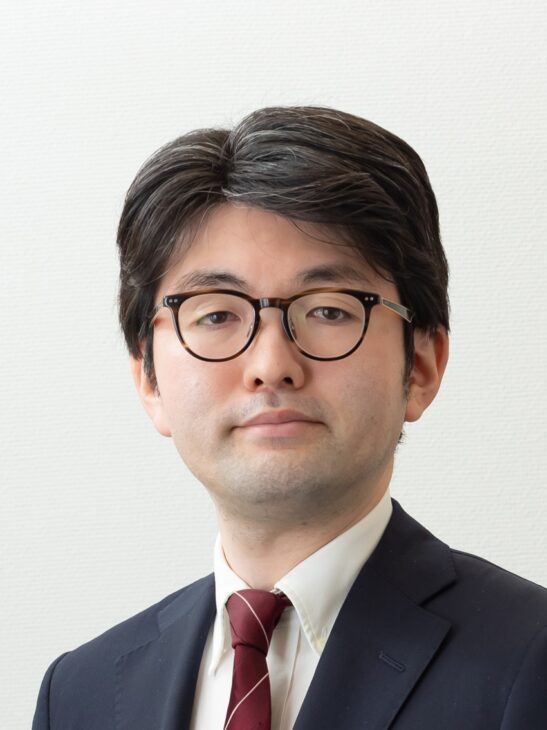 ENDO Masahisa, Ph.D.
Professor, Graduate School of Social Sciences, Waseda University.
Born in 1978. Received his Ph.D. in political science from Waseda University. His research fields are political science, voting behavior, and public opinion research. He is the co-author of Generational Gap in Japanese Politics: A Longitudinal Study of Political Attitudes and Behaviour (Palgrave Macmillan) and co-editor of Mutohaso no Kenkyu (Research on the independents) (Yuhikaku), and Public Behavioural Responses to Policy Making during the Pandemic: Comparative Perspectives on Mask-Wearing Policies. (Routledge.).
[1] The political funding scandal involving LDP factions (the so-called “slush fund scandal”) emerged as a major social issue between late November and December 2023.
[2] In Japan, the term ‘liberal’ primarily refers to political forces and intellectuals who are non-conservative, often advocating for post-war democratic values, gender equality, and social welfare.
[3] The calculation involves taking the sum of the squared vote shares for all parties and dividing one by this total.
[4] Intergenerational conflict self-identification is a dummy variable coded as 1 for respondents who identified themselves as a party to intergenerational conflict, and 0 otherwise. To examine how the effect of this identification varies by age, an interaction term between this variable and Age was included in the model.
Gender is a dummy variable where 1 represents female and 0 represents male. Education level is a dummy variable assigned 1 for those with education beyond high school and 0 for those with a high school education or less.
Regarding Ideology, based on an 11-point self-positioning scale ranging from liberal (0) to conservative (10), three dummy variables were created and included in the analysis: Liberal (0–4), Moderate (5), and Conservative (6–10). The reference category is DK answer for the ideology question.
Keywords
- party politics
- party competition
- voting patterns
- intergenerational conflict
- generational divide
- social conflicts
- ideological conflict
Related posts:
 From Tomiichi Murayama to Sanae Takaichi: Thirty Years After the Cold War—The Present Location of Japanese Politics
 “Reforms in the Reiwa Era” in the Age of Populism: The Option of a Multi-Member District System with Proportional Representation
 The LDP Faces Tectonic Shifts in Japanese Politics
 A Policy Vision Beyond Abenomics
 Special Dialogue: Prospects for Japanese Diplomacy in 2026—Advancing the Strategies of the “Free and Open Indo-Pacific” Further