


Japan’s Strategy as a Pioneer in Central Asian Diplomacy: Observations from the First “Central Asia plus Japan” Dialogue Summit
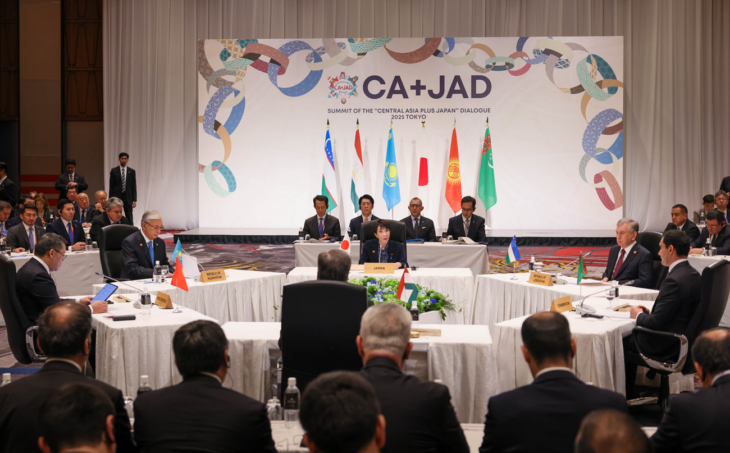
“Amidst various actors intensifying their approaches to Central Asia, it is crucial for Japan—which has maintained the ‘Central Asia plus Japan’ framework for over 20 years—to realistically identify and pursue the interests of both Japan and Central Asia while leveraging its accumulated experience.”
Photo: Cabinet Public Affairs Office
In 2025, major powers intensified their diplomatic engagement with Central Asia. What is the strategy for Japan—a long-standing partner in the region—to ensure it does not “lose its presence”?
- Major powers hold an overwhelming advantage in terms of historical ties and economic scale.
- While China is strengthening logistics, Russia is struggling with its declining presence.
- Japan is required to leverage its accumulated diplomatic experience and demonstrate its “true commitment.”
On December 20, 2025, the first Summit of the “Central Asia plus Japan” Dialogue was held. Originally, this summit was scheduled to take place in Astana, Kazakhstan, in August 2024 to coincide with the 20th anniversary of the “Central Asia plus Japan” Dialogue framework. However, due to an earthquake off the coast of Kyushu and the issuance of the Nankai Trough Earthquake Extra Information bulletin, then-Prime Minister Kishida Fumio canceled his visit, and the summit was called off. At the recent summit, the new name “CA+JAD” was introduced for this diplomatic framework in an attempt to re-establish its significance both domestically and internationally. As a tangible outcome, 158 signed documents were presented, and Prime Minister Takaichi Sanae set a target of 3 trillion yen in investments over the next five years.
Japan launched the “Central Asia plus Japan” initiative in 2004. This “Central Asia plus One” framework was subsequently adopted by South Korea, the United States, the European Union (EU), and others as a method for their own diplomacy with Central Asia. In 2025, several countries besides Japan held summit meetings using this framework (it should be noted that the EU and Italy also held summits in addition to the countries mentioned in this article).
Interest in Central Asia has surged following Russia’s invasion of Ukraine in 2022. Since Russia regards Central Asia as part of its “sphere of influence,” there is a perception among Western nations that the region is a target for “decoupling” from Russian influence. Furthermore, due to the growing need to mitigate Russia-related risks and the increasing difficulty of using maritime routes such as the Middle Eastern waters and the Suez Canal, the “Middle Corridor”—a logistics route connecting East Asia and Europe via Central Asia while bypassing Russia—has garnered significant attention.
This article provides an overview of recent approaches by major powers toward Central Asia, while attempting to position, comparatively analyze, and examine the first Summit of the “Central Asia plus Japan” Dialogue (CA+JAD).
China: Increasing presence centered on logistics
China’s strengthening of ties with Central Asia is remarkable. It was in 2013 that Xi Jinping announced the “Belt and Road” Initiative (BRI) in Kazakhstan. Even before that, China had been expanding its presence in Central Asia through investment and trade, but until around 2020, it was difficult to point to any representative projects as definitive examples of Chinese business in the region. One could say the reality at the time was that the influence of the emerging superpower rippled outward like water slowly flowing from high to low ground.
However, after Russia’s invasion of Ukraine, China’s presence in Central Asia surged as an “alternative” for foreign relations. The China-Kyrgyzstan-Uzbekistan Railway, which had been proposed since the 1990s but had not been realized due to technical and budgetary issues, finally broke ground in 2024. Furthermore, China’s participation in the development of the “Middle Corridor” has been prominent. Given that China is the “world’s factory” with overwhelming cargo supply capacity, it is inevitable that it would take the initiative in the logistics sector.
China’s meetings with the leaders of Central Asian countries were already held online as early as January 2022. The first in-person summit took place in Xi’an in May 2023. Two years later, in June 2025, the second summit was held in Astana, Kazakhstan.
However, these two summits offered little in the way of novel content that went beyond existing political dialogue, focusing instead on reaffirming each participating country’s unique development process and their commitment to non-alignment. While there was a strong nuance of confirming China’s presence and deterring Western involvement in the region, it remained unclear what China specifically intended to achieve within this framework, or what consistent strategy China holds regarding its engagement with Central Asia.
Nevertheless, there is no doubt that logistics has become one of the most critical issues in China’s diplomacy toward Central Asia. In Xi’an, where the first face-to-face summit was held, terminal construction has since progressed as a key logistics hub, and Central Asian countries have also established consulates and trade representative offices there. Furthermore, in Lianyungang—a port that serves as a base for logistics to Central Asia among Chinese ports—a meeting of Ministers of Internal Affairs and Public Security from Central Asia and China was held to discuss ensuring the safety and security of the BRI.
Russia: Presence of the “Former Sovereign Power” with Limited Options
Following the invasion of Ukraine, the “distancing from Russia” by Central Asian nations has frequently been a subject of intense discussion. For instance, President Kassym-Jomart Tokayev of Kazakhstan publicly stated in the presence of President Putin that he would not recognize the independence of the two “People’s Republics” in eastern Ukraine.[1] Similarly, President Emomali Rahmon of Tajikistan drew significant attention when he addressed President Putin at an international conference, stating, “Do not treat us as if we were still in the Soviet era,” and “We want respect.”
Nevertheless, within the former Soviet space, Central Asia remains a region with a particularly strong dependence on Russia in terms of both economy and security. Consequently, a rapid “departure from Russia” is unlikely, at least in the short term. Many countries in the region are achieving high economic growth by “taking advantage of” the international situation following the invasion of Ukraine—specifically through the activation of circumvention trade to bypass Western sanctions and the influx of capital and human resources from Russia. In some respects, it can be said that regional actors have reaffirmed that their ties with Russia are difficult to sever.
The first “Central Asia plus Russia” summit hosted by Russia was held in October 2022 in Astana, Kazakhstan. Russia’s intent to utilize Central Asia as a lifeline under Western sanctions is evident in its focus on building new supply chains, promoting import substitution, and establishing new financial settlement mechanisms. At the second summit held in Dushanbe, Tajikistan, in October 2025, the discussions were limited to confirming the progress of these initiatives. Furthermore, both summits were held in conjunction with the meetings of the Council of Heads of State of the Commonwealth of Independent States (CIS).
Originally, Russian Foreign Minister Lavrov viewed the “Central Asia plus One” framework as a “Western attempt to sever Central Asia from Russia,” and thus Russia does not seem to place much importance on the framework itself. That said, as Central Asian countries now account for half of the CIS membership, the importance of the region has undoubtedly increased for President Putin, who emphasizes the “bonds” of the former Soviet space.
It is worth noting that immediately after the summit with the United States in November 2025 (to be discussed later), President Tokayev of Kazakhstan visited Russia to hold talks with President Putin. Furthermore, immediately following the CA+JAD summit, an Informal CIS Summit was held in St. Petersburg. Whether these were previously scheduled or organized in haste remains unclear, but the result was to leave a strong impression, both domestically and abroad, that consideration toward Russia remains indispensable for Central Asia.
The United States: Deploying “Deal-Making” Diplomacy in Central Asia
The “C5+1” Presidential Summit between Central Asia and the United States was held on November 6, 2025, in Washington, D.C., in a working dinner format. For this reason, the Presidential Office of Tajikistan described the meeting on its website as a “Working Dinner” rather than a formal summit. During this “summit,” President Donald Trump explicitly stated, “One of our key priorities is critical minerals.” A stance of placing specific, strategic importance on Central Asia as a region was not clearly visible; instead, one could glimpse the nuance that Central Asia was being addressed merely as part of the broader “deal-making” diplomacy being deployed worldwide.
Prior to the Presidential Summit, a business conference commemorating the 10th anniversary of the C5+1 was held on November 5 at the John F. Kennedy Center. The main agenda of this conference focused on strengthening relations in trade, economy, and investment, as well as investments in fields such as infrastructure, energy, and innovation. Breakout sessions were organized under themes such as the “Development of Transport Routes between the US and Central Asia,” the “Utilization of Artificial Intelligence (AI),” “Connectivity through the Digital Economy,” and “How to Invest in the United States.”
The final item, in particular, was a surprising choice of theme, given that discussions regarding the development of economic relations between Central Asian and Western countries have traditionally centered on “How to attract investment from developed nations into Central Asia.” (It appears the session introduced mechanisms for Central Asian entrepreneurs to enter the US market.) One might call this a novel approach; however, to be frank, it reflects the current US administration’s indiscriminate push to “pull in foreign investment to the United States by any means.”
What deserves attention are the “deals” exchanged in parallel with this C5+1 Presidential Summit. First among these is aircraft. Around the time of the summit, it was announced that Kazakhstan would purchase up to 15 Boeing 787-9 aircraft, Uzbekistan would purchase eight, and Tajikistan would also purchase some (reportedly 10 aircraft, including 737s). It is possible that rare earths and aircraft were the centerpieces of this “deal” with Central Asia.
As an outcome of this series of events, it was reported that Uzbekistan would invest $100 billion in the United States over the next 10 years, and 29 documents totaling $17 billion were signed between Kazakhstan and the United States in sectors such as mining, energy, education, and digital affairs. Furthermore, it was later reported that Uzbekistan’s akfa, a major aluminum profile manufacturer, would invest $600 million in a joint venture with a Turkish company to build a factory in Kentucky, USA.
A point of particular note regarding this C5+1 Presidential Summit is the complete disappearance of Western norms, which had previously been a point of contention between the United States and Central Asia. In this context, the signing of a cotton supply contract between the Uzbek entity UzSanoatExport and the American company Cargill is symbolic, considering that the United States had previously banned the import of Uzbek cotton due to the human rights situation in the country (a ban that was lifted in 2019 following the leadership transition in Uzbekistan).
Japan: Leveraging Accumulated Experience and Pursuing Unique Niches
Prior to the “Central Asia plus Japan” framework, Japan’s diplomacy toward Central Asia had been proposed as broad strategic concepts, such as Prime Minister Hashimoto Ryutaro’s “Eurasian Diplomacy” (1997) and Prime Minister Aso Taro’s “Arc of Freedom and Prosperity” (2006). While these concepts emphasized norms such as “freedom,” “democracy,” and “human rights,” a look at the trajectory of the “Central Asia plus Japan” Dialogue reveals that, aside from the ten Foreign Ministers’ Meetings held to date, the primary focus has been on Expert Meetings. It can be said that the emphasis has been placed on more practical and pragmatic initiatives.
At the recent summit in December 2025, three priority areas were identified: (1) Green and Resilience, (2) Digital Transformation (DX) and Connectivity, and (3) Human Resource Development and Social Institutional Development. Looking at these challenges individually, the detailed thematic settings reflect the strengths of Japan’s accumulated experience. One can glimpse a sense of originality in connecting Japan’s strengths and domestic issues to the region—such as sharing Japan’s experience as a disaster-prone nation (Resilience) and matching the needs of Japan, which faces domestic labor shortages, with those of Central Asian countries, which have large youth populations but lack domestic employment opportunities (Human Resources). Furthermore, Central Asia is landlocked. According to a survey by Japanese logistics companies, the cost of logistics from Japan to Central Asian countries is six to nine times higher than that of transport to Hamburg, Germany. Regarding the “Connectivity” aspect of the second priority, there is an evident intention to improve the logistics environment. Simultaneously, for “DX,” the aim is to create local employment and business in fields unaffected by geographical handicaps through human resource development in the ICT sector, while also facilitating the supply of talent to Japan.
It should be noted that these priority areas had already been set as the agenda for the business events held in conjunction with the summit originally scheduled for August 2024; thus, they are not being “unveiled” for the first time. Nevertheless, it appears that the context and significance of each individual challenge have become deeper and more clearly defined.
Japan’s Future Commitment and the Test of its “True Mettle”
Reflecting on the Japanese government’s past diplomacy toward Central Asia, both Prime Minister Abe Shinzo’s tour of Central Asia in 2015 and the first summit scheduled by Prime Minister Kishida for August 2024 (which was ultimately cancelled) were either conducted or set to take place just before the stepping down of their respective administrations. This serves as evidence that diplomacy toward Central Asia has not necessarily been granted high priority by successive Japanese governments.
However, as a result of various coincidences, this summit was held approximately three months after the inauguration of the Takaichi administration. Political leaders in Central Asian countries will now be closely watching how the Japanese government brings the outcomes of this summit to fruition.
As mentioned earlier, in recent years, the diplomacy of major powers toward Central Asia has taken on a stronger tone of greedily pursuing interests rather than emphasizing norms. Western nations previously clashed frequently with Central Asian countries over issues such as human rights. However, since Russia’s invasion of Ukraine, they appear to have become more restrained in putting norms at the forefront as they attempt to bring Central Asian countries into their fold. Amidst various actors intensifying their approaches to Central Asia, it is crucial for Japan—which has maintained the “Central Asia plus Japan” framework for over 20 years—to realistically identify and pursue the interests of both Japan and Central Asia while leveraging its accumulated experience. Moving forward, Japan will be challenged on how to prove the “strategic importance and potential” of Central Asia and how to effectively utilize them.
Translated from “Tai-Chuoajia Gaiko Kusawake Nihon no Senryaku wa — Dai 1-kai ‘Chuo Ajia + Nihon’ Shuno Kaigo kara (Japan’s Strategy as a Pioneer in Central Asian Diplomacy: Observations from the First “Central Asia plus Japan” Dialogue Summit),” Gaiko (Diplomacy), Vol. 95 Jan. / Feb. 2026, pp. 126–131. (Courtesy of Jiji Press) [March 2026]
 SAITO Ryota, Ph.D.
Researcher, Institute for Russian & NIS Economic Studies, Japan Business Association ROTOBO
Born in 1986. He graduated from the University of Tsukuba and completed the Doctoral Program in the Graduate School of Humanities and Social Sciences, University of Tsukuba, where he earned a Ph.D. in International Studies. His previous roles include serving as Attache/Researcher at the Embassy of Japan in the Kyrgyz Republic and as a Researcher at the Sasakawa Peace Foundation, before assuming his current position. He is a co-author of Nihon no Kokusai Kyoryoku— Ajia-hen Keizai Seicho kara ‘Jizoku Kano na Shakai’ no Jitsugen e (Japan’s International Cooperation: Asia – From Economic Growth to the Realization of a “Sustainable Society”) (Minerva Shobo).
[1] These refer to the two entities established by pro-Russian armed groups after unilaterally declaring independence in the Donetsk and Luhansk regions of eastern Ukraine—specifically, the Donetsk People’s Republic (DPR) and the Luhansk People’s Republic (LPR).
Keywords
- Central Asia plus Japan
- Central Asia plus One
- diplomacy
- logistics
- foreign investment
- Japan’s strengths
- accumulated experience
Related posts:
 Reading China’s Tactics Aiming to Change the Status Quo
 Defending Japan’s Sovereignty in the AI Era: Leveraging Linguistic Uniqueness to Build Sovereign AI
 The Dynamics of the “Coalition of the Willing” in the Indo-Pacific
 Afghanistan Earthquake: Relief Activities by Peace Japan Medical Services and Peshawar-kai
 Japan’s Path to Success in Quantum Computer Development