Diplomacy - Japan Policy Forum
Home > Topics > Diplomacy

Archives Diplomacy

No.
Vol.2, Diplomacy  Feb. 8, 2026

Regarding the “Limited Exercise of the Right of Collective Self-defense” Based on the Determination of “Survival-threatening Situations”

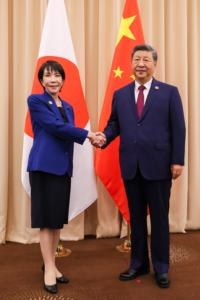
What constitutes a “survival-threatening situation”? The government’s view is that Prime Minister Takaichi’s November 2025 response, in which she stated that a naval blockade around Taiwan could constitute such a situation, does not change the government’s previous position. However, many issues remain unresolved, and the legal basis is not necessarily clear. Tsuruta Jun examines the situation envisioned in this response, the legal structure of such existential threat situations, and the right of collective self-defense. Tsuruta Jun, Associate Professor, Meiji Gakuin University Prime Minister Takaichi’s remarks to the question of survival-threatening situations During the Lower House Budget Committee session on 7 November 2025, Prime Minister Takaichi Sanae responded to a question from an opposition lawmaker who asked whether a blockade of the Bashi Channel between Taiwan and the Philippines would constitute a “survival-threatening situation.” She stated the following: “If an armed attack [by China] were ... ... [Read more]

No.
Vol. 1, Diplomacy  Jan. 27, 2026

Recent Cyber Situations and the Bill Introducing Active Cyber Defense

Recent cyberattacks in the context of geopolitics Since around 2022, state-sponsored cyberattacks have become increasingly prevalent. This is partly due to the rogue cyber nations[1] using cyberattacks to achieve their national objectives. Cyberattacks that do not involve large-scale destruction or loss of life do not constitute armed attacks. These attacks can disable an adversary’s critical infrastructure without inciting armed conflict. Furthermore, ransomware attacks on critical infrastructure or supply chains make it difficult to distinguish between attacks by criminal groups and those ordered by a state. This makes it possible to damage an enemy country while concealing state involvement. In this respect, cyberattacks have become a convenient tool for rogue cyber nations. Furthermore, information-theft cyberattacks, which take advantage of the technical characteristics of cyberattacks that make it difficult to identify attackers, are becoming more prevalent, stealing policy information, business secrets, and intellectual property from target ... ... [Read more]

No.1
Vol. 1, Diplomacy  Jan. 19, 2026

War and Order from the Global South

War has thrown the international order into flux. The search for a multipolar order centered on various “Souths” has begun. Key Points: The presence of emerging powers, which sometimes surpass developed nations, is growing. New, regionally driven frameworks for conflict management are emerging and warrant closer scrutiny. Japan should consider shifting away from “American dominance” and toward “diversification.” Kawashima Shin, Professor, University of Tokyo Wars and hostilities frequently erupt across Eurasia, from Ukraine to the Middle East, India and Pakistan, Thailand and Cambodia. After occupying and annexing the Crimean Peninsula in 2014, Russia’s fighting in eastern Ukraine escalated into a full-scale invasion in 2022. This aggression continues to this day. On October 7, 2023, Hamas attacked Israel. Israel subsequently retaliated by extending its attacks beyond Gaza to include pro-Iranian forces, such as Hezbollah. Israel also launched military strikes on Iran, targeting its nuclear program. ... ... [Read more]