


Pathways to Balancing Working Hour Deregulation and Child-rearing Support
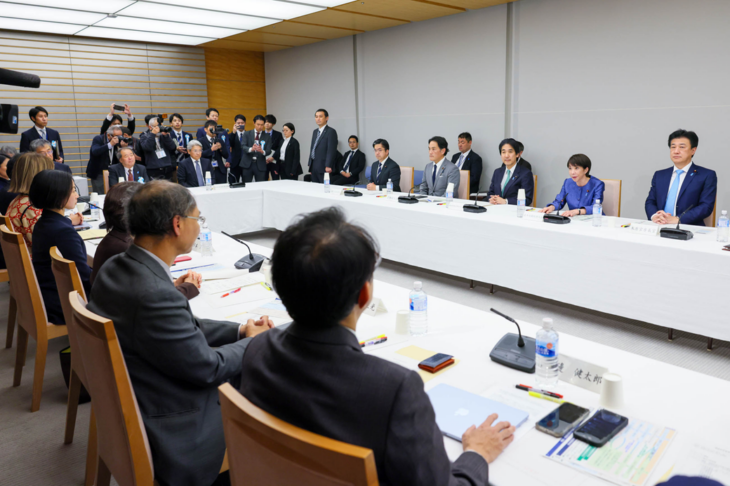
At the Council for Promotion of Regulatory Reform held on December 24, 2025, Prime Minister Takaichi, in collaboration with the Headquarters for Japan’s Growth Strategy, stated, “I would like to ask you to consider a system design that will lead to the promotion of highly productive and flexible working styles, taking into account surveys on the current operation and actual situation of working hour legislation by industry and company size, as well as the voices of workers on the ground.”
Photo: Cabinet Public Affairs Office
Does the deregulation of working hours contradict measures against the declining birthrate? The flexibility in working hours promoted by the Takaichi administration holds the potential to maximize both the “earning power” and the “time discretion” of child-rearing households. Professor Oguro Kazumasa shines a new light on this controversial policy from the perspective of demographic challenges.
The Current Political Debate Over Working Hour Deregulation
Since Prime Minister Takaichi Sanae mentioned a “review of the upper limits on working hours,” an intense debate has continued in the Diet. This is undoubtedly driven by the fact that Japan is transitioning into a full-scale labor-shortage economy, with chronic labor shortages persisting across a wide range of sectors—including services, healthcare/nursing care, construction, and logistics—amid a rapidly shrinking working-age population.
From the corporate side, there are expectations that allowing flexible work styles will lead to accelerated innovation and better talent acquisition; at the same time, the underlying intent to “have those who wish to work more do exactly that” is also apparent. It is noteworthy that Prime Minister Takaichi, while taking these current conditions into account, has referred to the necessity of “Selective Labor,” which allows individuals to choose their work style according to their life stage. On the other hand, labor unions and opposition parties are strongly opposed to deregulation itself, citing concerns over an “increase in karoshi (death from overwork).”
Consequently, the debate is often framed as a binary choice between “regulations to prevent overwork” and “deregulation to increase flexibility.” However, the greatest structural problems facing Japan today are the “declining birthrate” and “population decline.” If the debate over working hour deregulation proceeds without the perspective of countermeasures against the declining birthrate, or solely as a quick fix for labor shortages, there is a risk that the sustainability of the nation itself could be undermined.
With the birthrate continuing to fall, the institutional design of working hours should inherently be constructed from two perspectives: “how much it can foster industrial growth” and “how much it can make it easier to give birth to and raise children.” Based on that, it is necessary to consider how to respond to a labor-shortage economy and how to position diverse work styles and “Selective Labor.” However, this perspective has not been sufficiently shared in policy discussions.
The Overlooked Relationship Between “Time” and “Productivity”
When returning to the discussion of working hours, the following two estimations likely serve as the foundation.
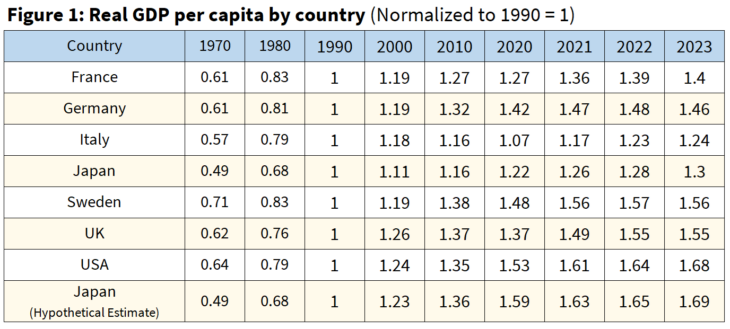
Estimation 1: If Japan had maintained the same working hours as in 1990 (2,031 hours), its real GDP per capita as of 2023 would potentially have been 1.69 times higher. This would have surpassed the United States (1.55) and placed Japan among the top tier of major economies.
In 1990, Japan’s annual working hours were 2,031, which was more than 250 hours longer than those of the United States (1,764 hours) and the United Kingdom (1,618 hours). During this period, Japan was truly the “hardest-working country in the world,” and that volume of labor supported its overwhelming economic power at the time. In fact, Japan led the world in nominal GDP per capita, surpassing both the US and the UK.
However, over the following 35 years, Japan’s working hours decreased rapidly, shrinking significantly to 1,617 hours by 2024. Meanwhile, the United States remained almost unchanged from 1990 at 1,796 hours, resulting in a “reversal” where Japan’s working hours became approximately 180 hours shorter than those of the US.
The following institutional history lies behind this change:
- In the 1980s, international criticism that “Japanese people work too hard” escalated into a global issue amid escalating trade frictions.
- In 1988, the government officially set a target of “1,800 annual working hours” under its “Economic Management Plan.”
- The five-day workweek (two days off per week) spread rapidly across the country.
- The 1992 Act on Temporary Measures concerning the Promotion of Reduction of Working Hours and the 1994 amendment to the Labor Standards Act fixed the statutory working hours at 40 hours per week.
As these policy-driven trends toward shorter working hours took hold, Japan made a significant shift toward “forcibly reducing working hours.” As a result, it cannot be denied that this created structural problems, leading to a slowdown in real wages and economic growth.
Source: Created by the author based on OECD data and other sources
So, what would have happened if Japan had maintained the same working hours as in 1990, under the assumption that labor productivity would not have declined even with a significant increase in working hours? While the details of the estimation method are omitted here, the results of that calculation are shown in Figure 1. Since Japan’s economic power was at its strongest around 1990, the real GDP per capita of each country, including Japan’s hypothetical estimation, has been normalized to 1.00 as of 1990.
Among these G7 nations, the highest growth, reaching the top position in real GDP per capita, is “Japan (Hypothetical)” at 1.69, as calculated in Estimation 1. However, the actual Japan remains at 1.30, resulting in the second-lowest performance among these countries. Nevertheless, this fact does not lead to the conclusion that we “should return to long working hours.”
It is necessary to note that Estimation 1 is a mechanical assumption focusing solely on the “volume effect”—the idea that productivity remains unchanged even if working hours increase. On the contrary, as will be discussed later, there is a possibility that Japan’s productivity could actually improve with shorter working hours.
The key lies in the optimization of working hours; what is essential is not a binary choice between increasing or decreasing volume, but a system where individuals can choose the hours that allow them to produce the greatest results. The question is whether the “Selective Labor” mentioned by Prime Minister Takaichi can be turned into a truly substantive system.
The Key is the Optimization of Working Hours
Estimation 2: While Japan continues to have long working hours (approx. 1,600 hours) compared to other developed nations, OECD data suggest the possibility that real GDP per capita could actually increase even if working hours were further reduced to approximately 1,360 hours.
Although Japan’s working hours have decreased since the 1990s, they remain long compared to European countries, with the exception of the United States. Even in the latest OECD data, Japan’s annual working hours in 2024 stood at 1,617 hours, which is high compared to the UK (1,512 hours), France (1,491 hours), and Germany (1,331 hours).
However, in the same year, “Labor Productivity per Hour Worked” (in PPP-adjusted US dollars) for Japan was $56.8, lagging significantly behind major European nations (UK: $80.6, France: $92.8, Germany: $96.5). In other words, compared to countries like Germany, Japan has fallen into a structural inefficiency characterized by “low productivity despite long working hours.”
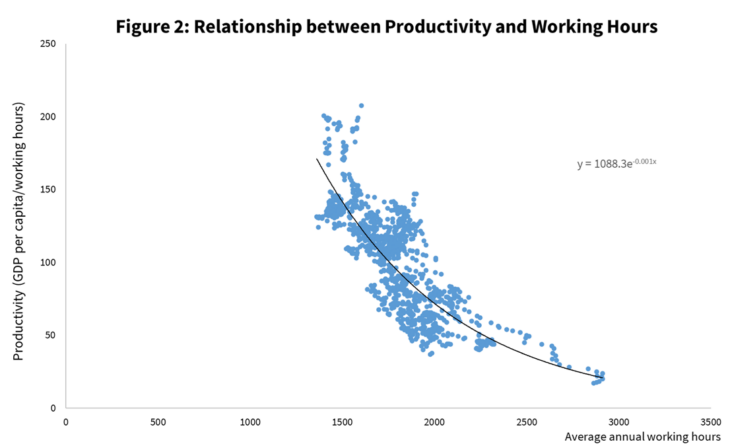
The decisive evidence comes from a long-term data analysis of 35 OECD countries (1970–2015). When plotting the annual average working hours (horizontal axis) against “GDP per capita / working hours” (vertical axis), a clear negative correlation is confirmed (Figure 2). It should be noted that in time-series data, “annual working hours” in developed nations tend to decline, while “productivity (GDP per capita / working hours)” tends to rise due to economic growth; therefore, a standard plot is highly likely to show a “spurious correlation.”
To eliminate this issue, the productivity values (GDP per capita / working hours) for each OECD country have been normalized so that the OECD average for each year equals 100. Even with this adjustment, the relationship remains extremely robust: countries with shorter working hours exhibit higher productivity per unit of time.
As is evident from Figure 2, there is a negative correlation between “working hours” and “productivity (GDP per capita / working hours).” To generate the flexible thinking and novel ideas that serve as the “detonator” for the breakthrough growth of a knowledge-intensive economy, “time luxury” must also be necessary. So, if productivity increases, does GDP per capita also increase? It would be meaningless if GDP per capita were to decrease, even if annual working hours fell and productivity per unit of time (GDP per capita / working hours) increased.
Source: Created by the author based on OECD.StatExtracts data
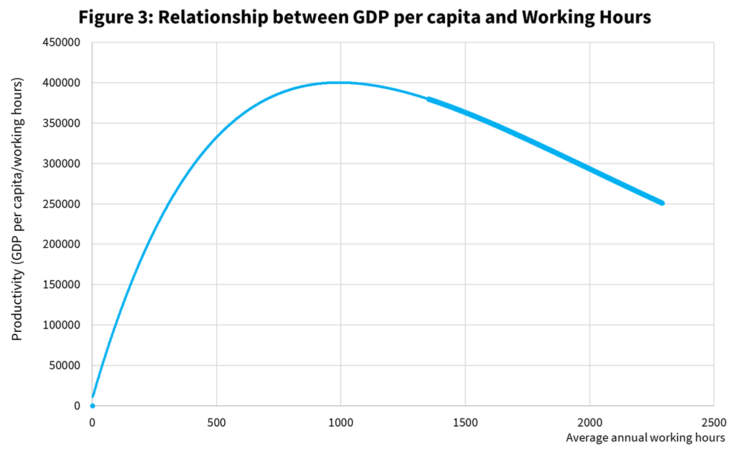
Whether or not such a phenomenon occurs can be determined from the relationship: “GDP per capita = Productivity × Average Annual Working Hours.” First, the approximation curve y (productivity) is derived from the plot data in Figure 2. Figure 3 is created by calculating and plotting “GDP per capita” from the product of this approximation curve y and x (working hours).
The “curve” (a downward-opening or concave-down curve) in Figure 3 represents the relationship between GDP per capita and working hours. If this curve is valid, it indicates that the point where GDP per capita is maximized is at an annual average of approximately 1,000 working hours. Of course, since 1,000 hours includes a range where almost no actual data exists, its strict interpretation should be handled with caution. However, even based solely on the range where actual data exists (around 1,360 hours), there is a possibility that Japan’s GDP per capita could increase even if working hours were reduced from around 1,600 hours to 1,360 hours. A reduction of 240 hours per year is equivalent to approximately 30 days of “leeway” when converted into 8-hour workdays. This “slack time” is directly linked to the core of productivity, such as improving competitiveness in knowledge-intensive industries.
The two estimations above may appear contradictory at first glance:
- GDP could have been maintained by continuing long working hours (Estimation 1).
- However, productivity tends to increase with shorter working hours (Estimation 2).
In reality, this is not a contradiction, but a question of how to optimize “quantity” and “quality.” Therefore, the conclusion is clear: shifting from a fixed working hour system to a “Selective Labor” system where individuals can choose is precisely what must become the core of Japan’s growth strategy.
This aligns with the selective work styles championed by Prime Minister Takaichi and represents the only path to simultaneously address industrial structural transformation and the labor-shortage economy
Source: Created by the author
Evaluation of the Review of Working Hour Regulations from the Perspective of Countermeasures Against the Declining Birthrate
In addition, regarding the relationship with the rapidly progressing population decline, the question of whether the deregulation of working hours can be compatible with measures against the declining birthrate is also crucial. Discussions on working hour regulations must be predicated on an “understanding of the time constraints faced by child-rearing households as a whole.”
<Lack of time is the biggest cause of declining birth rates>
In the burden of child-rearing, the most serious challenge is not “money” but “time.” For dual-income households juggling work, housework, and childcare all at once, the lack of time on weekdays becomes chronic, often leading them to give up on having a second or third child. Even in the Basic Survey on Birth Trends, the top reason for hesitating to have children is the “difficulty of balancing work and childcare.”
<Implementation of “Selective Labor” as the Core of Countermeasures Against the Declining Birthrate>
Working hour policies as a measure against the declining birthrate must satisfy the following three criteria:
- Establish an environment where those who wish to work can do so flexibly.
- Guarantee a system that allows for the autonomous adjustment of working hours during child-rearing years.
- Create a framework ensuring that such adjustments to working hours do not disadvantage individuals in terms of future wages or career advancement.
There is one more perspective that should be added here: “the visualization of the child-rearing environment of each company.” By calculating and disclosing indicators such as company-specific fertility rates (e.g., how many children are born per employee household within a certain period), childcare leave uptake rates, and utilization rates of shortened working hours, and sharing them with society as a whole, it becomes possible to visualize “which companies are truly child-rearing friendly workplaces.”
If such information is disclosed, young people engaged in job hunting and those seeking to change careers can use “whether it is a company where it is easy to have children in the future” as a factor in their decision-making, alongside wages and branding. Companies, in turn, will have a strong incentive to work on making working hours more flexible and expanding childcare support measures from the perspective of recruitment power and reputation.
The “deregulation” promoted by the Takaichi administration has the potential to work positively for point 1. However, points 2. and 3. risk having the opposite effect if no measures are taken. If working hour regulations are loosened due to labor shortages, companies may find it easier to demand long working hours, and child-rearing households could lose the room to choose how they work. In other words, working hour deregulation, in its current form, contradicts “countermeasures against the declining birthrate.”
Conversely, however, if “Selective Labor” is institutionalized and its effectiveness is guaranteed through the visualization of company-specific fertility rates and other metrics, it becomes possible to achieve both deregulation and an improvement in the birthrate simultaneously. Whether the philosophy of “Selective Labor” championed by Prime Minister Takaichi can be translated into a specific mechanism combined with countermeasures against the declining birthrate will determine its future success or failure.
A New Growth Strategy Required for a Depopulating Society
Japan is at a historical turning point where a declining birthrate and labor shortages are progressing simultaneously. Based on the above, future growth strategies—particularly regarding labor supply—must be redesigned around the “reallocation of time” and the “maximization of productivity.” Furthermore, by combining this with “information disclosure (visualization)” to encourage behavioral changes in companies, a mechanism can be built where the private sector itself develops child-rearing-friendly workplaces without relying solely on increased government regulation. This three-pronged strategy will become the Japanese-style growth model suited for a depopulating society.
(1) Institutionalizing Flexibility in Working Hours and “Freedom of Choice”
Working hour policy is not a simple conflict of “increasing versus decreasing”; the most important factor is to institutionally guarantee work styles that individuals can choose. The review of working hour regulations must be inseparable from a system design that provides flexibility for those who wish to work more, while allowing for significant adjustments to working hours during child-rearing or caregiving periods.
- Ensure flexibility by relaxing overtime limits for those who wish to work more.
- Legally guarantee a system that allows individuals to significantly reduce their working hours during child-rearing or caregiving periods.
- Promote side jobs and recurrent education (reskilling).
This concept forms the substantive core of the “Selective Labor” system mentioned by Prime Minister Takaichi.
(2) “Slack time” as the Deciding Factor for Japan’s Growth Potential
As indicated by OECD data, a negative correlation is observed between annual working hours and productivity; in a knowledge-intensive economy, long working hours can potentially act as an impediment to growth. In the modern era of advancing digitalization and AI, it is “slack time” (yohaku no jikan) that generates value. If a work style of working shorter hours with high-intensity results becomes widespread, it will lead to:
- Innovation
- Creation of new businesses
- Strengthened corporate competitiveness
In this way, “time flexibility” directly becomes the capital for productivity growth. In a shrinking society, the source of growth is no longer the quantity of labor, but productivity itself.
(3) Introduction of “Visualization” to Change Corporate Behavior
Alongside time-based policies, a mechanism to voluntarily change corporate behavior is essential. At the center of this is the “disclosure of company-specific fertility rates and work-life balance indicators.”
- Aggregate and disclose company-specific data, including fertility rates, average number of children, childcare leave uptake, and utilization of shortened working hours.
- Include “Child-rearing Friendliness Indicators” in integrated reports and job-seeking websites, alongside “Wages” and “Growth Potential.”
- Provide incentives, such as tax breaks and additional points in public procurement, to companies with high-performing indicators.
Rather than the government minutely regulating companies, this approach encourages behavioral changes through information disclosure and market evaluation. It is the most efficient mechanism to trigger private-sector-led competition toward “child-rearing-friendly workplaces” while avoiding excessive regulation.
In any case, for a Japan struggling with a declining birthrate and low growth, the debate over working hour regulations is not merely a labor policy but a national strategy itself. Shifting from a simple review of working hours to a system where time can be “selected” is the core of a new growth model in a depopulating society. By combining this with the “visualization” of disclosing company-specific fertility rates and work-life balance indicators, a force is generated to change corporate behavior from within.
In other words:
- “Those who wish to work can do so with flexibility.”
- “Parents have the ‘time luxury’ needed during child-rearing years.”
- “Productivity increases even as working hours are reduced.”
- “Companies that support child-bearing and rearing are fairly valued in the recruitment market.”
Realizing these four points simultaneously is the only path to linking Japan’s growth strategy with countermeasures against the declining birthrate. The deregulation of working hours promoted by the Takaichi administration is not necessarily contradictory to child-rearing support. Rather, through careful institutional design, the two can be fully compatible; at the heart of this is a new concept of redistributing “time” and changing corporate behavior through the “visualization of company-specific fertility rates.”
For Japan to return to a robust growth trajectory, the key lies not in the mere “quantity” of labor, but in the reconstruction of a system that combines the “quality” of work (labor productivity) with “time” and “information disclosure.” It is precisely in a depopulating society that a growth strategy centered on these pillars is required.
Translated from “Tokushu 1: Sanaenomikusu wa Doko e Mukau ‘Rodojikan Kiseikanwa to Ikuji Shien no Ryoritsu eno Michisuji’ (Special Feature 1: What direction is Sanaenomics headed in? ‘Pathways to Balancing Working Hour Deregulation and Child-rearing Support’),” Voice, February 2026, pp. 74–83. (Courtesy of PHP Institute) [March 2026]
 OGURO Kazumasa, Ph.D.
Professor, Faculty of Economics, Hosei University / Nonresident Senior Fellow, The Tokyo Foundation
Born in 1974. Received his Ph.D. in economics in 2010 from the Graduate School of Economics, Hitotsubashi University. Joined the Ministry of Finance in 1997, became an associate professor at the Institute of Economic Research, Hitotsubashi University, in 2010, and became a professor in the Faculty of Economics, Hosei University, in 2015.
Keywords
- working hour deregulation
- time flexibility
- selective labor
- flexible working styles
- child-rearing support
- declining birthrate
- productivity
Related posts:
 A Policy Vision Beyond Abenomics
 What Is Meant by Supply Chain Resilience?
 Why Are Debates Surrounding Family and Gender So Contentious? The “Principle of Deliberation” to Which We Must Return
 From Tomiichi Murayama to Sanae Takaichi: Thirty Years After the Cold War—The Present Location of Japanese Politics
 Special Dialogue: Prospects for Japanese Diplomacy in 2026—Advancing the Strategies of the “Free and Open Indo-Pacific” Further