


“Reforms in the Reiwa Era” in the Age of Populism: The Option of a Multi-Member District System with Proportional Representation

“The parallel system for the Lower House, introduced during the ‘Heisei political reforms’ with the aim of achieving a ‘democracy capable of change in government’ accompanied by elections for choosing the administration, is not functioning sufficiently,” argues the author. “… We should consider a “multi-member district system with proportional representation.”
Photo: Faula Photo Works / photolibrary
Electoral System Reform as a Political Issue
Along with the reduction of seats in the Lower House, radical reform of the electoral system has emerged as a major issue in Japanese politics.
On October 20, 2025, upon the inauguration of the Takaichi Sanae administration, the “Coalition Government Agreement” signed between the Liberal Democratic Party (LDP) and the Japan Innovation Party (JIP) included a goal to reduce the number of Lower House seats by 10 percent. Furthermore, it incorporated a commitment to consider the abolition of the parallel electoral system (combining single-member districts and proportional representation, hereinafter “parallel system”) and the introduction of a multi-member district system (MMD). Although the bill was ultimately placed under continued deliberation, on December 5 of the same year, a bill was submitted to reduce the Lower House membership by 45 or more seats. This bill contained a provision for an automatic reduction of 25 seats from single-member districts and 20 from proportional representation if specific measures were not finalized within one year.[1] While the JIP is promoting seat reduction as a symbol of its “reform that cuts its own flesh” (reforms involving self-sacrifice), its underlying aim to use this as a catalyst for achieving radical electoral reform is also apparent.
Looking back, on June 18, 2024, the “Bipartisan Group for the Radical Reform of the Lower House Electoral System as a Pillar of Political Reform” was established. Furukawa Yoshihisa of the LDP, Shina Takeshi of the Constitutional Democratic Party of Japan (CDPJ), and Kanemura Ryuna of the JIP were appointed as co-representatives, while Fukushima Nobuyuki of Yushi no Kai (“Volunteer Association”) assumed the post of Secretary-General.[2] In accordance with the group’s request, the Council on the Electoral System was established within the Lower House, and discussions are currently underway.
Within the Bipartisan Group, there is strong support for the introduction of a multi-member district system with block voting (hereinafter “block voting system”[3]).[4] It is also fresh in our memory that former Prime Minister Ishiba Shigeru was reported to be in favor of introducing the block voting system, and during the LDP Presidential election on October 4, 2025, candidate Hayashi Yoshimasa advocated for electoral reforms such as the “reintroduction of the multi-member district system.”
Behind these movements lies the reality that the parallel system in the Lower House—introduced during the “Heisei political reforms” in the 1990s to replace the multi-member district system with single non-transferable vote[5]—has failed to fully function as expected.[6] After confirming this point, this article will examine what kind of electoral system would be desirable if “Reforms in the Reiwa Era” were to be implemented.[7]
What Were the “Heisei Political Reforms” of the 1990s?
The political reforms realized in 1994 under the Hosokawa Morihiro administration primarily consisted of electoral system reform—shifting the Lower House from the multi-member district system with single non-transferable vote (SNTV system) to the parallel system—and political finance reform, which included tightening restrictions on donations from corporations and organizations and the introduction of the public party subsidy system.
Political reforms continued thereafter. The administrative reform under the Hashimoto Ryutaro administration, which took office in 1996, strengthened cabinet functions and reorganized government ministries. Furthermore, the 1999 Law to Reinvigorate Diet Deliberations was enacted, leading to the introduction of party leader debates and the abolition of the government delegate system. Manifesto-based elections began in 2003.
The aforementioned “Heisei political reforms in the 1990s” aimed to dismantle the 1955 System,[8] under which the Liberal Democratic Party (LDP) had built a long-term government almost single-handedly for 38 years, and to realize a “democracy capable of change in government.” In other words, the goal was not a pseudo-change of government between LDP factions, but a true change of government between political parties through Lower House elections serving as a choice of administration.
A concurrent objective was politician-led policymaking (or Kantei-led politics),[9] aimed at strengthening the power of the Prime Minister and party leaders to weaken “zoku” politicians (policy tribes) linked to factions and bureaucrats in various ministries, thereby enhancing political leadership. Manifesto-based elections were the mechanism through which voters would choose a government based on policy during the Lower House election, and the winning party would implement its pledges through top-down leadership after taking power.
These “Heisei political reforms” signified an approach toward British-style politics. In fact, the single-member district system, party leader debates, and manifesto-based elections were all modeled after the British system.
Arend Lijphart categorizes democracy into two types (Table 1). The majoritarian model seen in the UK is characterized by the single-member district system, a two-party system, single-party majority cabinets, executive dominance over the legislature, centralization, and unicameralism. In contrast, the consensus model is composed of proportional representation (PR), a multi-party system, multi-party coalition cabinets, executive-legislative balance, decentralization, and bicameralism.
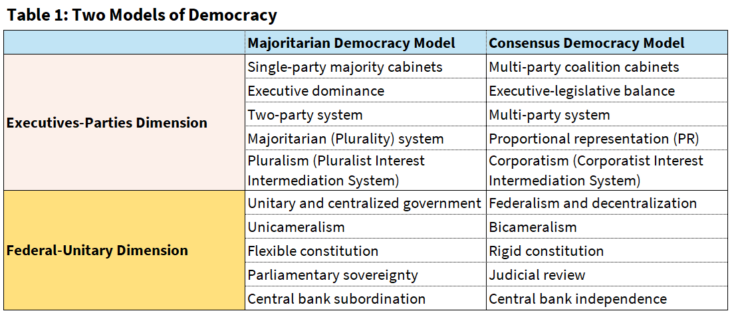
Source: Arend Lijphardt (translated by Kasuya Yuko et al.), Minshushugi tai Minshushugi (Democracy vs. democracy, 2nd edition) (Patterns of Democracy: Government Forms and Performance in Thirty-Six Countries [2nd ed.]),” Keiso Shobo, 2014, p. 3
The SNTV system is an electoral system with a more proportional character than the D’Hondt method of allocating seats in proportional representation systems and can be viewed as a component of Consensus Democracy.[10] It can be said that the “Heisei political reforms,” which introduced an electoral system centered on the single-member district system to the Lower House, intended a transition of democracy from the consensus model to the majoritarian model.
However, the Lower House parallel system—while primarily based on single-member districts in terms of seat allocation and other factors—is a parallel system with a closed-list proportional representation tier (where parties pre-determine the ranking of candidates) divided into 11 regional blocs; it is not the First-Past-The-Post (FPTP) system seen in the House of Commons of the United Kingdom. Therefore, care must be taken to note that it does not necessarily bring about a two-party system or single-party majority cabinets.
There are opinions that the simple FPTP system should be introduced to the Lower House. Indeed, Ozawa Ichiro made such an argument during the political reform process,[11] and this claim is still seen occasionally today.
However, as Kawato Sadafumi (Professor Emeritus, The University of Tokyo) points out, the fluctuation in the vote shares of major parties in Japan is significant.[12] Compared to the two major parties in the UK or the US, there are fewer “safe seats,” a trend particularly prominent among non-LDP forces. For example, the Democratic Party of Japan (DPJ), which won 221 out of 300 single-member district seats in the 2009 Lower House election, plummeted to 27 seats in 2012. If the FPTP system were introduced, Japanese politics would undoubtedly become extremely unstable, and political parties would surely face a crisis in terms of human resources. There are certain rational reasons for adopting the parallel system instead of the FPTP system and establishing the dual candidacy system within that framework.
From a Two-Bloc Multi-Party System to a Multipolar Multi-Party System
Now, what kind of party system does the parallel system of the Lower House bring about? Matthew Shugart and Martin Wattenberg, who analyzed mixed-member parallel systems,[13] argue that a “two-bloc” multi-party system is created. In the parallel systems seen particularly in Italy and Japan, there is a strong tendency for two competing blocs to form before an election, for an election to be held to choose the administration between them, and for a coalition government with a majority of seats to be established.[14]
In short, while it becomes a multi-party system due to the existence of proportional representation, the high weight of the single-member district system causes a “two-bloc” formation, resulting in a “two-bloc multi-party system.” The electoral system of the Upper House, which consists of prefectural constituencies and a nationwide proportional representation tier, has a similar effect due to the importance of the 32 single-seat districts.
As Sona N. Golder points out, blocs are formed because, in electoral systems with a moderate degree of proportionality, electoral cooperation is tactically effective, leading to the formation of pre-electoral coalitions despite being a multi-party system.[15] On the other hand, under a pure proportional representation (Pure PR) system[16] like that of the Netherlands, electoral cooperation is meaningless; instead, coalition negotiations are conducted after the election based on the number of seats and policy distance. This is a “multipolar multi-party system” where blocs for the purpose of electoral cooperation are not formed (Table 2).
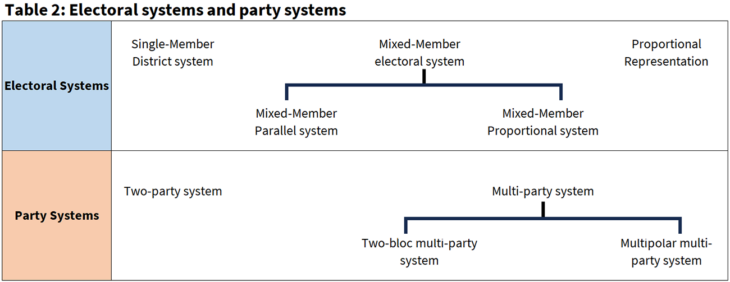
Source: Nakakita Koji, Jiko Seiken towa Nanika (What is the LDP-Komeito government?), Chikuma Shinsho, 2019, p. 93.
In Japan, since 1993—when a coalition government of eight non-LDP and non-Communist parties was established and the 1955 System of LDP dominance collapsed—coalition governments have continued under a multi-party system. Among them, the one that has survived for many years since 1999 is the ruling LDP-Komeito coalition. The LDP-Komeito bloc became the only stable framework for a coalition precisely because of their close electoral cooperation.
To be specific, the LDP and Komeito not only conducted flawless candidate coordination, but also built a win-win relationship through the exchange of votes via mutual endorsement—for instance, LDP candidates in single-member districts would call for “Komeito in the proportional tier” in exchange for support. This was possible because both parties possessed thick support bases, allowing them to maximize seats through the exchange of organizational votes. [17]
In 2009, when the Democratic Party of Japan (DPJ) formed a coalition government with the Social Democratic Party (SDP) and the People’s New Party to achieve a change in government, it appeared that a two-bloc multi-party system had been established. However, the SDP left the coalition over the relocation issue of the US Marine Corps Air Station Futenma, and the DPJ administration moved toward dissolution. Since then, non-LDP forces have continued to fail in bloc formation; although an opposition struggle involving the Japanese Communist Party (JCP) was attempted following the protests against the 2015 Security Legislation, it ultimately only spurred further fragmentation among the opposition.
Consequently, after the second Abe Shinzo administration was established in 2012, the LDP-Komeito government continued. Under the dominance of the single LDP-Komeito bloc, although the country drifted away from a “democracy capable of change in government,” the administration’s management became more stable. Kantei-led politics was strengthened, leading to what was called Abe’s “one-strong” dominance.
However, against the backdrop of “politics and money” scandals, both the LDP and Komeito lost their majority in the 2024 Lower House election, falling into a minority government. With the increase in unaffiliated voters, emerging parties utilizing social media in election campaigns rose to prominence; the Democratic Party for the People (DPP) made significant gains in the 2024 Lower House election, as did the right-wing populist Sanseito in the 2025 Upper House election. The ruling parties were forced to respond through “partial coalitions,” securing cooperation from parts of the opposition on a bill-by-bill basis.
As the dominance of the single LDP-Komeito bloc wavered following defeats in both the Lower House and Upper House elections, Komeito dissolved the coalition upon the LDP’s election of Takaichi as its new president. The LDP formed a “coalition” government with the Japan Innovation Party (JIP), but this remained limited to cooperation from outside the cabinet and cannot be considered a coalition in political science terms. Regarding electoral cooperation, while candidate coordination between the two parties is possible, the exchange of votes through mutual endorsement is difficult.
Thus, despite the existence of the parallel system, the dissolution of the LDP-Komeito bloc has led to a transition toward a multipolar multi-party system, which lacks a stable coalition framework based on electoral cooperation. Among voters who refer to social media for voting, there is significant support for emerging parties, including Reiwa Shinsengumi and the Conservative Party of Japan, and the trend toward a multipolar multi-party system is likely to continue.[18] Under these circumstances, Lower House elections can no longer serve as a choice of administration.
Demerits of the Single-Member District System and Demerits of the Multi-Member District System
Under a single-member district system, third and smaller parties are eliminated, leading to a two-party system. This is known as “Duverger’s Law.” Strictly speaking, it merely means that each district is contested by two leading candidates, and the system does not necessarily converge into a two-party system in cases where powerful regional parties exist. Nevertheless, it is certain that the single-member district system, with a magnitude of one, is an electoral system based on a fierce, winner-take-all competitive principle. Consequently, cooperation between parties competing in single-member districts—especially between the two major parties—is not easy.
The demerits of such a single-member district system manifest when the ruling party fails to hold a majority of seats in the Upper House, resulting in a “twisted Diet” (divided government). Under the Constitution, the Lower House holds superiority regarding the designation of the Prime Minister, deliberation on the budget, and approval of treaties; however, if a bill is rejected by the Upper House, it cannot be enacted unless it is passed again in the Lower House by a majority of two-thirds or more. The powers of the Japanese Upper House are strong.
When the LDP and Komeito lost their majority in the 2007 Upper House election under the first Abe cabinet, the management of the administration stagnated. The successor, Prime Minister Fukuda Yasuo, reached an agreement on a grand coalition with DPJ leader Ozawa, but the DPJ executive board decided to oppose it. When a “twisted Diet” occurred following the 2010 Upper House election, Prime Minister Kan Naoto of the DPJ sought a grand coalition with the LDP in the wake of the Great East Japan Earthquake, but this too failed. Ultimately, it is difficult for two major parties that fight fiercely in single-member districts to form a grand coalition.
As mentioned earlier, the single-member district system is a component of majoritarian democracy, while bicameralism is a component of consensus democracy; they lack institutional complementarity. To begin with, various systems under the Constitution of Japan—whether it be the high degree of autonomy of the Diet, bicameralism, or the rigid constitution—are basically of the consensus type. It must be said that there was considerable strain in the “Heisei political reforms” caused by introducing an electoral system centered on the single-member district system to the Lower House.
While the single-member district system under a multi-party system promotes the formation of two blocs, it not only makes grand coalitions—such as those seen in Germany—difficult but also acts as an inhibiting factor for flexible coalition realignment. Consequently, when a two-bloc multi-party system collapses and transitions into a multipolar multi-party system, it tends to result in minority governments.
Rather than forming a coalition with a ruling party with which they compete fiercely in single-member districts, opposition parties attempt to realize their own policies through partial coalitions and appeal to voters while maintaining their position as the opposition without responsibility for government management. This is the phenomenon currently occurring in recent Japanese politics. The strain of this situation is likely to affect matters such as fiscal discipline.
Therefore, there is a certain reason for the rising calls for the revival of a multi-member district system that produces electoral results closer to proportional representation (PR). At the same time, however, there were also specific reasons why the multi-member district system was abolished in the past.
The greatest drawback of the multi-member district system with single non-transferable vote (SNTV system), which elects three to five members from a single district, is that it deviates significantly from being party-centered and becomes an excessively candidate-centered election. Particularly within the LDP, which held power for a long period, nominating multiple candidates from the same district led to internal infighting, which in turn gave rise to personal support organizations, factions, and interest-led politics, thereby obstructing policy-centered politics. As a result, harmful effects such as the spread of money-driven corruption and an increase in hereditary politicians emerged.
Furthermore, under the SNTV system, large parties are required to achieve two things: nominating an appropriate number of candidates and equalizing the votes among those candidates. If they over-nominate or fail in vote-splitting, they face “mutual destruction” (falling together). Only when they succeed tactically can they obtain seats comparable to those under D’Hondt proportional representation.[19]
Can the aforementioned problems be resolved even under a multi-member district system by shifting from the “single-vote system” (SNTV), where voters choose only one candidate, to a “block voting system,” where they write multiple names? Within block voting, there is the “full block vote system,” where one votes for as many people as the district magnitude, and the “limited vote system,” where one votes for fewer people than the magnitude; these must be discussed with a clear distinction. The term “multi-member district block voting system” has taken on a life of its own without accurate knowledge.
In the case of a full block vote system, it is equivalent to combining multiple single-member districts and increasing the magnitude, making it an electoral system close to a single-member district system. On the other hand, the limited vote system is not fundamentally different from the single-vote system in that it is a “restricted voting system” where one can only vote for fewer than the magnitude,[20] and the effect of the electoral system varies depending on the ratio of the number of votes to the magnitude. Furthermore, in the case of any block voting system, a complex situation deviating from party-centeredness may arise, such as voters splitting their votes among candidates from different parties or candidates from different parties cooperating with each other.
The Option of a Multi-Member District System with Proportional Representation
Considering the issues with the block voting system mentioned above, the electoral system for the Lower House should, after all, transition toward proportional representation (PR). This carries the implication of aiming for a Consensus Democracy.
Looking back, the representative document that advocated for a block voting system during the process leading up to the Heisei political reforms was the “Founding Declaration” of the Japan New Party (JNP) by Hosokawa Morihiro. However, Sato Seizaburo (1932–99) (Professor, The University of Tokyo)—a close ally of Koyama Kenichi (1933–97) (Professor, Gakushuin University), who authored that declaration—proposed an open-list proportional representation (open-list PR) at the prefectural level.[21] Under a PR system, unlike the SNTV system or block voting, harmful effects such as over-nomination or failures in vote-splitting do not occur.
The open-list system proposed by Sato is currently adopted in the Upper House proportional representation elections. In this method, voters write either a party name or a candidate’s name; seats are first allocated to each party according to the number of votes received by the party (including those for its candidates), and within each party, candidates are elected starting from those with the highest number of individual votes. This system has an intermediate character between being party-centered and politician-centered. In contrast, the most politician-centered system is the Single Transferable Vote (STV) proportional representation system, seen in the Irish Lower House, where voters rank candidates by preference and winners are determined by transferring votes that exceed the quota. The most party-centered system is closed-list proportional representation (closed-list PR).
Regarding district magnitude, Sato argued against the multi-member district system that elects 3 to 5 members from a single district, instead advocating for prefectural units, which have a larger district magnitude. Notably, to avoid the fragmentation of small parties, he advocated for the introduction of an electoral threshold that would deny seats to parties failing to reach 3% or 5% of the total national vote.
This perspective of avoiding the fragmentation of small parties is even more important today than it was during the period of the Heisei political reforms. This is because the individualization of Japanese politics has progressed, the stable support bases of established parties have dissolved, and as a result, the number of unaffiliated voters has increased. Furthermore, with the rise of emerging parties making full use of social media, multi-party fragmentation is advancing. This trend is evident when looking at the transitions in seat shares and proportional vote shares of the two major parties (the LDP and the DPJ lineage) in both the Lower House and Upper House (Figure 1).
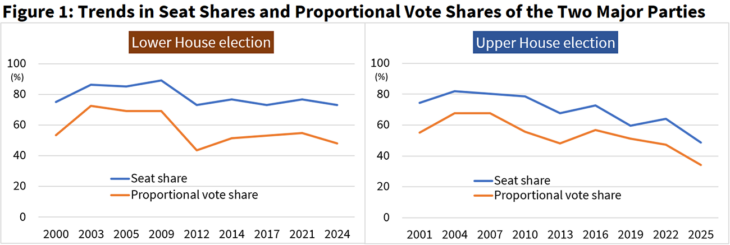
Source: Compiled by the author
In the Netherlands, where the Lower House adopts a pure proportional representation system, stable support bases known as “pillars” once supported Christian Democratic and Social Democratic parties, allowing for coalition governments formed by a limited number of parties. However, as the “pillarized” society dissolved and diverse new parties, including right-wing populist parties, emerged, multi-party fragmentation has advanced, making coalition negotiations increasingly difficult.[22]
From the perspective of avoiding the fragmentation of small parties, the German-style mixed-member proportional system proposed by the Japan Socialist Party and Komeito during the “Heisei political reforms” is essentially a nationwide proportional representation system and is therefore not appropriate.
In Germany at that time, with the 5% electoral threshold also in effect, a “moderate pluralism” (Giovanni Sartori) had been established. It centered on the two major parties—the Christian Democratic Union/Christian Social Union (CDU/CSU) and the Social Democratic Party (SPD)—along with the Free Democratic Party (FDP) and the Green Party (Die Grünen), resulting in centripetal competition among four parties. Today, however, the rise of left-wing and right-wing populist parties, namely the Left Party (Die Linke) and Alternative for Germany (AfD), has been remarkable. Germany has fallen into a “polarized pluralism” where six or more parties with large policy distances compete centrifugally.[23]
There is a milder way to avoid the fragmentation of small parties than introducing an electoral threshold: reducing the district magnitude. In the case of a prefectural unit, for example, the magnitude for Tokyo would be nearly 50. As a result of an extremely large number of candidates competing, voters would no longer be able to make rational choices. To avoid this, it is appropriate to keep the district magnitude small.
If that is the case, while adopting a multi-member district system that elects 3 to 5 (or more broadly, 2 to 6) winners, consideration could be given to electing them through an open-list PR system, rather than through either a single-vote (SNTV) or block voting system. This could be called a “multi-member district system with proportional representation (MMD-PR).”[24]
John M. Carey and Simon Hix argue that the relationship between proportional representation, which offers high representativeness, and the single-member district system, which offers superior accountability, is not a linear trade-off. Instead, they assert that an open-list PR system with a small district magnitude of 4 to 8 seats is the optimal electoral system. Under such a system, a party system is established that combines both a high reflection of the popular will in the legislature and the executive, and a moderate number of parties (coalitions of 2 to 3 parties).[25] This can be described as a “moderate pluralism” that is multipolar but not polarized.
Toward an Era of Consensus Democracy
The argument of this article is simple. The parallel system for the Lower House, introduced during the “Heisei political reforms” with the aim of achieving a “democracy capable of change in government” accompanied by elections for choosing the administration, is not functioning sufficiently. Therefore, there are ample reasons to consider the reintroduction of a multi-member district system. However, since a block voting system cannot fully resolve the drawbacks of the former SNTV system, we should consider a “multi-member district system with proportional representation (MMD-PR).”
The parallel system is an electoral system that places the single-member district system, which aggregates the popular will, at its center while also striving to reflect the popular will by incorporating proportional representation. In contrast, MMD-PR is an electoral system that adopts proportional representation to reflect the popular will while also taking into account the aggregation of that will by keeping the district magnitude small. In that case, an open-list system, which has an intermediate character between being party-centered and candidate-centered, is desirable.
Electoral system reform is costly and requires considerable energy. That being the case, one option is to maintain the current parallel system and once again aim for a two-bloc multi-party system. However, even if that were to succeed, if left-wing and right-wing populist parties rise further—as seen in Western countries—there will be little room for two blocs centered on two major parties (center-right and center-left) to conduct elections for choosing the administration and establish coalition governments with majorities in both the Lower House and Upper House.
Partly due to the increasing influence of social media, extreme opinions have gained ground among voters, making the formation of consensus difficult. Anti-elitist populism is on the rise, fiscal discipline is being neglected, and the sustainability of the social security system is wavering. We should recognize that we have entered an era that demands not an exclusive, competitive, and adversarial majoritarian democracy, but an inclusive, negotiatory, and compromissory Consensus Democracy. The extent to which this recognition can be shared will be the key to realizing the “Reforms in the Reiwa Era.”
Translated from “Popyurizumu-jidai no ‘Reiwa no Seiji-kaikaku’ (‘Reforms in the Reiwa Era’ in the Age of Populism: The Option of a Multi-Member District System with Proportional Representation),” Chuokoron, February 2026, pp. 132–141 (Courtesy of Chuo Koron Shinsha) [April 2026]
 NAKAKITA Koji, Ph.D.
Professor, Faculty of Law, Department of Political Science, Chuo University
Born in 1968. Graduated Faculty of Law, University of Tokyo and gained a doctorate in law at the Graduate School of Law, also at the University of Tokyo. He specializes in contemporary Japanese politics. His publications include Gendai Nihon no Seito democracy (Party democracy in contemporary Japan), Jiminto—”Ikkyo” no Jitsuzo (The Liberal Democratic Party of Japan: The Realities of ‘Power’), Jiko Seiken towa Nanika (What is the LDP-Komeito government) and Nihon Kyosanto (Japanese Communist Party).
[1] This bill was scrapped following the dissolution of the Lower House in January 2026. However, in March 2026, following the general election, the Liberal Democratic Party and the Japan Innovation Party reached a new agreement to reintroduce a bill to reduce the number of seats by 45, with specific details to be finalized at a later date.
[2] This article is a summary of the report presented at the meeting of the Bipartisan Group on November 19, 2025.
[3] In this system, multiple representatives are elected from one district, and voters can cast votes for multiple candidates (usually up to the number of seats available). This allows voters to support all candidates from a specific party, reducing intra-party friction.
[4] The Yomiuri Shimbun, December 6, 2025.
[5] This system, used in Japan’s Lower House until 1993, elects multiple representatives from one district, but each voter can cast only one vote for a single candidate. It often leads to “intra-party competition,” where candidates from the same party compete against each other.
[6] Heisei refers to the Heisei era, which followed the Showa era, and spanned from 1989 to 2019.
[7] Reiwa is the current era name, beginning in 2019.
[8] The 1955 System refers to the political framework in Japan characterized by the long-term dominance of the Liberal Democratic Party (LDP) against the Japan Socialist Party (JSP). Established following the merger of conservative parties in 1955, this system operated under the multi-member district system (SNTV), which allowed for internal competition among LDP factions while maintaining overall stability. It lasted until the LDP’s first loss of power in 1993.
[9] The Kantei refers to the Prime Minister’s Official Residence and the executive office. In the context of Japanese politics, “Kantei-led politics” signifies a system where decision-making power is concentrated in the Prime Minister and their immediate staff (such as the Chief Cabinet Secretary and special advisors), rather than in traditional party organs or the bureaucracy.
[10] Kawato Sadafumi, Senkyo Seido to Seito Sisutemu (Electoral Systems and Political Party Systems), Bokutakusha, 2004, Chapter 3.
[11] Ichiro Ozawa, Nippon Kaizo Keikaku (Plan for reforming Japan), Kodansha, 1993, p. 70.
[12] Kawato Sadafumi, Sho-senkyoku Hirei-daihyo-heiritsu-sei ni okeru Seito-kan Kyoso (Inter-party competition in the mixed-member proportional representation system) (Ronkyu Jurist, No. 5, 2013).
[13] Shugart and Wattenberg (2001) define Japan’s current system as a mixed-member parallel system (MMM). This is distinct from a mixed-member proportional system (MMP), as the two tiers (single-member districts and proportional representation) are calculated independently without a compensatory mechanism.
[14] Matthew Soberg Shugart and Martin P. Wattenberg, eds., Mixed-Member Electoral Systems, Oxford University Press, 2001.
[15] Sona N. Golder, The Logic of Pre-Electoral Coalition Formation, The Ohio State University Press, 2006.
[16] The Netherlands employs a pure proportional representation system with a single nationwide constituency. Because there is virtually no electoral threshold (minimum percentage of votes required to enter parliament), the system achieves the highest level of proportionality among developed democracies. This leads to an extreme multi-party system, necessitating complex multi-party coalition negotiations.
[17] Nakakita Koji, Jiko Seiken towa Nanika (What is the LDP-Komeito government?), Chikuma Shinsho, 2019, Chapter 7.
[18] The Yomiuri Shimbun, August 1, 2025.
[19] Same as footnote 4.
[20] Kato Shujiro, Nihon no Senkyo (Elections in Japan), Chuko Shinsho, 2003, pp. 18-20.
[21] Nakakita Koji, Jiminto Seiji no Henyo (The transformation of LDP politics), NHK Books, 2014, pp. 149-156.
[22] Mizushima Jiro, Oranda: ‘Kanzen Hirei-daihyo-sei’ no Isseiki (The Netherlands: A century of ‘Perfect Proportional Representation’) (Annual Review of Political Science, No. 1, 2021).
[23] Yasui Hiroki, Doitsu ni okeru Renritsu Seiji no Henka (Changes in Coalition Politics in Germany) (Life and Economic Policy, No. 259, 2018); Frank Decker and Kondo Masaki, 2025-nen Doitsu Renpo Gikaisenkyo to Seito Sisutemu no Henyo (The 2025 German Federal Parliament Elections and the Transformation of the Party System) (Journal of Law, Vol. 197, No. 1, 2025).
[24] Oyama Reiko (Professor Emeritus at Komazawa University) also mentions the “Multi-member district system with proportional representation (MMD-PR)” in the following book: Hisae Masahiko and Uchida Kyoji (eds.), Shogen Sho-senkyoku-sei wa Nihon wo Do Kaetaka (Testimony: How the single-member district system changed Japan,) Iwanami Shoten, 2024.
[25] John M. Carey and Simon Hix, “The Electoral Sweet Spot: Low-Magnitude Proportional Electoral Systems,” American Journal of Political Science, Vol. 55, Issue 2, 2011.
Keywords
- electoral system reform
- parallel electoral system
- proportional representation
- single-member districts
- Heisei Political Reforms
- party systems
- consensus democracy
Related posts:
 From Tomiichi Murayama to Sanae Takaichi: Thirty Years After the Cold War—The Present Location of Japanese Politics
 Reading “Intergenerational Conflict”
 Reading China’s Tactics Aiming to Change the Status Quo
 Pathways to Balancing Working Hour Deregulation and Child-rearing Support
 The Dynamics of the “Coalition of the Willing” in the Indo-Pacific